- Trending
- Comments
- Latest

Qivalis, the consortium building a regulated euro-backed stablecoin, has added 25 lenders to bring its total membership to 37 banks across 15 European countries, including ABN AMRO, Intesa Sanpaolo, and Nordea, in one of the largest coordinated pushes by traditional financial institutions into blockchain-based digital currency.
The growing alliance reflects increasing urgency among European financial institutions to secure a stronger role in the digital asset economy before dollar-backed stablecoins become even more dominant globally.
The rise of tokenized finance has intensified competition among global banks and payment firms, with stablecoins increasingly becoming the preferred settlement layer for blockchain-based transactions.
A Pan-European stablecoin could provide Europe with a regulated digital payment infrastructure capable of supporting tokenized securities, cross-border settlements, decentralized finance applications, and institutional blockchain transactions under European oversight.
Currently, the global stablecoin market is overwhelmingly controlled by U.S. dollar-backed tokens. According to industry data, the sector’s total market capitalization stands near $318 billion, with Tether’s USDT and Circle’s USDC accounting for more than 80% of total supply.
That imbalance has sparked growing concern among European policymakers and financial executives who fear excessive dependence on American-issued digital assets could weaken Europe’s financial sovereignty in the long term.
“This infrastructure is essential if Europe is to compete in the global digital economy while preserving its strategic autonomy,” said Howard Davies, chairman of Qivalis’ supervisory board.
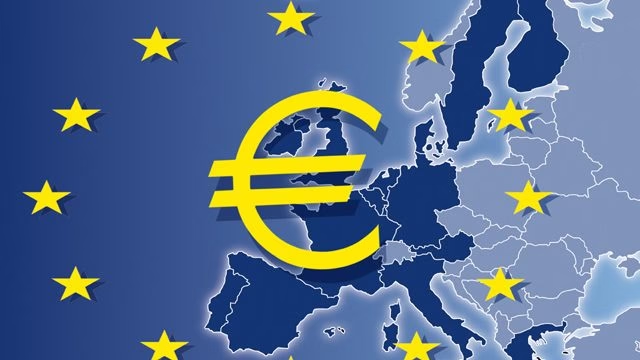
The consortium’s expanding footprint suggests European lenders increasingly view the Pan-European stablecoin project as a strategic necessity rather than a niche experiment.
One major factor driving institutional confidence behind the Pan-European stablecoin initiative is Europe’s Markets in Crypto-Assets regulation, commonly known as MiCA.
Unlike the fragmented regulatory landscape seen in several other jurisdictions, MiCA establishes a unified framework for crypto assets across the European Union, offering banks and fintech firms clearer rules for issuance, custody, reserve management, and consumer protection.
Qivalis said its euro-backed token is expected to launch during the second half of 2026 under the MiCA framework. The group is also pursuing an electronic money institution license from the Dutch central bank, a move designed to reinforce compliance and regulatory oversight.
Analysts say Europe’s structured regulatory approach could give the Pan-European stablecoin project a significant advantage among institutional users seeking legal certainty before deploying blockchain-based financial infrastructure.
“Institutions want regulated rails before they scale tokenized finance,” said Marina Markezic, executive director and co-founder of the European Crypto Initiative. “Europe is trying to position itself as the jurisdiction where compliant digital finance can mature safely.”
The expansion of the Pan-European stablecoin consortium comes amid surging interest in tokenization across global financial markets.
Banks, asset managers, and payment firms are increasingly experimenting with blockchain-based settlement systems that allow traditional assets such as bonds, equities, and money market instruments to move on decentralized networks.
Stablecoins play a central role in that ecosystem because they offer instant settlement and programmable liquidity without relying on traditional banking hours or legacy payment rails.
As institutional adoption accelerates, European banks appear eager to ensure the euro maintains relevance inside the next generation of digital financial infrastructure.

Industry observers say the success of the Pan-European stablecoin initiative may ultimately depend on whether it can build sufficient liquidity and developer adoption to compete with entrenched dollar-backed ecosystems.
That challenge remains significant. Dollar stablecoins benefit from massive network effects, deeper liquidity pools, and integration across most global crypto exchanges and decentralized finance platforms.
Still, European institutions believe a regulated euro alternative could carve out a strong role in trade settlement, regional payments, and tokenized asset markets.
Beyond technology and finance, the push for a Pan-European stablecoin also reflects broader geopolitical and monetary concerns.
European officials have repeatedly warned about the risks of allowing foreign-controlled payment systems to dominate digital commerce. The rapid expansion of U.S. stablecoins has only intensified those debates.
A euro-backed stablecoin governed by European institutions could help reduce dependence on dollar-denominated settlement systems while strengthening the euro’s international role in digital finance.
The effort mirrors wider initiatives across Europe aimed at reinforcing economic autonomy, including discussions surrounding a digital euro issued by the European Central Bank.
While the ECB’s digital euro project remains focused on retail central bank money, private-sector initiatives such as the Pan-European stablecoin consortium are targeting institutional and commercial blockchain applications.

Together, these efforts signal that Europe is increasingly determined to remain competitive as digital assets reshape global finance.
Despite the relatively small size of euro stablecoins today, analysts believe the sector could expand dramatically over the next decade.
S&P Global Ratings recently projected that the euro stablecoin market could grow from roughly €770 million today to as much as €1.1 trillion by 2030. Much of that growth is expected to come from tokenized finance, cross-border settlement, and institutional blockchain adoption.
Those projections have helped fuel optimism surrounding the Pan-European stablecoin initiative as more banks seek exposure to the rapidly evolving digital asset economy.
Still, significant hurdles remain. The project must compete against dominant dollar-backed rivals that already control the majority of trading activity, liquidity, and global crypto infrastructure.



Copyright © 2025 - The Bit Gazette.