

- Trending
- Comments
- Latest

For nearly a decade, Ethereum stood at the center of the crypto economy. Decentralized finance, NFTs, stablecoins, tokenization, and smart contracts all flowed through its ecosystem. The assumption behind that dominance was simple: as more applications and users relied on Ethereum, the value of ETH itself would inevitably rise.
That assumption is now facing its most serious test.
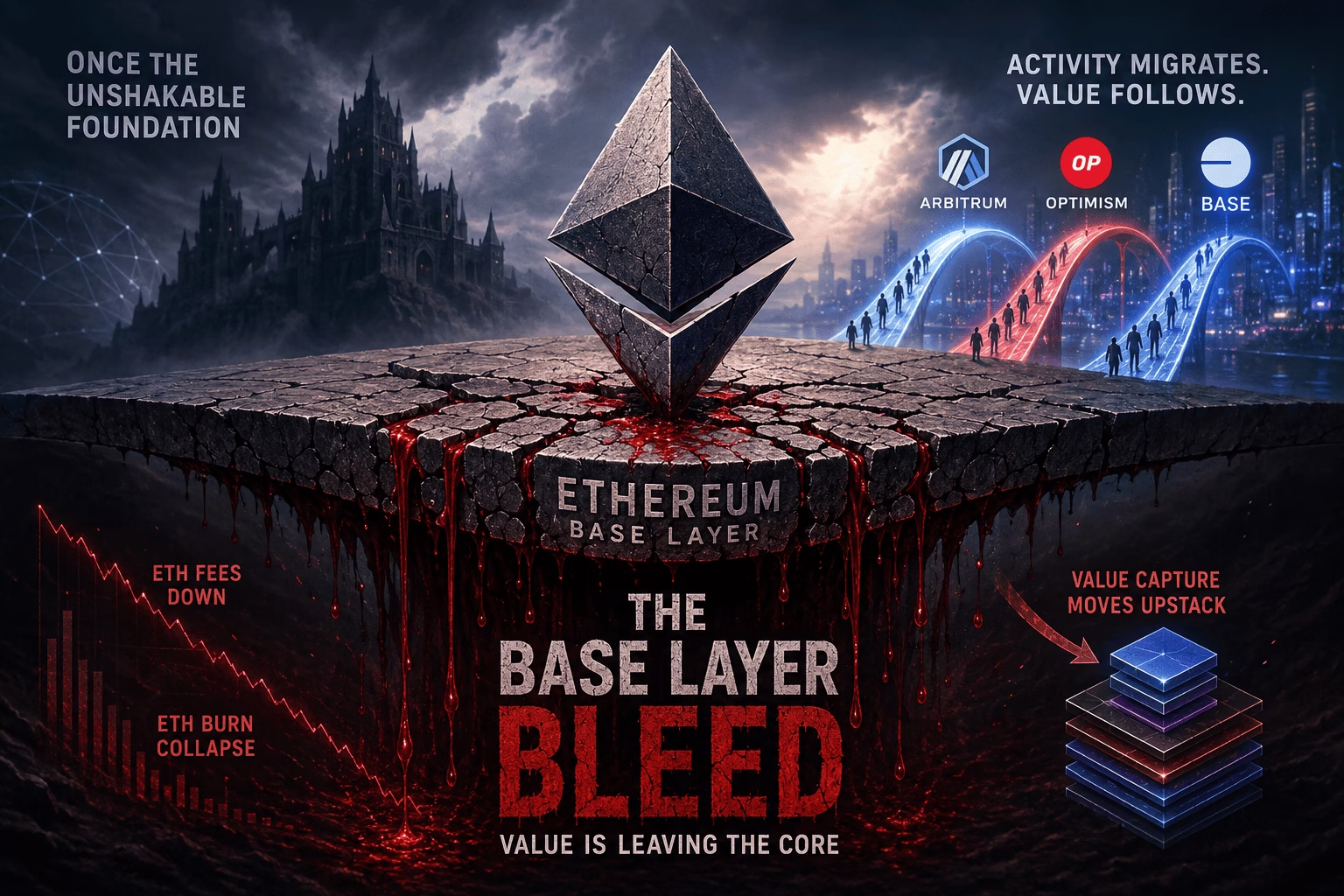
The “Base Layer Bleed” is no longer a theoretical concern whispered by critics on Crypto Twitter. It is becoming one of the most important structural debates in digital assets. Ethereum still commands deep liquidity, unmatched developer activity, and institutional credibility. Yet the economic gravity that once anchored the network is beginning to weaken as activity migrates away from the Layer-1 chain.
The uncomfortable reality behind the Base Layer Bleed is that Ethereum may have solved scalability while unintentionally diluting the economics that justified ETH’s premium valuation in the first place.
As crypto analyst Hasu once argued, “Blockchains ultimately compete on economic security and credible neutrality.” Ethereum still leads in both categories. But the Base Layer Bleed raises a more difficult question: what happens when the network secures most of the ecosystem but captures less of the economic upside?
Ethereum’s long-term strategy always depended on one critical idea: the base chain would remain the heart of economic activity even as scaling solutions expanded around it.
Layer-2 rollups were marketed as extensions of Ethereum rather than replacements for it. Networks such as Offchain Labs’s Arbitrum, OP Labs’s Optimism, and Coinbase-backed Base were designed to process transactions cheaply while ultimately settling back to Ethereum’s main chain.
In theory, that model strengthened Ethereum.
More transactions across the ecosystem would create more settlement demand. More settlement demand would increase ETH burn through EIP-1559. And stronger burn dynamics would reinforce ETH’s scarcity narrative.
But the Base Layer Bleed is revealing a flaw in that logic.
Users are increasingly interacting with Layer-2 ecosystems without meaningfully touching Ethereum itself. They care about low fees, speed, liquidity, and convenience. Very few retail users wake up thinking about Ethereum’s settlement assurances or modular architecture.
They simply use the chain that feels easiest.
That shift matters because Ethereum’s Layer-1 was intentionally expensive. Scarce blockspace was supposed to create value pressure for ETH. Yet by pushing activity outward to rollups, Ethereum reduced the direct competition for Layer-1 usage that once fueled its economic engine.
The Base Layer Bleed is essentially the byproduct of Ethereum outsourcing user activity faster than it can capture the resulting value.
One of the clearest indicators behind the Base Layer Bleed is Ethereum’s declining fee revenue.
Historically, Ethereum generated enormous transaction fees during periods of heavy demand. High gas fees became a symbol of network dominance. Painful costs were framed as proof that Ethereum blockspace was the most valuable commodity in crypto.
That narrative is now fading.
Following Ethereum’s scaling upgrades and the rapid expansion of Layer-2 adoption, base-layer fee generation has weakened dramatically during extended market periods. ETH burn rates have also slowed, occasionally pushing the asset back toward inflationary territory despite continued ecosystem growth.
That creates a direct challenge to Ethereum’s “ultrasound money” narrative.
Vitalik Buterin has repeatedly emphasized that rollups are central to Ethereum’s future scalability. Technically, that strategy is working. But economically, the Base Layer Bleed is exposing a growing disconnect between network activity and ETH value accrual.
Security alone does not automatically guarantee monetary dominance.
That distinction is becoming harder for investors to ignore.
The Base Layer Bleed becomes especially dangerous if Ethereum continues functioning primarily as backend infrastructure while external ecosystems absorb most user engagement, liquidity flows, and branding power.
The most underestimated part of the Base Layer Bleed is that Ethereum’s rollups are evolving into ecosystems with identities of their own.
Arbitrum, Optimism, and Base are no longer viewed merely as scaling tools. They are becoming separate economic zones with dedicated communities, incentive structures, developer cultures, and liquidity networks.
That evolution changes the balance of power.
Users increasingly identify with the applications and Layer-2 chains they use daily rather than with Ethereum itself. In practice, many users barely recognize when they are interacting with Ethereum infrastructure underneath the surface.
The Base Layer Bleed intensifies as this behavioral shift accelerates.
In traditional business terms, Ethereum risks becoming a commoditized infrastructure provider while Layer-2 ecosystems control the profitable customer relationship. That was never the original ETH investment thesis.
Crypto researcher Chris Burniske previously warned that value capture in blockchain networks depends heavily on where users spend most of their time and attention. The Base Layer Bleed suggests that attention is increasingly flowing toward rollups instead of Ethereum’s core chain.
That dynamic creates a dangerous long-term perception problem for ETH holders.
The rise of Solana Labs intensified concerns surrounding the Base Layer Bleed because it demonstrated strong demand for unified execution environments.
Solana’s appeal extends beyond fast transactions.
Its ecosystem feels coherent. Applications, liquidity, users, and execution all exist within a single environment. Developers build within one system, and users move seamlessly between apps without navigating bridges or fragmented liquidity pools.
Ethereum increasingly feels different.
Instead of one unified economy, users navigate multiple rollups with separate wallets, standards, and interoperability layers. Technically, Ethereum’s modular roadmap may be sophisticated. But markets often reward simplicity over architectural elegance.
The Base Layer Bleed reflects that growing tension.
Retail traders, meme communities, and younger crypto users are gravitating toward ecosystems that feel culturally energetic and frictionless. Ethereum, by contrast, increasingly resembles institutional-grade infrastructure rather than an exciting consumer network.
That distinction matters because crypto markets still thrive on narrative momentum.
Ethereum remains one of the most important networks in crypto. It still benefits from regulatory familiarity, deep liquidity, developer loyalty, and enormous institutional trust. Spot ETH ETFs reinforced that legitimacy and cemented Ethereum’s role in mainstream financial discussions.
But the Base Layer Bleed introduces a fundamental question the market can no longer avoid.
If ecosystem growth no longer translates directly into stronger ETH economics, how should investors value the asset going forward?
Ethereum’s biggest threat may not be technological failure. The network is still remarkably resilient. The larger danger is economic dilution — a future where Ethereum remains critically important infrastructure while the majority of financial upside migrates elsewhere.
That is the uncomfortable reality behind the Base Layer Bleed.
The crypto market once believed every successful application in blockchain would inevitably strengthen ETH itself. Today, that relationship looks far less certain.
And if Ethereum cannot restore stronger economic gravity to its base layer, the industry may eventually realize that its ultimate line of defense was never just technology.
It was the belief that every road in crypto would always lead back to ETH.



Copyright © 2025 - The Bit Gazette.