
- Trending
- Comments
- Latest

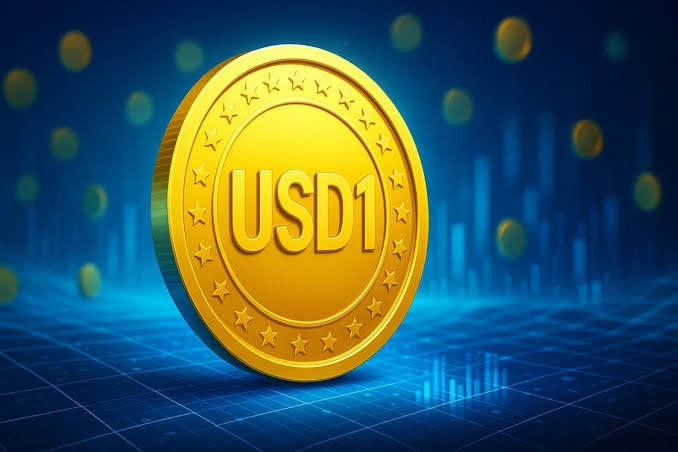
World Liberty Financial, the crypto venture roughly 38% owned by an entity affiliated with President Donald Trump and his family, secured conditional approval from the Office of the Comptroller of the Currency on August 14, 2026, to establish a national trust bank that would issue and custody its USD1 stablecoin.
A federally chartered trust bank could allow World Liberty Financial to consolidate functions surrounding USD1, including issuance, custody and reserve management, rather than relying as heavily on outside financial institutions.
The OCC approval is conditional, meaning World Liberty Financial must satisfy regulatory requirements before the proposed bank can begin full operations.
The structure also differs from that of a conventional commercial bank because a national trust bank is not generally designed to accept ordinary customer deposits or operate as a traditional lender.
The approval follows World Liberty Financial’s earlier application to create World Liberty Trust Company, a national trust bank designed around stablecoin-related services.
The proposed institution is intended to provide a regulated framework for USD1 and related digital-asset activities.
For World Liberty Financial, that represents a strategic shift from operating primarily as a crypto venture toward building infrastructure that more closely connects digital assets with the conventional financial system.
The OCC’s conditional decision does not mean the company has received unrestricted permission to operate like a conventional bank. Instead, it establishes a regulatory pathway subject to further requirements and oversight.
USD1 is at the center of the banking initiative. The dollar-backed stablecoin has grown rapidly since its launch, putting World Liberty Financial among the companies seeking a larger role in the expanding market for blockchain-based representations of the U.S. dollar.
Reuters reported that USD1 had reached roughly $4 billion in circulation by August 2026. For World Liberty Financial, greater control over the infrastructure surrounding USD1 could potentially reduce dependence on third-party providers.
Crypto exchanges, market makers, investment firms and other professional participants increasingly rely on stablecoins for settlement, liquidity management and transfers between digital-asset markets.
If World Liberty Financial successfully completes the remaining regulatory conditions, the bank could therefore become an important component of the company’s broader strategy to expand USD1 beyond its existing user base.
For crypto investors, the World Liberty Financial development should be viewed as both a regulatory milestone and a test of the company’s ability to scale responsibly.
A national trust bank charter could improve the perception of USD1 among institutions that prioritize regulated custody, transparent reserve arrangements and clearly defined oversight.
It could also help World Liberty Financial compete with established stablecoin issuers that already have significant relationships with the traditional financial system.
At the same time, the approval does not eliminate the risks associated with stablecoins. Investors still need to consider reserve quality, redemption mechanisms, regulatory requirements and the competitive position of USD1 relative to larger dollar-backed tokens.
The distinction between conditional approval and full operational authorization is also important. World Liberty Financial still has regulatory conditions to satisfy before the proposed trust bank can operate at full capacity.
The OCC decision gives World Liberty Financial a significant opportunity to deepen its presence in the U.S. digital-asset ecosystem, but the next phase will be closely watched by crypto investors and financial regulators.
For World Liberty Financial, successfully completing the approval process could turn the proposed bank into a key piece of USD1’s infrastructure.
For the wider stablecoin market, the move signals how crypto-native companies are increasingly seeking formal banking structures as regulators establish clearer rules around digital dollars.
The immediate question is no longer simply whether World Liberty Financial can obtain a banking charter. It is whether the company can use that regulatory foundation to expand USD1 while maintaining investor confidence, meeting federal requirements and competing effectively in one of crypto’s fastest-growing sectors.



Copyright © 2025 - The Bit Gazette.