


- Trending
- Comments
- Latest

Microsoft said early Saturday it has fully restored Outlook, Teams and Copilot after an outage that began around 1 p.m. Eastern on Thursday, November 12, and drew more than 130,000 Downdetector reports from users in over 70 countries. The company has attributed the failure to a technical fault, not a cyberattack, but has not yet published a post-mortem.
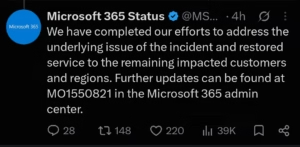
In an update posted on X early Saturday, Microsoft said it had completed its recovery efforts and resolved the underlying technical issue responsible for the disruption.
The Microsoft outage first emerged shortly before 1 p.m. Eastern Time on Thursday, November 12, when the company acknowledged technical problems affecting its services.
The disruption quickly spread across its productivity ecosystem, affecting email communications, workplace collaboration and AI-powered applications.
According to Downdetector, a website that monitors service interruptions through user reports, more than 130,000 people reported problems accessing Microsoft services on Thursday.
Reports also indicated that users in more than 70 countries and territories experienced disruptions, although Microsoft has not disclosed the total number of affected customers.
The scale of the incident is significant given Microsoft’s reported 430 million users of Microsoft 365 applications.
The Microsoft outage affected both individual customers and organisations that rely on the company’s products for daily operations, including students, families, businesses and government agencies.
Users reported difficulties sending and receiving emails, accessing workplace applications and obtaining approvals for routine business activities.
One affected user told CBS News Los Angeles that the disruption made it difficult to send reports and obtain necessary approvals.
The problems also extended to companies using Microsoft’s infrastructure to connect other digital services. OpenAI and Anthropic reported difficulties connecting to Microsoft 365 tools, highlighting the wider implications of disruptions to cloud-based business platforms.
The Microsoft outage created operational challenges across several industries, with organisations in North America, Asia and other regions reporting difficulties.
In the United States, industrial technology company Workhorse Group delayed a conference call concerning its quarterly earnings because of the disruption.
In Australia, Home Affairs Minister Tony Burke said he had discussed the incident with Microsoft’s senior executive in the country and the government’s national cybersecurity coordinator.
Burke said Microsoft did not believe the disruption was caused by malicious activity.
“They don’t believe they are dealing with a cyberattack. They believe that they are dealing in some ways (with something) similar to what we saw with respect to CrowdStrike where there is an update that has gone awry,” Burke told reporters in Sydney.
His comments drew comparisons with the July 2024 CrowdStrike incident, when a faulty software update disrupted millions of Windows computers, affecting airlines, hospitals, banks and retailers worldwide.
However, Microsoft has not confirmed that its latest incident was caused by a faulty update.
The disruption also affected government operations in Asia. Singapore’s Government Technology Agency reported problems with government email services and said it was working with Microsoft to restore access.
The Philippines’ Supreme Court disclosed that the incident had affected some of its operations, including email responses.
In Japan, Deputy Chief Cabinet Secretary Masanao Ozaki said the disruption had affected government IT infrastructure and that authorities were monitoring developments.
Airlines also experienced varying levels of disruption. India’s IndiGo reported problems with its email support services, affecting its ability to receive customer enquiries, although other customer support channels remained available.
Air India said its flight operations were unaffected but temporarily redirected its email services to ensure customer enquiries continued reaching the airline.
Microsoft apologised to customers and business partners over the disruption, acknowledging the inconvenience caused by the incident.
“We are deeply sorry for the disruption this incident has caused our customers and partners,” the company said in a statement posted on X on Friday.
“We know the trust they place in our services and take that responsibility extremely seriously.”
Charles Lamanna, Microsoft’s executive vice president of Copilot, Agents and Platform, also acknowledged that the recovery process had been more complicated than usual.
In a social media update, Lamanna said technical challenges and unexpected failure scenarios had made restoring services more difficult.
“I’m working closely with the engineering team to complete the full post-mortem,” Lamanna said.
He added that Microsoft would publish an investigation detailing the incident’s timeline and the measures being considered to prevent similar disruptions.
The Microsoft outage has renewed questions about the resilience of cloud-based infrastructure, particularly as organisations increasingly depend on a small number of technology providers for email, collaboration, data management and artificial intelligence services.
Although the company has confirmed that its services have been restored, the technical explanation behind the incident remains an important outstanding issue.
Microsoft’s forthcoming post-mortem is expected to provide further details about the failure, the difficulties encountered during recovery and the changes planned to strengthen service reliability.



Copyright © 2025 - The Bit Gazette.