
- Trending
- Comments
- Latest

Mastercard will sponsor a 36-hour XRP Ledger hackathon in New York on Oct. 24–25, XRPL Commons confirmed, days before Ripple’s Swell conference opens in the same city.
XRPL Commons announced the 36-hour event on Aug. 26, confirming Mastercard as a sponsor alongside a broader program designed to bring developers together around applications and infrastructure for the XRP Ledger.
The Mastercard XRP Ledger hackathon will take place ahead of Ripple’s Swell conference and is expected to focus on four areas: protocol development, agentic finance, lending and borrowing, and an open category for projects that add functionality to the XRP Ledger.
Mastercard’s sponsorship demonstrates interest in the developer ecosystem, but it does not, by itself, establish that Mastercard is launching a new XRP-based payment product or deploying a commercial application on the XRP Ledger.
The Mastercard XRP Ledger hackathon is structured around four tracks intended to attract developers working on both the underlying network and financial applications.
One track will concentrate on protocol innovation, including network amendments, client implementations and developer tooling.
Another will examine agentic finance, a developing area in which software agents can initiate or manage financial transactions.
The lending and borrowing category will allow participants to experiment with the proposed XRP Ledger Lending Protocol and associated functionality.
A separate open track will give existing projects an opportunity to incorporate XRP Ledger capabilities into their products rather than requiring teams to start entirely new applications.
The event therefore has a broader technical scope than a conventional marketing partnership. Developers will be able to work on infrastructure, financial applications and tools that could potentially expand the range of activity taking place on the network.
XRPL Commons, which organizes the event, has listed the Mastercard XRP Ledger hackathon on its official events calendar. The organization has not disclosed Mastercard’s financial contribution, judging responsibilities or the extent of any technical involvement.
For XRP investors, the most important qualification surrounding the Mastercard XRP Ledger hackathon is that sponsorship should not automatically be interpreted as a commercial integration.
Mastercard has not announced that it will launch a product developed during the hackathon. There has also been no confirmation that participants will receive access to Mastercard’s payment network or guaranteed commercial partnerships.
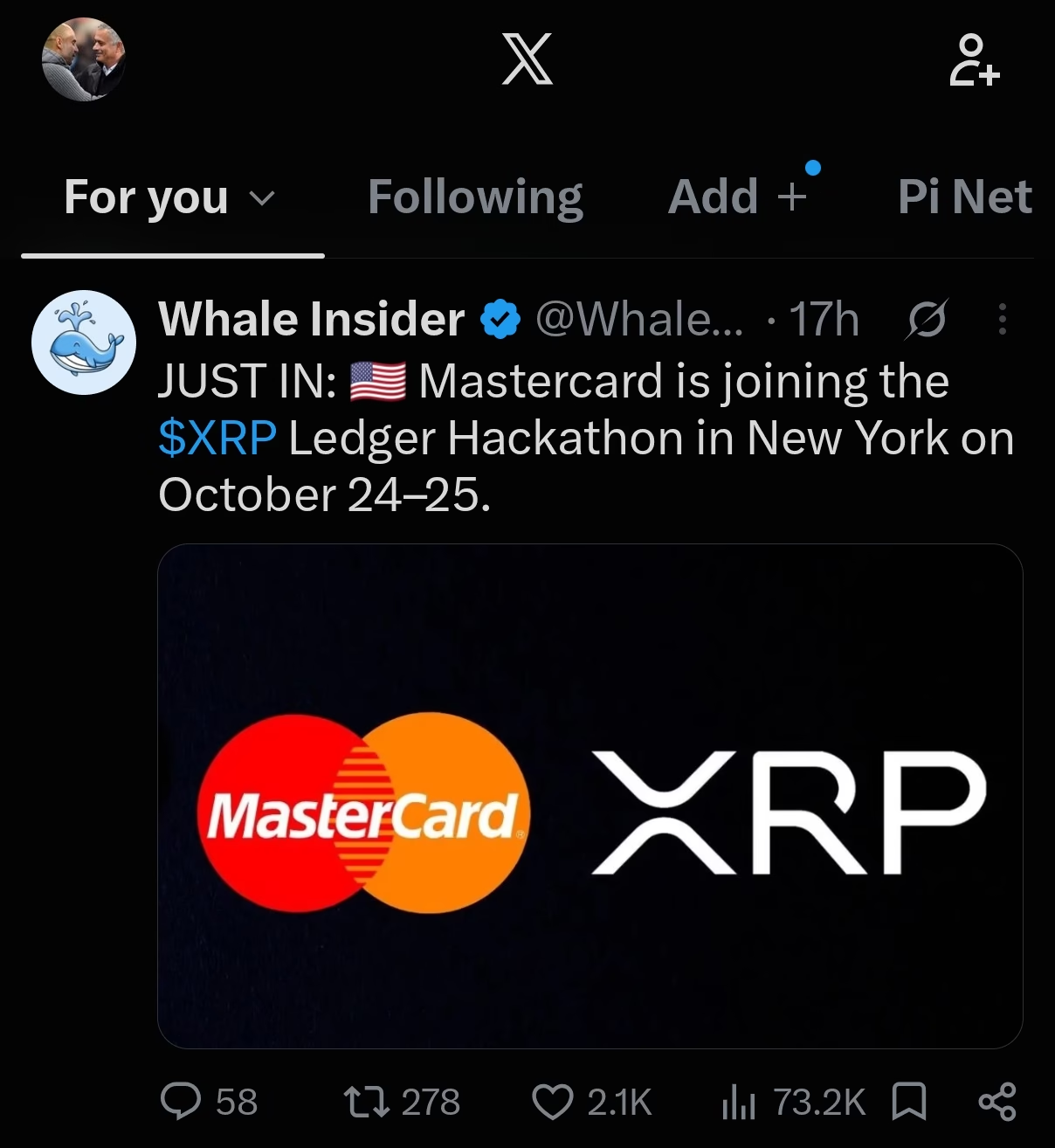
A social-media post circulated ahead of the announcement, stating: “JUST IN: 🇺🇸 Mastercard is joining the $XRP Ledger Hackathon in New York on October 24–25.” — Whale Insider.
That description captures Mastercard’s participation, but it does not establish a direct connection between the company and XRP as a payment asset.
For market participants, the Mastercard XRP Ledger hackathon should therefore be viewed primarily as an ecosystem-development event unless Mastercard or XRPL Commons announces a specific commercial deployment.
The Mastercard XRP Ledger hackathon comes as Mastercard is separately moving toward blockchain-based settlement using regulated stablecoins.
In June, Mastercard announced plans to expand its settlement capabilities to support regulated stablecoins, including Ripple’s RLUSD, across eight blockchain networks. The networks named by Mastercard include XRPL, Ethereum, Solana, Polygon, Arbitrum, Base, Canton and Tempo.
Mastercard said the expansion would give financial institutions greater flexibility around transaction settlement. The company described the initiative as providing issuers and acquirers with “more choice in how and when they settle transactions.
The planned system includes intraday, weekend and holiday settlement options. However, Mastercard’s support for RLUSD does not mean all transactions on its network will move through the XRP Ledger, nor does it mean XRP itself will serve as the settlement asset.
RLUSD is a stablecoin designed to maintain a value linked to the U.S. dollar, while XRP is the native digital asset of the XRP Ledger. Increased use of one does not automatically create proportional demand for the other.
The Mastercard XRP Ledger hackathon adds another institutional name to the growing list of companies engaging with blockchain infrastructure, but investors should separate ecosystem development from confirmed token adoption.
Mastercard’s existing stablecoin settlement plans provide a more direct indication of the company’s blockchain strategy than the hackathon sponsorship alone.
The company has already identified XRPL as one of the networks that will support its planned regulated-stablecoin settlement capabilities.
Ripple has also previously worked with Mastercard, WebBank and Gemini on an initiative exploring RLUSD settlement for Gemini credit-card transactions. The project was described as an exploration rather than a guarantee of full commercial deployment.
Investors will want to see whether applications built during the event progress into real products, whether Mastercard becomes directly involved with any of those projects, and whether additional commercial agreements follow.
The immediate milestone is the October event itself. XRPL Commons has confirmed the dates, while further details concerning registration, judging and sponsor participation are expected as the hackathon approaches.
Mastercard XRP Ledger hackathon represents a meaningful signal for the broader XRPL developer ecosystem, but it should not be treated as proof of a new Mastercard-XRP payment integration.
For XRP investors, the more consequential developments may come from actual transaction volume, institutional use of XRPL, stablecoin settlement activity and any future commercial deployments that emerge from the partnership ecosystem.



Copyright © 2025 - The Bit Gazette.