

- Trending
- Comments
- Latest

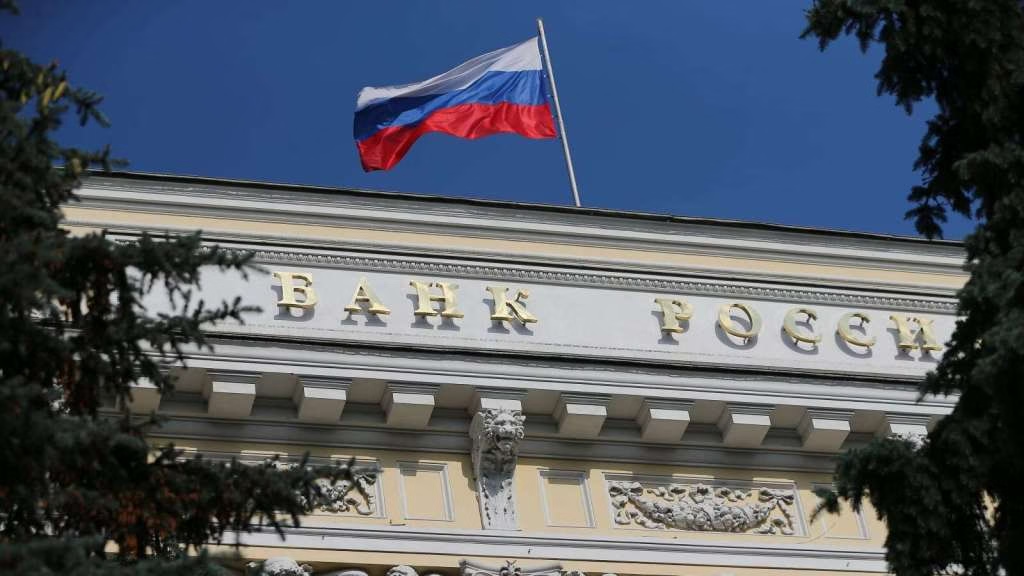
Russia’s federal law on digital currencies took effect on September 1, 2026, placing the country’s crypto market under Bank of Russia supervision for the first time and capping retail investors at 300,000 rubles, roughly $3,700, in annual purchases per licensed intermediary.
President Vladimir Putin signed the legislation, Federal Law No. 282-FZ, on August 4, 2026, after the State Duma passed it on July 21, 2026.
The law creates Russia’s first unified legal framework for crypto exchanges, brokers, digital depositories, asset managers, trading venues, clearing houses, custody providers and miners, all of which must now register as licensed intermediaries and join an approved financial-market self-regulatory organization to operate legally.
Non-qualified retail investors must pass a Bank of Russia suitability test before their first trade, regardless of amount. Once cleared, they can buy up to 300,000 rubles worth of approved cryptocurrencies per year through each licensed intermediary.
A Bank of Russia draft directive published August 11, 2026, names Bitcoin, Ethereum and Tether’s USDT as the only assets currently eligible, based on criteria including two years of qualifying market capitalization and trading volume plus five years of price history on a licensed foreign exchange. Qualified investors face no purchase ceiling once they meet regulatory suitability requirements.
The law leaves Russia’s ban on using cryptocurrency to pay for goods and services domestically fully in place; the ruble remains the country’s sole legal tender for local transactions.
The one carve-out applies to foreign trade: businesses engaged in cross-border commerce may now accept or settle payments in cryptocurrency for international contracts between Russian residents and non-residents, a channel that could give exporters facing Western sanctions an alternative settlement route outside conventional currency systems.
Not every provision of the law takes effect at once. Core rules on licensing, investor caps and the domestic payment ban began September 1, 2026, but reporting on the compliance timeline for existing market participants varies by provision: some coverage points to a March 1, 2027, grace period for currently operating exchanges, additional issuance and circulation rules phasing in by September 1, 2027, and full licensing compliance required by July 1, 2027.
The Bank of Russia has not yet published a final, consolidated list of approved digital assets or finalized testing requirements for investors.
Licensed exchanges must hold a minimum of 15 million rubles in equity under the new framework. The law also grants cryptocurrency formal legal status as property in Russia, giving holders a basis to seek legal protection over their holdings for the first time.



Copyright © 2025 - The Bit Gazette.