




- Trending
- Comments
- Latest

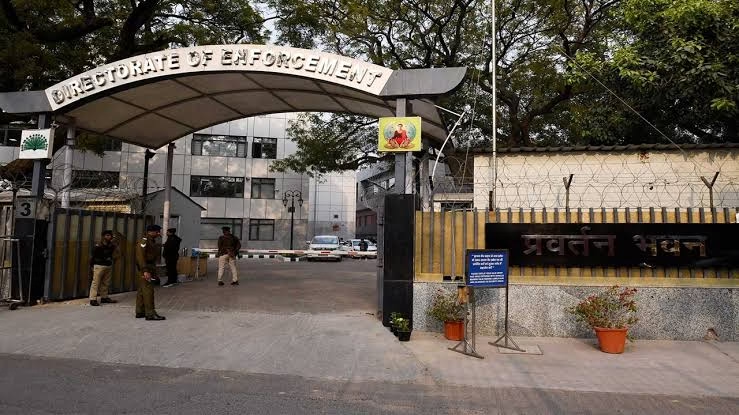
India’s Enforcement Directorate has arrested two men and raided 17 premises across Tamil Nadu, West Bengal and Puducherry-linked jurisdictions in a pair of money-laundering probes, one tied to the Rs 40 crore Hashpe cryptocurrency fraud, the other to alleged drug-trafficking proceeds.
The cryptocurrency fraud case stems from a First Information Report filed by the Puducherry Cyber Crime Police. According to the ED, Hitesh Kumar, Imran Basha and Syed Usman allegedly operated a fraudulent investment scheme under the name Hashpe.
The platform was presented to investors as a cryptocurrency trading venture, with the purported TCX token promoted as an opportunity to generate lucrative returns.
The agency said promotional events, celebrity endorsements and social-media campaigns were used to attract investors. The alleged scheme then involved artificially increasing the token’s value to encourage further investment.
The ED said withdrawals were subsequently blocked after funds had been collected.
“around Rs 40 crore” was allegedly collected from investors through the activities under investigation, according to the agency’s reported findings.
The investigation further alleged that the money was diverted through shell entities, associates and relatives. Bank-account analysis reportedly showed that portions of the funds were transferred into accounts connected to the accused and businesses associated with their family members.
The cryptocurrency fraud case therefore centres not only on the alleged deception of investors but also on the movement and layering of the proceeds, which forms the basis of the ED’s money-laundering investigation.
The investigation escalated on September 3 when the ED arrested Imran Basha and Hitesh Kumar under Section 19 of the Prevention of Money Laundering Act, 2002.
Both accused were subsequently produced before a Special Court dealing with PMLA cases. The court granted the ED five days of custody, according to the agency’s reported statement.
The agency said the investigation had established the alleged roles of Basha and Kumar as key accused in the money-laundering activities connected with the Hashpe cryptocurrency fraud case.
Search teams also seized documents and digital evidence that the ED said were connected with the alleged money-laundering activities.
“Further investigation is under progress,” the Enforcement Directorate said in its reported statement.
The cryptocurrency fraud case remains under investigation, and the allegations against the individuals involved have yet to be tested through the judicial process.
The ED’s operations also extended beyond the cryptocurrency fraud case, with its Madurai Sub-Zonal Office searching six premises in Nagapattinam on September 3.
That investigation concerns alleged money laundering connected to methamphetamine and ganja trafficking.
According to the agency, M Alex, described as a repeat offender, was intercepted by the Narcotics Control Bureau in April 2025 while allegedly carrying methamphetamine.
The ED is investigating allegations that proceeds from drug trafficking were subsequently invested in properties, shrimp farms and vehicles in Nagapattinam, Velankanni and Thaliyamadi.
Documents and electronic devices were seized during searches conducted in both investigations.
While the Nagapattinam probe is separate from the cryptocurrency fraud case, both operations fall under the ED’s broader mandate to investigate suspected money laundering and trace assets allegedly derived from criminal activity.
The Hashpe cryptocurrency fraud case highlights the risks investigators face when alleged investment schemes combine digital assets with aggressive marketing and conventional financial networks.
According to the ED, the alleged operators used a combination of promotional events, celebrity endorsements and social-media campaigns to build interest around TCX. The agency alleges that the token’s value was artificially inflated before withdrawals were blocked.
The subsequent movement of funds through shell entities, associates and relatives is central to the cryptocurrency fraud case because investigators are seeking to establish how the alleged proceeds were transferred and potentially converted into other assets.
The ED’s action also demonstrates the financial-crime dimension of cryptocurrency investigations. Rather than focusing solely on the underlying digital token, authorities are examining bank accounts, companies, properties and other assets that may have been used to move or conceal alleged proceeds.
The cryptocurrency fraud case is now moving through the legal process following the arrests of Basha and Kumar and the five-day custody order.



Copyright © 2025 - The Bit Gazette.