




- Trending
- Comments
- Latest

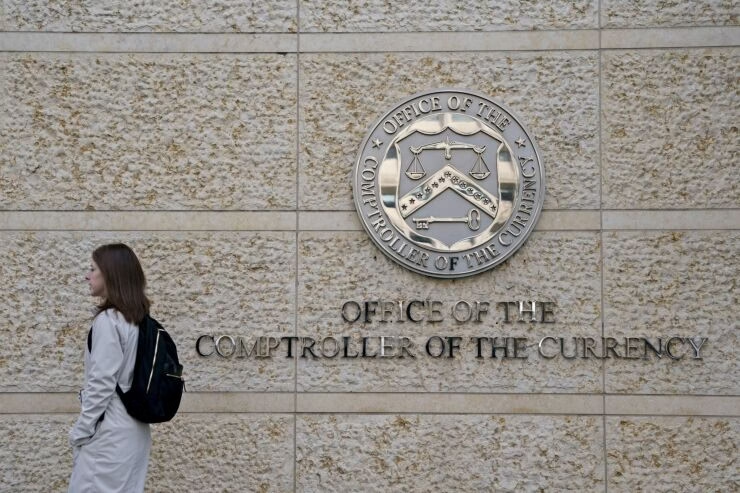
The U.S. Office of the Comptroller of the Currency (OCC) has given OpenReserve Bank preliminary approval for a national bank charter, marking a significant step toward launching the Salt Lake City, Utah-based institution as a regulated blockchain bank. The approval, announced Thursday, comes as crypto-focused financial firms increasingly seek access to the U.S. banking system following years of difficult relationships between digital-asset companies and traditional banks.
The proposed institution is backed by several prominent investors from the cryptocurrency and technology sectors, including Andreessen Horowitz, Jump Capital and Coinbase Ventures. Other backers named by the company include Acrew, Wintermute Ventures, Clocktower, Quona, AAF Management and Zero Knowledge Ventures.
The OCC has recently granted preliminary or conditional charters to a growing number of banking institutions, many of them trust companies. OpenReserve Bank, however, said it deliberately pursued a full national bank charter rather than a narrower trust structure.
“We chose the national bank path deliberately,” said Dee Choubey, co-founder and CEO of OpenReserve, in a statement.
Choubey said regulatory oversight would form part of the company’s strategy rather than conflict with its blockchain-focused model.
“Supervision, safety and soundness, compliance, and customer confidence are not constraints on what we are building; they are the foundation of it,” Dee Choubey, co-founder and CEO of OpenReserve.
According to the company, OpenReserve Bank is being developed as a full-service national bank with blockchain-based settlement capabilities built into its operations. The company said its services are intended primarily for institutional customers, with a focus on treasury management, stablecoin issuance and tokenized deposits.
The bank also said its proposed operations are designed to comply with regulations established under the Guiding and Establishing National Innovation for U.S. Stablecoins, known as the GENIUS Act.
The company’s approach reflects a broader effort among crypto businesses to establish regulated financial infrastructure that can connect traditional banking services with blockchain-based assets and transactions.
The investment backing for OpenReserve Bank includes major participants in the digital-asset industry. Andreessen Horowitz’s crypto division, a16z crypto, separately explained its investment by emphasizing the need for banking services that operate continuously.
“We need a bank that’s always on, always open, always available,” a16z crypto said in an online post explaining its investment decision.
The firm added: “A bank that never closes. A continuous bank.”
Despite the preliminary decision, OpenReserve Bank has not yet received its permanent charter. The company said it still requires final approval from the OCC before it can fully establish its operations under the national banking framework.
The company submitted its charter application to the banking regulator in April. The OCC had not immediately responded to a request for confirmation of the charter approval at the time of the report.
That distinction means the preliminary authorization represents an important regulatory milestone but does not constitute the final approval needed for the bank to begin operating permanently under its proposed charter.
The development comes during a period of increased interest in crypto-native banking institutions in the United States. After several years in which cryptocurrency companies faced challenges establishing and maintaining relationships with traditional banks, the industry has increasingly pursued direct access to regulated banking structures.
The administration of President Donald Trump, including OCC chief Jonathan Gould, has signaled a more welcoming approach toward digital-asset businesses seeking entry into the regulated banking sector.
OpenReserve Bank is therefore entering an expanding field of crypto-focused financial institutions seeking to combine conventional banking oversight with blockchain infrastructure.
The latest development involving OpenReserve Bank was accompanied Thursday by another OCC decision involving Revolut, a British fintech company. The U.S. agency approved a conditional banking charter for Revolut, which is expected to operate from Connecticut.
The two decisions highlight the growing number of digital-asset and fintech businesses pursuing regulated banking status in the United States.
For OpenReserve Bank, the next stage will depend on satisfying the OCC’s remaining requirements and securing final approval. Until that process is completed, the institution’s proposed services remain part of its planned business model rather than fully operational banking offerings.
The preliminary charter nevertheless gives OpenReserve Bank a regulatory pathway to pursue its stated goal of providing institutional treasury, stablecoin and tokenized-deposit services through a national banking structure.
As the U.S. banking sector continues to accommodate blockchain-based financial businesses, the company’s progress will be closely watched by the broader crypto industry, particularly institutions seeking regulated infrastructure for digital-asset transactions.



Copyright © 2025 - The Bit Gazette.