

- Trending
- Comments
- Latest

Poland’s Sejm fell 25 votes short of overriding President Karol Nawrocki’s third veto of the country’s crypto regulation bill on Sept. 4, voting 241–198 with three abstentions, leaving the KNF-led licensing framework in political limbo for a third time.
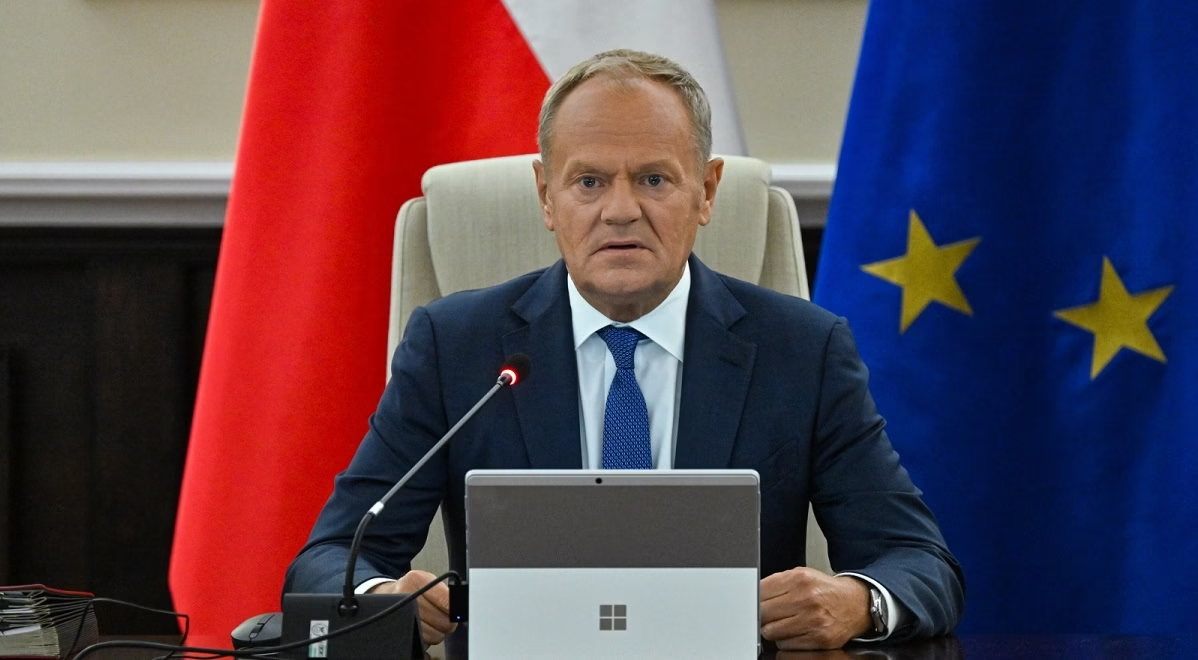
The defeat represents another blow to Prime Minister Donald Tusk’s government, which has repeatedly attempted to establish a domestic system for supervising crypto businesses and aligning Poland more closely with the European Union’s Markets in Crypto-Assets Regulation, or MiCA.
The proposed legislation would have given the Polish Financial Supervision Authority, known as the KNF, a central role in regulating the country’s crypto market.
The framework was designed to establish licensing, reporting and enforcement requirements for crypto-asset service providers while creating a clearer domestic structure for implementing MiCA.
The latest vote, however, showed that the government still lacks sufficient parliamentary support to overcome Nawrocki’s objections.
The president has repeatedly argued that the legislation imposes excessive requirements on legitimate crypto businesses and could drive companies to seek more favorable jurisdictions elsewhere.
When announcing his third veto, Nawrocki argued that Parliament had failed to adequately address objections raised by his office.
“Bad law does not become good law simply because it is passed a hundred times,” Nawrocki said in a video statement.
Nawrocki has maintained that he supports stronger protections against fraud and financial crime but favors a regulatory approach that does not place disproportionate costs on compliant companies. His office has also proposed an alternative framework aimed at strengthening protections while reducing what it considers unnecessary regulatory burdens.
The latest defeat is the culmination of months of confrontation between the Polish government and presidency.
Nawrocki first rejected the Crypto-Asset Market Act in December 2025. His concerns included the proposed powers of the regulator and provisions that could allow authorities to block websites associated with crypto activity.
The Sejm subsequently attempted to override that veto but failed to reach the required three-fifths majority.
A revised version later returned to Parliament, but Nawrocki issued another veto in February 2026, arguing that the legislation remained substantially similar to the earlier version.
By May, lawmakers were weighing competing proposals from the government, the president’s office, Poland 2050 and the Confederation party. The main disagreements centered on the KNF’s enforcement powers, licensing requirements and potential financial penalties.
The government-backed version eventually passed the Sejm on May 15. It included licensing and reporting obligations for crypto service providers, KNF supervision and criminal liability for certain violations.
The dispute is particularly significant because MiCA already applies across the European Union. While the EU regulation establishes common rules, national authorities remain responsible for important licensing, supervision and enforcement functions.
That makes the continued absence of a settled domestic framework an increasingly important issue for crypto companies operating in Poland.
The Poland crypto bill battle has also become intertwined with allegations surrounding the collapsed Zondacrypto exchange.
Before the Sept. 4 vote, Tusk urged lawmakers to support the veto override and referred to testimony connected with an investigation into the exchange.
According to Polish Radio’s account of the parliamentary debate, Tusk read excerpts of witness testimony alleging that former Justice Minister Zbigniew Ziobro had promised to intervene in the Zondacrypto case if he returned to government.
The testimony cited an alleged PLN 2 million payment, equivalent to roughly €463,000, described as compensation. It further alleged that PLN 500,000, or about €116,000, was intended for Ziobro’s personal expenses.
The claims remain part of an investigation and should not be treated as court-established findings.
Tusk nevertheless used the allegations to intensify his argument for tougher oversight of the crypto industry. During the debate, he also attacked opposition lawmakers, telling them: “You are disgracing yourselves.”
The controversy has previously spilled into debates over the crypto legislation. Nawrocki has rejected suggestions that he was connected to Zondacrypto, saying he had never met the exchange’s chief executive, Przemysław Kral, or its representatives.
The failure to override Nawrocki does not suspend MiCA itself. The EU regulation remains applicable across the bloc, but Poland’s domestic regulatory machinery remains caught in a political dispute.
For crypto businesses, that uncertainty can complicate questions surrounding licensing, supervision and enforcement.
The Poland crypto bill defeat also comes as other major jurisdictions pursue very different approaches to digital-asset regulation.
In the United States, the Securities and Exchange Commission unveiled its proposed “Regulation Crypto Assets” framework on Aug. 18. SEC Chairman Paul Atkins said the proposal was intended to provide crypto entrepreneurs with clearer routes to raise capital while preserving investor protections.
The proposal includes a startup exemption covering offerings of up to $5 million over four years and another exemption allowing qualifying offerings of up to $75 million over 12 months. It also proposes disclosure requirements and a conditional safe harbor related to investment contracts.
Unlike the Polish legislation, however, the SEC initiative focuses primarily on securities offerings involving crypto assets rather than creating a national licensing structure comparable to the MiCA framework.
For Poland, the immediate challenge is finding a compromise. The failed Sept. 4 vote means Nawrocki’s veto remains in place, while the government must now determine whether it can produce legislation capable of satisfying the president without weakening the regulatory structure needed to administer EU crypto rules.
The Poland crypto bill has therefore moved beyond a technical question of crypto regulation. It has become a broader test of how Poland balances investor protection, business competitiveness and compliance with Europe’s rapidly developing digital-asset rulebook.



Copyright © 2025 - The Bit Gazette.