
- Trending
- Comments
- Latest

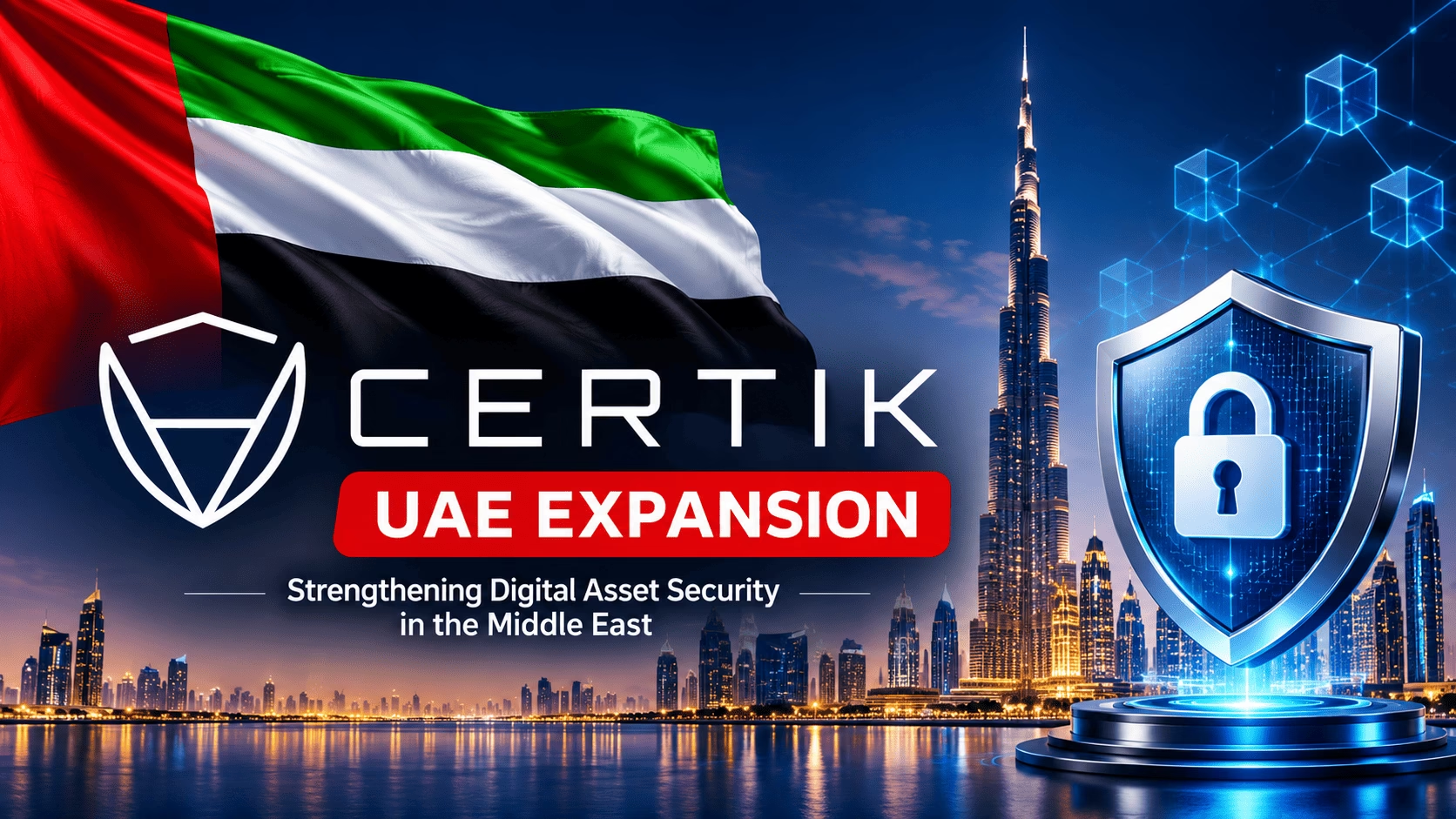
Blockchain security firm CertiK says five security incidents in 2026 originated in the United Arab Emirates or involved UAE-registered entities.
Four of them caused about $8.02 million in documented losses, according to CertiK research. The firm warns that regulatory approval does not replace continuous security, and says the real total may be higher because incident reporting is incomplete.
A major component of the CertiK UAE Expansion is its relationship with Hub71, Abu Dhabi’s technology ecosystem, which connects startups with investors, corporate partners and other business resources.
As an official Hub71 vendor, CertiK provides eligible startups operating within the Abu Dhabi Global Market (ADGM) ecosystem with access to discounted security services and complimentary CertiK Compliance tools.
The arrangement is designed to help emerging digital asset companies address technical and regulatory requirements as they prepare to enter the UAE’s increasingly structured financial environment.
For startups pursuing regulatory authorization, security assessments and compliance procedures can represent significant operational expenses. Access to specialized services through Hub71 could help reduce some of these costs while allowing businesses to address potential weaknesses before launching or expanding their operations.
CertiK’s engagement also extends to established cryptocurrency exchanges.
On March 5, 2026, the company announced that it had completed an independent Proof of Reserves verification for Gate Technology FZE, the Dubai-based entity of the Gate Group. Gate Dubai operates under a licence issued by the Virtual Assets Regulatory Authority (VARA).
The verification covered 10 digital assets and confirmed that each recorded a collateralization ratio of at least 100% against corresponding customer liabilities as of December 31, 2025.
The assessment involved examining customer liabilities and verifying control over the wallets holding the reported reserves. CertiK also independently reconstructed the exchange’s Merkle Tree to check the accuracy of its liability data.
Importantly, Proof of Reserves provides a point-in-time assessment rather than a permanent guarantee of an exchange’s financial health or solvency.
The expansion comes as reported security incidents highlight the risks facing businesses operating within the UAE’s digital asset ecosystem.
According to CertiK’s research, five security incidents recorded in 2026 originated in the UAE or involved entities registered in the country. Four of those incidents generated approximately $8.02 million in documented financial losses, while the impact of the remaining incident had not been established.
The company warned that the available figures might represent only part of the overall security problem. Incomplete incident reporting and difficulties establishing the origins of certain attacks can prevent researchers from identifying the full extent of financial damage.
This limitation makes it difficult to measure the actual security exposure facing digital asset businesses across the region.
The findings also highlight an important distinction for institutional investors and cryptocurrency users: obtaining regulatory authorization does not automatically eliminate cybersecurity vulnerabilities.
Exchanges and blockchain companies must still protect customer funds, secure their underlying infrastructure, manage access privileges and maintain effective internal risk controls.
As more institutions enter the market, weaknesses in any of these areas could undermine confidence in the wider digital asset ecosystem.
The growing importance of digital asset security was also highlighted during a media briefing hosted by CertiK at Dubai FinTech Summit 2026. The discussion, titled “The Trillion-Dollar Trust Gap: Why Institutional Finance Still Hesitates on Digital Assets,” explored why traditional financial institutions remain cautious about adopting blockchain-based financial services at scale.
CertiK Chief Business Officer Jason Jiang emphasized that regulatory approval should not be mistaken for complete protection against cyber threats and operational failures.
“Financial institutions are making real progress in bringing digital assets into financial services, but regulatory approval is only the starting point,” Jiang said. “Protecting customer assets and managing risks as operations scale requires continuous security and compliance.”
His remarks reinforce the company’s position that security must become an ongoing operational priority rather than a requirement businesses address only when applying for regulatory licences.
Jiang also described CertiK’s broader ambition to move beyond its traditional Web3 security role and become the “Trust Layer for Digital Value.” The objective is to support institutions as they establish reliable security and verification systems across an increasingly interconnected digital economy.
The message is particularly relevant as financial institutions explore tokenization, blockchain-based settlement systems and digital asset custody. Each development introduces additional technical and operational considerations that require consistent monitoring.
The CertiK UAE Expansion reflects the growing relationship between regulatory development and institutional participation in the cryptocurrency industry.
The UAE has positioned itself as an important destination for digital asset companies by developing specialized regulatory frameworks and attracting international blockchain businesses. Dubai’s VARA and Abu Dhabi’s ADGM provide distinct regulatory environments for companies seeking authorization to operate in the country.
However, the arrival of more regulated businesses also increases expectations around transparency, cybersecurity and consumer protection.
For exchanges, independent Proof of Reserves verification can provide customers with additional evidence that reported assets cover specified liabilities. For startups, security audits and compliance tools can help identify vulnerabilities and address licensing requirements before operations expand.
CertiK’s partnerships demonstrate how these services can serve different segments of the market, from early-stage blockchain companies to established trading platforms.
The company’s immediate priority will be turning its growing regional presence into deeper relationships with institutional clients and digital asset businesses. Its ability to deliver consistent security assessments, independent verification and practical compliance support could determine how effectively it benefits from the UAE’s expanding cryptocurrency market.
Ultimately, the CertiK UAE Expansion highlights a wider industry challenge: institutional adoption cannot depend on regulatory approval alone. Long-term confidence will require businesses to demonstrate that customer assets, trading infrastructure and operational systems remain protected as the digital economy grows.



Copyright © 2025 - The Bit Gazette.