
- Trending
- Comments
- Latest

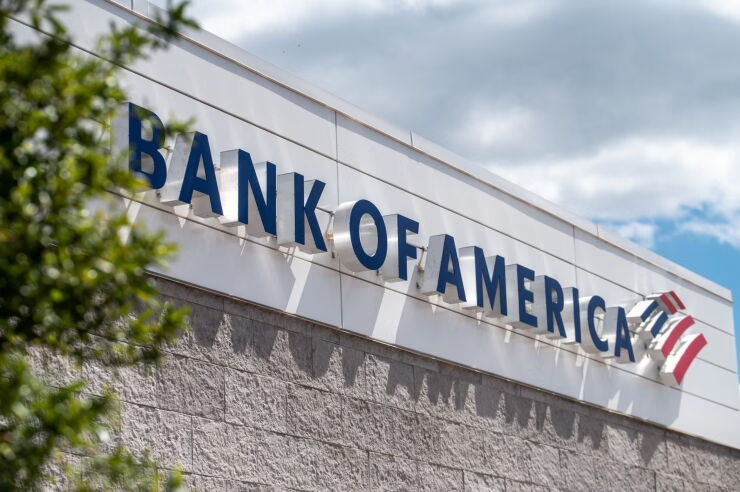
The U.S. Treasury has imposed more than $1.21 billion in penalties on Bank of America over anti-money-laundering and sanctions failures, including a record $750 million payment to the Office of the Comptroller of the Currency (OCC).
Regulators said the bank’s monitoring system let trillions of dollars in transactions pass without adequate oversight. The case does not involve cryptocurrency, but it lands as Binance and TD Bank remain the only larger penalties on record.
According to the OCC, Bank of America operated a seriously deficient transaction-monitoring system that allowed trillions of dollars in transactions to pass through without adequate oversight. The regulator also found that the bank submitted delayed suspicious activity reports involving billions of dollars, including transactions linked to suspected money laundering.
The agency said the bank had known for years that potentially illicit transactions were not consistently escalated for investigation but had failed to correct the underlying problems. It also raised concerns about the qualifications of compliance personnel and the adequacy of staff training on investigating and reporting suspicious financial activity.
The enforcement action represents one of the largest financial penalties imposed by the Treasury Department. Only two penalties cited in the report exceed it: Binance’s approximately $4 billion settlement in 2023 and TD Bank’s $3 billion settlement in 2024.
The OCC’s findings underscore why transaction monitoring remains central to financial regulation. Banks are expected to identify unusual activity, investigate potential warning signs, and report concerns before gaps in oversight can be exploited.
Bank of America acknowledged violations of the Bank Secrecy Act of 1970, legislation that requires financial institutions to maintain anti-money-laundering controls, keep appropriate records, and cooperate with authorities investigating suspected financial crimes.
In its response, the bank said: “Financial crime compliance is serious, and we are responsible for getting it right. We worked with regulators to reach these penalty resolutions stemming from violations cited in the previously reported 2024 (Comptroller of the Currency) Consent Order and FinCEN’s investigation.”
The bank added that it had invested billions of dollars in technology and hired thousands of employees to strengthen its financial crime prevention efforts. However, it acknowledged that additional work remained to address the issues identified by regulators.
The Bank of America case is not itself a finding of crypto money laundering. Instead, it illustrates compliance weaknesses that can affect financial institutions handling transactions involving customers, businesses, and international payment networks.
The Financial Crimes Enforcement Network (FinCEN), the Treasury bureau responsible for combating illicit finance, relies on suspicious activity reports submitted by financial institutions to help identify potential criminal activity. These reports can provide investigators with information about unusual transactions, suspected money-laundering networks, and the movement of funds across borders.
When reports are incomplete or delayed, authorities may find it harder to connect transactions involving different accounts, institutions, or jurisdictions. Such gaps can complicate investigations into activities ranging from fraud and sanctions evasion to terrorist financing and organized crime.
Similar concerns apply to crypto money laundering, where digital assets may move between exchanges, wallets, intermediaries, and jurisdictions. Cryptocurrency platforms are subject to applicable anti-money-laundering requirements, and regulators have repeatedly emphasized the importance of effective customer verification, transaction monitoring, and suspicious activity reporting.
However, the distinction between traditional banking violations and cryptocurrency-related offenses remains important. Bank of America’s penalties concern alleged and acknowledged regulatory compliance failures described by U.S. authorities; they do not establish that the bank’s conduct involved cryptocurrency transactions.
The case nevertheless challenges the assumption that illicit finance is primarily a cryptocurrency problem. Traditional banks continue to play a significant role in the global movement of money, making their compliance systems an important part of efforts to detect and disrupt financial crime.
U.S. Treasury Secretary Scott Bessent said the enforcement action demonstrated that major financial institutions remain accountable under the law, regardless of their size or market position.
That message has implications for the wider financial industry, including businesses involved in digital assets. Regulators expect firms to maintain controls proportionate to their risks and to address weaknesses when they are identified.
The Bank of America enforcement action also draws attention to previous cases involving cryptocurrency businesses. Binance, the world’s largest cryptocurrency exchange by trading volume, agreed to pay approximately $4 billion in penalties in 2023 after U.S. authorities found serious violations of anti-money-laundering and sanctions requirements.
The exchange acknowledged failures involving the Bank Secrecy Act and sanctions compliance. The settlement followed an investigation into its failure to implement and maintain adequate systems for monitoring suspicious transactions and meeting applicable legal obligations.
As part of the agreement, Binance accepted a five-year monitoring arrangement. Its founder, Changpeng Zhao, stepped down as chief executive and later received a four-month prison sentence after pleading guilty to failing to maintain an effective anti-money-laundering program.
At the time, U.S. Attorney General Merrick Garland criticized the exchange’s conduct, arguing that technological innovation did not excuse violations of the law.
“Employing novel technology to bypass legal frameworks does not make a firm a market disruptor, but rather a criminal,” Garland said, according to the account provided in the original report.
The Binance case remains a prominent example of how crypto money laundering concerns can lead to substantial enforcement actions when regulators identify failures in compliance controls. It also demonstrates that cryptocurrency companies are expected to meet legal requirements designed to prevent illicit financial activity.
The comparison with Bank of America, however, involves different institutions, investigations, and alleged failures. The penalties should not be interpreted as evidence that the two cases involved identical conduct.
TD Bank provides another comparison in the debate over financial crime prevention. The Canada-based bank agreed to a $3 billion settlement in 2024 after U.S. authorities identified serious weaknesses that enabled widespread money-laundering activity over an extended period.
Garland criticized the institution’s failures, saying: “TD Bank created an environment that allowed financial crime to flourish. By making its services convenient for criminals, it became one.”
The settlement reinforced concerns that inadequate compliance systems can allow criminal networks to exploit legitimate financial services. It also highlighted the potential consequences when institutions fail to respond effectively to known risks.
Taken together, the Bank of America, Binance, and TD Bank cases illustrate the importance of robust monitoring, qualified compliance teams, staff training, and timely reporting. They also show that enforcement actions can target both traditional financial institutions and cryptocurrency businesses when authorities identify serious violations.
For the digital asset industry, the renewed attention on crypto money laundering underscores the need to distinguish between legitimate innovation and failures to comply with financial regulations. Cryptocurrency businesses must address the risks associated with digital transactions, while traditional banks must ensure their own systems can detect and report suspicious activity.
Ultimately, the Bank of America penalties highlight a common regulatory expectation across the financial system: institutions cannot rely on their size, technology, or market reputation as substitutes for effective oversight. Preventing illicit finance requires consistent controls, meaningful accountability, and cooperation between financial institutions and law enforcement.
As regulators continue scrutinizing both conventional banking and digital asset markets, the central question is not simply which sector presents the greatest risk. It is whether institutions can identify suspicious transactions, act on warning signs, and provide authorities with the information needed to investigate financial crime.



Copyright © 2025 - The Bit Gazette.