

- Trending
- Comments
- Latest

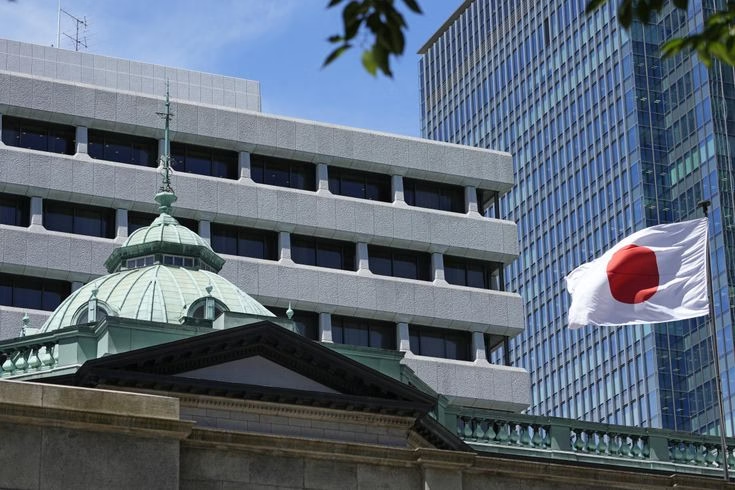
The Bank of Japan raised its policy rate to 1% this week, the highest level since 1995, unwinding decades of ultra-cheap yen funding that has quietly underpinned leveraged positions across global risk assets, including crypto.
The effects may not appear immediately on a Bitcoin chart, but the mechanics are already moving beneath the surface.
A move from 0.75% to 1% may appear insignificant compared with rates elsewhere. But the significance lies in what the number represents.
Japan spent decades maintaining ultra-low interest rates, effectively becoming the world’s cheapest funding source.
Investors borrowed yen, converted it into dollars or other currencies, and deployed that capital into higher-yielding assets ranging from equities to cryptocurrencies.
The BOJ’s decision marks another step in dismantling that regime. More importantly, it signals that monetary normalization is no longer theoretical.
Policymakers have indicated a willingness to continue adjusting rates as inflation and economic conditions evolve.
For crypto markets, the concern is not the rate itself. It is the potential re-pricing of leverage built on years of cheap Japanese funding.
The yen carry trade has long operated as a silent liquidity provider to risk assets.
The process is straightforward: borrow cheaply in yen, exchange into higher-yielding currencies, and invest in assets with stronger returns. As long as the yen remains weak and funding costs remain low, the strategy works.
A 1% BOJ policy rate changes the equation. Rising funding costs reduce profitability, while expectations of a stronger yen introduce currency risk.
When both pressures emerge simultaneously, investors often unwind positions rather than absorb the additional risk.
Crypto becomes particularly vulnerable because it is one of the most liquid and easily tradable risk assets in global markets. When investors need to reduce leverage quickly, digital assets are frequently among the first positions sold.
Recent market behavior offers a warning. Analysts tracking previous BOJ tightening cycles have noted that Bitcoin experienced significant corrections following several Japanese rate hikes between 2024 and 2025.
While correlation does not prove causation, the pattern highlights how sensitive crypto can be to shifts in global liquidity conditions.
What makes the current situation more important is scale. Institutional participation in crypto is far larger today than during earlier BOJ policy shifts.
Spot ETF inflows, derivatives exposure, and hedge-fund activity have deepened crypto’s connection to macro liquidity cycles.
That means a carry-trade unwind no longer remains confined to currency markets. It can quickly cascade into digital assets through leveraged positioning and portfolio rebalancing.
Investors often focus too heavily on the policy announcement itself. The bigger question is whether market participants begin to reassess the future path of Japanese rates.
If investors conclude that 1% is merely a stepping stone toward additional tightening, the incentive to maintain yen-funded leverage weakens considerably.
That is why analysts are paying close attention to BOJ communication, bond-purchase plans, and guidance regarding future normalization.
The market reaction to those signals may matter more than the headline rate decision. For crypto investors, this is the critical takeaway: liquidity contractions rarely announce themselves with dramatic headlines.
They emerge through funding markets, currency movements, and leverage adjustments before appearing in asset prices.
The BOJ’s 1% reset is not simply a Japanese monetary story. It is a reminder that crypto remains connected to the broader global financial system.
The era of virtually free yen funding helped support risk-taking across markets for years. As that era fades, investors should expect greater sensitivity to liquidity shocks and leverage-driven volatility.
Tokyo may seem distant from Bitcoin’s daily price action. But when the world’s largest source of cheap funding starts closing the tap, crypto investors have every reason to pay attention.



Copyright © 2025 - The Bit Gazette.