
- Trending
- Comments
- Latest

Texans lost $56.8 million to cryptocurrency kiosk scams in 2025, the highest total of any U.S. state, according to FBI data presented to the Texas House Committee on Homeland Security, Public Safety and Veterans’ Affairs on Thursday. Texas accounted for 1,179 of the 13,460 complaints filed nationwide, as losses tied to the machines climbed 58% year-over-year to $389 million.
The surge has intensified pressure on state lawmakers, who are now weighing stricter regulations and potentially a ban to curb Crypto Kiosk Scams.
The figures emerged during a legislative hearing on foreign financial influence, where testimony quickly shifted to the growing threat posed by Crypto Kiosk Scams. Lawmakers, banking officials, and financial crime experts warned that criminals are increasingly using cryptocurrency kiosks to exploit victims through sophisticated fraud schemes, many powered by artificial intelligence.
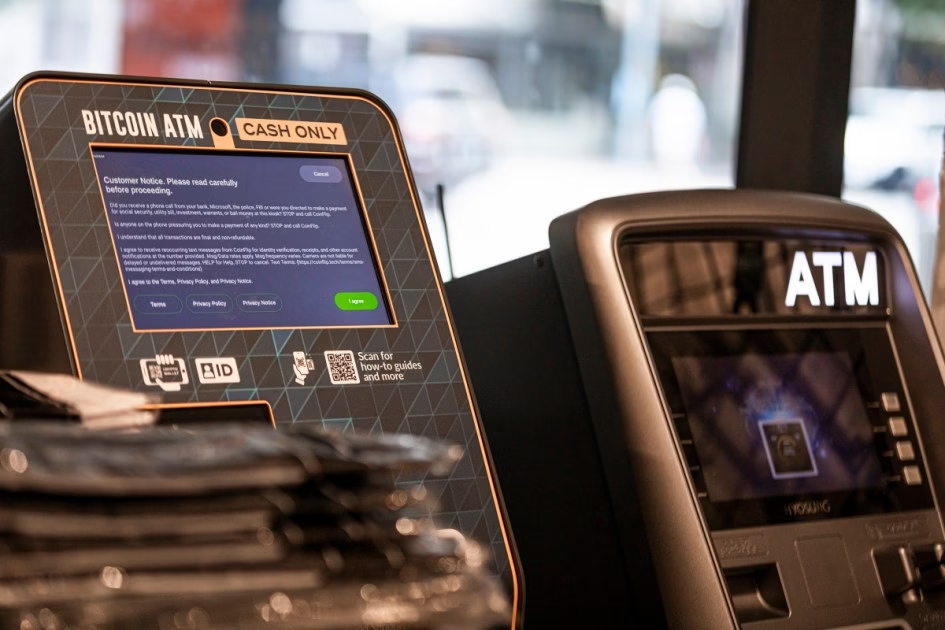
The FBI’s latest figures place Texas at the center of a rapidly growing fraud trend involving cryptocurrency kiosks, commonly known as crypto ATMs. These machines, typically located in convenience stores and gas stations, allow customers to exchange cash for digital assets.
According to the Texas Tribune, approximately 4,000 cryptocurrency kiosks operate across the state, making them widely accessible to both legitimate users and fraud victims.
Authorities told lawmakers that Crypto Kiosk Scams usually begin with scammers impersonating government agencies, financial institutions, or law enforcement officers. Victims are convinced that their savings are at immediate risk and instructed to withdraw cash before depositing it into a cryptocurrency kiosk.
Once the cryptocurrency is transferred to wallets controlled by criminals, recovering the funds becomes exceptionally difficult.
Rep. AJ Louderback described the effectiveness of the fraud schemes in stark terms during the committee hearing.
“In my career, I’ve never seen a more efficient, cleaner way to steal money.” — Rep. AJ Louderback, Texas House of Representatives
His remarks reflected growing concern among lawmakers that Crypto Kiosk Scams are expanding faster than existing consumer protection measures can address.
Witnesses appearing before the committee argued that the issue extends well beyond isolated fraud incidents.
Kelley Currie, a senior fellow at the Atlantic Council, told lawmakers that international law enforcement agencies increasingly view large-scale online fraud as a global criminal enterprise.
“Interpol now treats scamming as an industry comparable to drug and human trafficking.” — Kelley Currie, Senior Fellow, Atlantic Council
Currie also claimed that cryptocurrency kiosks found in gas stations “are run by Chinese money launderers.”
While the U.S. Department of Justice has prosecuted Chinese nationals connected to scam compounds in Southeast Asia and dismantled Chinese money laundering networks responsible for moving illicit cryptocurrency proceeds, it has not stated that such groups generally operate cryptocurrency kiosks.
Nevertheless, lawmakers said the testimony highlighted the international nature of Crypto Kiosk Scams, where stolen digital assets can move across multiple jurisdictions within minutes.
Officials from the Texas Department of Banking explained that victims rarely recover stolen funds because cryptocurrency transactions become increasingly difficult to trace after they leave the kiosk.
Deputy Commissioner Jesse Saucillo said criminals typically transfer funds into unhosted wallets before routing them through cryptocurrency mixers designed to obscure transaction histories.
“It gets into a mixer… very hard to get any of that back.” — Jesse Saucillo, Deputy Commissioner, Texas Department of Banking
Saucillo also warned lawmakers that artificial intelligence has made Crypto Kiosk Scams significantly more convincing. Criminals increasingly use AI-generated voices and realistic impersonations of police officers, government agencies, and financial institutions to pressure victims into making immediate payments.
These tactics, combined with the irreversible nature of blockchain transactions, have made the scams particularly difficult for investigators and financial regulators to combat.
The sharp increase in Crypto Kiosk Scams has prompted states across the country to tighten oversight of cryptocurrency kiosks.
According to AARP, nearly 30 states have enacted or introduced legislation regulating crypto kiosks since 2023.
South Dakota has imposed transaction limits of $1,000 per day and $10,000 per month while requiring operators to provide refunds to eligible fraud victims. Wisconsin and Virginia have adopted similar limits.
Earlier this year, Indiana became the first U.S. state to prohibit cryptocurrency kiosks outright, empowering the attorney general to pursue legal action against kiosk operators and businesses hosting the machines. Tennessee and Minnesota have since followed with similar bans.
Meanwhile, Maine’s financial regulator secured a $1.9 million settlement with Bitcoin Depot to reimburse victims affected by fraudulent kiosk transactions.
Texas lawmakers now appear ready to consider stronger measures.
Committee Chair Rep. Cole Hefner indicated that lawmakers may pursue legislation that goes beyond regulation.
“I got a pretty good idea coming down. And it’s kind of simple, but kind of abrupt.” — Rep. Cole Hefner, Chair, Texas House Committee on Homeland Security, Public Safety and Veterans’ Affairs
Although no bill has yet been introduced, the committee’s discussion suggests Texas could become the next state to significantly restrict or potentially ban cryptocurrency kiosks if lawmakers conclude that existing safeguards are insufficient to stem Crypto Kiosk Scams.



Copyright © 2025 - The Bit Gazette.