

- Trending
- Comments
- Latest

BitMEX courted British traders for years with front-page newspaper ads and sponsored trading contests, even after the Financial Conduct Authority warned in 2020 that it appeared to be operating without authorisation, an investigation by The Bureau of Investigative Journalism has found. BitMEX denies operating illegally in the UK, and the report reached no legal finding against it.
Founded in 2014 by Ben Delo and two co-founders, BitMEX became known for offering cryptocurrency derivatives that allowed traders to take positions worth substantially more than their initial deposits.
The exchange offered leverage of up to 100 times a customer’s stake, meaning a £100 position could provide exposure equivalent to £10,000. While leverage can amplify gains, it can also magnify losses when prices move against a trader.
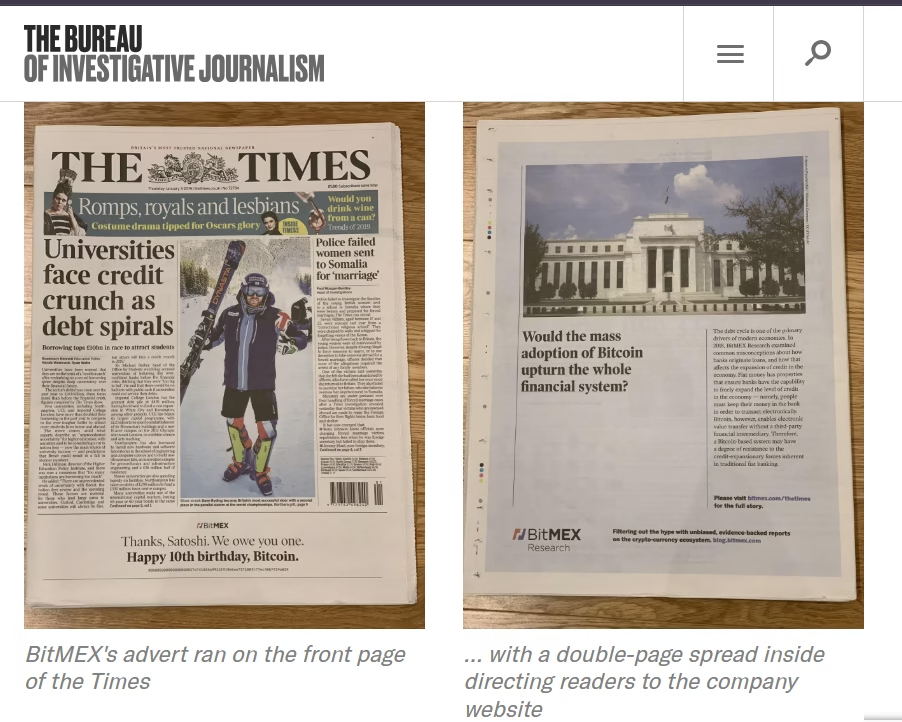
The investigation found that BitMEX promoted its services to British audiences through mainstream publications, including The Spectator and The Times, in 2018 and 2019.
One advertisement commemorating Bitcoin’s 10th anniversary appeared on the front page of The Times in January 2019. The Advertising Standards Authority subsequently upheld complaints that a related advertisement exaggerated potential investment returns and failed to illustrate the risks adequately.
The FCA had already raised concerns about the exchange’s activities. In March 2020, it warned consumers that BitMEX was unauthorised and appeared to be conducting regulated activities without the necessary permission.
The regulator stated: “Based upon information we hold, we believe it is carrying on regulated activities which require authorisation.”
That warning became central to subsequent questions about the BitMEX UK regulatory breach allegations, particularly because the investigation found evidence that British customers could continue accessing the exchange after the warning was issued.
The investigation also examined BitMEX-sponsored events in London, where participants were introduced to cryptocurrency trading through demonstrations, competitions and promotional incentives.
At least three London-based events were identified during 2025. One competition, called Battle of the Bots, presented trading as a contest involving real markets, live leaderboards and prizes.
Organisers sought more than 200 participants and advertised sign-up bonuses for new customers. Existing users could also receive matched-deposit incentives.
An attendee identified as Polina told the Bureau that the event attracted inexperienced participants.
“There wasn’t really a bar to clear before you could join the competition,” she said.
The investigation reported that attendees included students, beginners and intermediate traders. Some activities involved perpetual futures, financial products that allow traders to speculate on cryptocurrency prices without owning the underlying assets.
The events raised questions about whether BitMEX’s promotional activities were compatible with UK financial rules.
The regulatory framework is particularly important because the FCA prohibited firms under its jurisdiction from selling crypto derivatives to ordinary UK retail customers from January 2021. The rules were intended to address concerns about the complexity and risks of these products.
The alleged BitMEX UK regulatory breach is therefore not simply a question of whether British residents could access an offshore website. It also concerns whether the exchange actively solicited customers and promoted products in circumstances that required regulatory permission.
The investigation consulted former regulators, who said the evidence raised concerns about possible violations if no applicable authorisation or exemption existed.
However, the report did not establish a final legal determination that BitMEX had broken UK law.
BitMEX has denied allegations that it operated illegally in the UK. Responding to claims made in a separate High Court lawsuit, the company said: “We deny [the allegations] entirely and look forward to responding to them in the proper forum should the case be served.”
The case involves British software engineer Lewis Barber, who alleges that BitMEX provided him with cryptocurrency trading services between 2018 and 2022 without the authorisation required under UK law.
His solicitors say Barber believes he is among thousands of non-professional UK investors who suffered losses after being targeted by the exchange.
The investigation also identified accounts on online forums and review platforms belonging to people who reported UK connections. Some described continued trading after the FCA warning, while others complained about losses, withdrawal difficulties and account charges.
The scale of British participation remains unclear. However, statements submitted by BitMEX’s lawyers in a US court case indicated that five trading firms with deposits exceeding $260 million used UK companies or London-based traders.
These findings provide additional context for the continuing BitMEX UK regulatory breach concerns, although they do not establish how many British retail customers used the platform or whether every account violated applicable rules.
The investigation also examined the political activities of BitMEX co-founder Ben Delo, who has pledged £44 million to Reform UK, including a £36 million donation announced in September 2026, according to the report.
Delo previously pleaded guilty in the United States to wilfully failing to maintain an adequate anti-money-laundering programme at BitMEX. US President Donald Trump pardoned him in 2025.
There is no evidence presented in the investigation that Delo’s political donations were linked to specific decisions by Reform UK.
Nevertheless, the party has called for changes to the Financial Conduct Authority’s powers. Its Treasury spokesperson, Robert Jenrick, has said Reform would like to “curtail the scope of the FCA”.
The political dimension matters because the regulator is expected to assume wider responsibilities for cryptocurrency regulation in October 2027.
Meanwhile, consumer advocates continue to warn about the consequences of high-risk trading. GamCare, an organisation supporting people affected by gambling-related harm, said some individuals seeking help over cryptocurrency trading had reported losses of up to £50,000.
The investigation ultimately leaves several questions unanswered: whether BitMEX operated under an applicable exemption, whether the FCA took sufficient enforcement action, and how many British customers were exposed to the risks associated with its products.



Copyright © 2025 - The Bit Gazette.