
- Trending
- Comments
- Latest

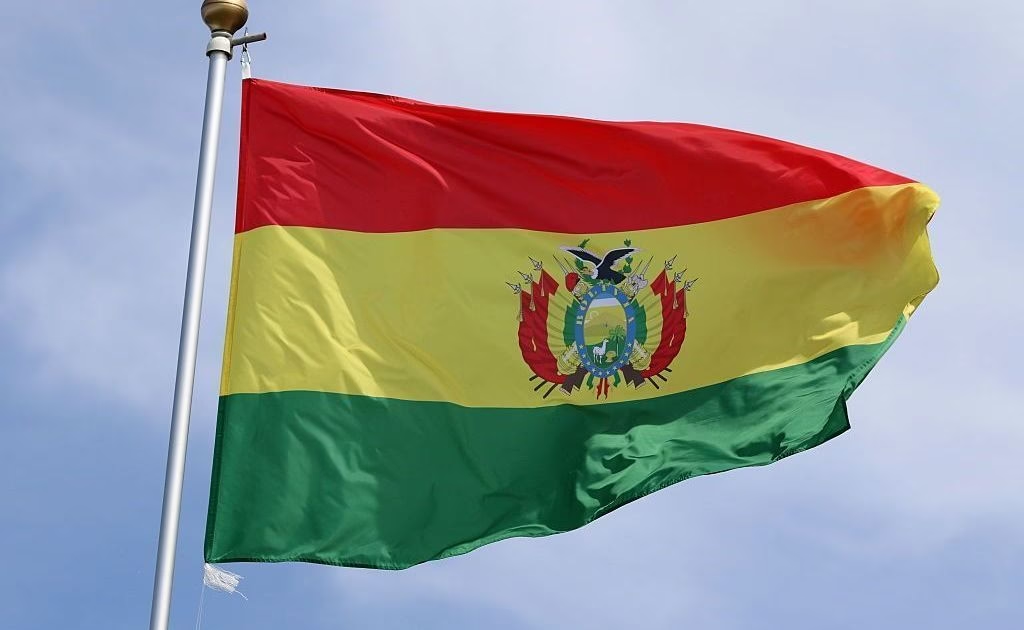
Bolivia has committed to tighter crypto regulation as part of a $1.9 billion, 36-month IMF reform program, as the country grapples with dollar shortages, rising stablecoin use and concerns over illicit capital outflows.
The commitment was included in Bolivia’s Sept. 10 Memorandum of Economic and Financial Policies and forms part of a broader effort to strengthen financial supervision, foreign-exchange controls and anti-money-laundering measures.
However, authorities have yet to disclose the regulator that would oversee virtual assets, the precise rules that will apply or a timetable for implementation.
At the center of the new Bolivia crypto regulation plans is the government’s intention to establish what its policy memorandum describes as a “robust” framework for regulating and supervising virtual assets.
The proposal comes as Bolivia faces significant pressure on its foreign-currency reserves and financial system. The country has experienced shortages of U.S. dollars, increasing demand for dollar-linked alternatives and wider economic reforms designed to stabilize its external position.
The government has not said whether crypto exchanges or other virtual-asset service providers would require licenses, whether transactions would face additional reporting requirements or whether stablecoin conversions would be subject to specific restrictions.
Authorities have also not clarified whether the framework would require new legislation, an executive decree or administrative rules. That uncertainty leaves market participants without a clear picture of how compliance requirements could eventually affect crypto businesses and users.
The broader IMF-supported program is valued at approximately $1.9 billion over 36 months and is designed to rebuild international reserves, reduce fiscal and external vulnerabilities and modernize monetary and exchange-rate frameworks. (
The push for Bolivia crypto regulation comes as USDT has gained greater visibility in the country during a period of dollar scarcity.
Residents and businesses have increasingly turned toward dollar-denominated digital assets as conventional access to U.S. currency has become more difficult.
Tether CEO Paolo Ardoino said in August that USDT adoption was increasing in Bolivia and other economies experiencing monetary instability.
Bolivia’s central bank has also published a reference exchange rate for USDT based on weighted peer-to-peer trading activity on Binance.
According to Chainalysis data cited by crypto.news, Bolivia recorded an estimated $14.8 billion in crypto activity between July 2022 and June 2025.
Officials have considered allowing the stablecoin to operate within the national payments system alongside the boliviano and U.S. dollar.
A proposal reported in July would have allowed USDT to become a payment option, while Banco Unión and Banco FIE were already providing services associated with the stablecoin. Final implementation rules had not been published at the time.
The new Bolivia crypto regulation initiative is not an isolated cryptocurrency measure. It sits within a broader IMF-backed reform agenda covering fiscal policy, foreign exchange, international reserves, banking supervision and anti-money-laundering controls.
The IMF said its July agreement with Bolivia would strengthen monitoring of banking and system-wide risks, improve financial-sector resilience and enhance coordination between government agencies.
The agreement remains subject to approval by the IMF Executive Board and implementation of agreed prior actions. The IMF has previously argued that countries need comprehensive crypto policies to address risks involving financial stability, consumer protection, market integrity and capital flows.
In a 2025 briefing, IMF communications director Julie Kozack said crypto assets can create risks in these areas and that countries should establish strong policy frameworks to manage them.
The IMF’s earlier assessment of Bolivia also called for stronger oversight of virtual assets, including monitoring banks’ exposure to crypto businesses, regulating providers and improving consumer protection.
The assessment noted that Bolivia had lifted its previous restrictions on virtual assets in June 2024 following a recommendation from the Financial Action Task Force of Latin America.
Anti-money-laundering requirements are another major factor shaping Bolivia crypto regulation. Bolivia remains under increased monitoring by the Financial Action Task Force, commonly known as the FATF grey list.
The country committed in June 2025 to work with FATF and the Financial Action Task Force of Latin America to address weaknesses in its anti-money-laundering and counter-terrorist-financing systems.
In its June 2026 review, FATF acknowledged progress but identified additional measures Bolivia needed to complete, including stronger risk-based supervision, enforcement of beneficial-ownership requirements and increased money-laundering investigations and prosecutions.
The organization’s standards also require jurisdictions to identify and address money-laundering and terrorist-financing risks associated with virtual assets.
As a result, Bolivia crypto regulation is likely to develop alongside the country’s broader efforts to improve financial transparency and compliance.
For exchanges, stablecoin providers and other crypto businesses, future rules could determine how transactions are reported, how service providers are supervised and how digital assets interact with Bolivia’s foreign-exchange system.
The government has not announced a specific implementation date, named a primary virtual-asset regulator or published detailed licensing and reporting requirements.
Investors and crypto businesses will therefore need to monitor subsequent legislation and regulatory announcements before determining the practical impact of the proposed framework.



Copyright © 2025 - The Bit Gazette.