

- Trending
- Comments
- Latest

Three members of the Canadian Armed Forces are among seven men arrested after a crypto exchange owner was allegedly abducted at gunpoint in Toronto, Toronto police said on October 14, 2026.
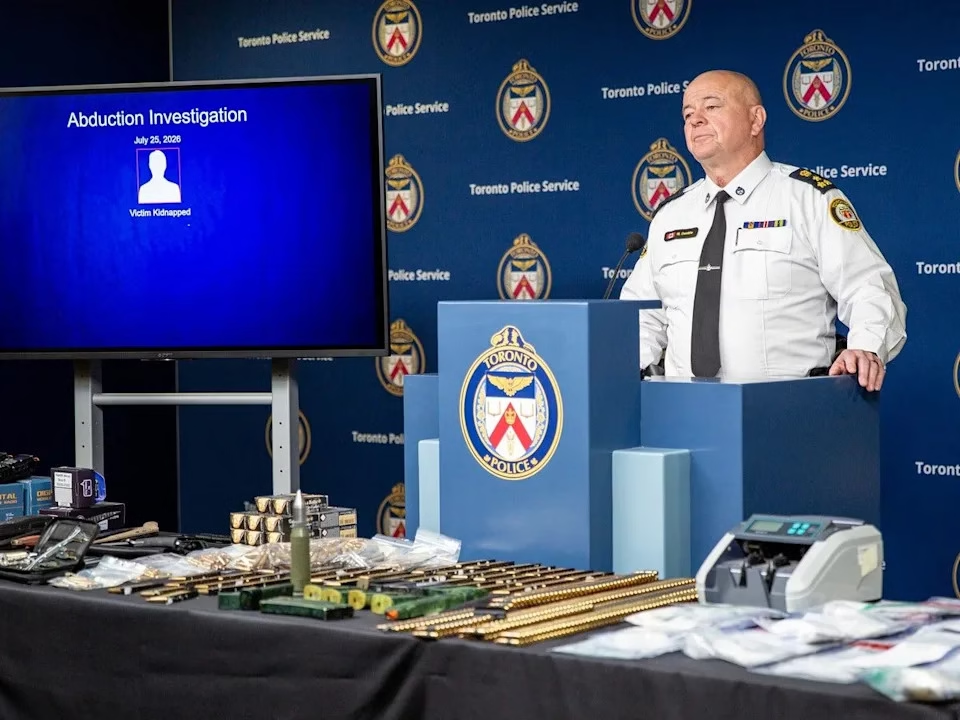
Police laid 82 charges and say they seized four firearms, two silencers and about 2,700 rounds of ammunition, some of it allegedly stolen from the military.
Investigators say the incident occurred on July 25 in the Finch Avenue East and Bayview Avenue area of Toronto. The victim, described in police reporting as a cryptocurrency exchange owner, was allegedly approached while heading towards a vehicle before being abducted at gunpoint.
According to the police account, the victim was handcuffed and assaulted during the incident. The suspects allegedly attempted to gain access to the victim’s cryptocurrency holdings and business-related security systems before releasing him with a warning not to contact law enforcement.
According to Toronto police, the three military members named in the investigation are Talarambage Fernando, James Moreau and Jack Miley. Authorities allege that they were part of a group of seven individuals involved in the incident.
The suspects have been accused of serious offences, and the allegations remain subject to the judicial process.
Police Chief Myron Demkiw described the circumstances surrounding the alleged attack as particularly troubling because of the training associated with military service.
Toronto police said the investigation began with efforts to identify those responsible for the abduction. Within 24 hours, investigators reportedly identified a vehicle believed to have been used in the incident and arrested two suspects.
Further inquiries led to additional arrests in August and late September. By September 24, all seven accused had been arrested and charged, according to the police service.
The case subsequently expanded beyond the original kidnapping allegations. Search warrants executed at properties and vehicles across the Greater Toronto Area led to the recovery of firearms, ammunition, suspected controlled substances and other items that investigators considered relevant to the wider inquiry.
Police have not publicly identified the victim in the report. The allegations against the accused must be assessed through the Canadian judicial process, and an arrest or charge does not establish guilt.
The investigation took a broader turn after police uncovered a cache of weapons and other suspected criminal material. Authorities reported seizing four firearms, including a shotgun and three 9mm firearms, as well as two silencers, ten over-capacity magazines and more than 2,700 rounds of ammunition.
Investigators also recovered methamphetamine, cocaine and other suspected controlled substances, alongside mobile phones, GPS tracking devices, handcuffs, radios, knives and other items.
Police said approximately 2,500 rounds of ammunition and five over-capacity magazines were allegedly stolen from the Canadian Armed Forces.
The discovery prompted investigators to examine potential connections between the abduction, firearms offences and suspected drug-related criminal activity. Chief Superintendent Joe Matthews said the inquiry had expanded as investigators followed the evidence.
Blockchain analytics firm Chainalysis reported that criminals stole more than $30 million from cryptocurrency holders through violent attacks during the first half of 2026.
These incidents are commonly known as “wrench attacks,” a term used to describe situations in which criminals use threats, physical violence or kidnapping to force victims to surrender digital assets.
For cryptocurrency investors, the Toronto investigation underlines an important distinction: securing digital assets requires more than choosing a strong password or storing recovery phrases safely.
Investors must also consider how their public profile, personal information and spending habits might expose them to unwanted attention. One practical precaution is to avoid publicly disclosing the size of cryptocurrency holdings.
Posting wallet balances, discussing large investment gains or sharing identifiable details about asset storage arrangements may provide potential attackers with information they could exploit.
A compromised email address, leaked identity document or exposed home address can create risks that extend beyond online fraud. Strong account authentication, secure devices and careful handling of recovery phrases remain important, but these measures should form part of a wider security strategy.
The Crypto kidnapping plot further demonstrates why businesses operating in the digital-asset sector must take threats against employees, founders and customers seriously.
Companies can strengthen security awareness, restrict access to sensitive customer information and establish clear procedures for reporting suspicious approaches or threats.
However, no security measure can eliminate every risk, and individuals should avoid confronting suspected criminals themselves. Immediate threats or suspected physical surveillance should be reported to the appropriate authorities.
Toronto police said the investigation remained active, although officers were not seeking additional suspects at the time of their October 14 update.
The seven accused face charges that vary by individual and include kidnapping for ransom, forcible confinement, conspiracy, firearms offences and drug-related allegations.
The alleged Crypto kidnapping plot shows how criminals may seek to exploit the people behind the assets, making privacy, personal safety and law-enforcement cooperation increasingly important parts of cryptocurrency risk management.
As adoption grows and digital assets become more widely held, protecting investors will require attention to both online threats and the possibility of violence in the real world.



Copyright © 2025 - The Bit Gazette.