• Trending
  • Comments
  • Latest
AI People joins Dubai’s innovation one — Declares war on the forgetting of humanity

AI People joins Dubai’s Innovation One program: Declares war on the forgetting of humanity

07/22/2025 - Updated On 07/23/2025
FBI nabs Nigerian ‘tech queen’ Sapphire Egemasi in multi-million dollar fraud scheme

FBI arrests Nigerian ‘tech queen’ Sapphire Egemasi in $1.3M heist targeting U.S. government

06/05/2025 - Updated On 06/17/2025
Crypto investor and wife found dead in Dubai as police investigate possible link to digital assets

Crypto investor and wife found dead in Dubai as police investigate possible link to digital assets

11/08/2025
Polygon Discord Channel Hacked, Throws Crypto Community in Turmoil

Polygon Discord Channel Hacked, Throws Crypto Community in Turmoil

2
Bitcoin reclaims $107,000 as Iran-Israel ceasefire cools market tensions

Bitcoin reclaims $107,000 as Iran-Israel ceasefire cools market tensions

2

Hello world!

1
Trump to host exclusive gala dinner for Trump memecoin holders amid impeachment saga

Trump says he’ll review pardon for Samourai Wallet founder days before prison term

12/16/2025
Singapore Retail Crypto Market Enters New Phase of Stability and Confidence

StraitsX to bring Singapore dollar and US dollar stablecoins to Solana in 2026

12/16/2025
Wyoming Crypto Bank petition headlines a rapidly intensifying legal confrontation that could reshape how crypto banks access the U.S. financial system. Wyoming-chartered Custodia Bank has formally petitioned the full Tenth Circuit Court of Appeals to review the Federal Reserve’s denial of its master account, escalating a five-year fight with sweeping implications for federal power, state banking authority, and digital asset innovation. Wyoming Crypto Bank petition filings submitted on December 15 request an en banc review, asking all active judges on the Tenth Circuit to reconsider an October panel ruling that upheld the Fed’s decision. Custodia argues the panel misread federal law and endorsed a system that grants regional Federal Reserve Banks unchecked discretion over legally eligible state-chartered institutions. Wyoming Crypto Bank Petition Challenges Fed’s Master Account Authority At the heart of the Wyoming Crypto Bank petition is the Federal Reserve’s refusal to grant Custodia access to a master account—an essential gateway to core payment rails such as wire transfers and automated clearinghouse (ACH) services. Without it, Custodia says its Wyoming-issued charter is effectively rendered meaningless. Custodia contends the ruling conflicts directly with the Monetary Control Act (MCA), which states that Federal Reserve services shall be available to nonmember depository institutions. The bank argues the Fed has transformed that mandate into what it calls an unconstitutional veto over state banking decisions. When the Fed denies a master account to a state-chartered financial institution, it effectively vetoes a bank charter that State regulators have approved, Custodia wrote in its petition. State Banking Authority Under Threat The Wyoming Crypto Bank petition also raises serious federalism concerns. Wyoming chartered Custodia in 2020 as a Special Purpose Depository Institution (SPDI), a regulatory framework specifically designed to attract digital asset firms while minimizing systemic risk through 100% reserve backing and a prohibition on lending. Custodia argues the Fed’s rejection undermines Wyoming’s carefully constructed regulatory regime and erodes states’ constitutional authority to charter banks. The petition warns that allowing the Fed such power could discourage innovation-driven state banking models nationwide. Constitutional Red Flags in the Wyoming Crypto Bank Petition Beyond federalism, the Wyoming Crypto Bank petition pushes into constitutional territory. Custodia’s legal team argues that if regional Federal Reserve Bank presidents possess unreviewable discretion over master accounts, they effectively function as “Officers of the United States” without proper constitutional appointment. Federal Reserve Bank presidents are selected by private bank directors and approved by the Board of Governors. Custodia says that structure violates the Appointments Clause if those officials wield significant executive authority. Judicial Split Deepens Over Wyoming Crypto Bank Petition The petition highlights a growing divide within the Tenth Circuit itself. Judge Timothy Tymkovich’s dissent in Custodia’s case aligns with Judge Robert Bacharach’s earlier opinion in Fourth Corner Credit Union v. Federal Reserve Bank of Kansas City, creating a 2-2 split among circuit judges. Tymkovich warned that the Fed’s interpretation grants “unreviewable discretion” that contradicts the plain language of the MCA and raises “thorny questions” under Article II of the Constitution. Fed’s Own Records Undermine Denial Rationale The Wyoming Crypto Bank petition also points to contradictions within the Federal Reserve’s own process. The Kansas City Fed denied Custodia’s application in January 2023 after a 27-month review, citing risks tied to “crypto-asset activities.” Yet internal documents show Fed staff initially found Custodia’s capital levels “adequate” and praised its leadership as “impressive.” Custodia says the decision only shifted after intervention by the Board of Governors. Federal Reserve Governor Christopher Waller later acknowledged publicly that the Fed has sufficient supervisory tools to manage risk without blanket denials. In an October interview, Waller said the Fed can “tailor” master account structures to fit a bank’s specific risk profile. Wyoming Crypto Bank Petition Lands Amid Crypto Debanking Reckoning The Wyoming Crypto Bank petition arrives as regulators face mounting scrutiny over crypto debanking. In December, the Office of the Comptroller of the Currency revealed that all nine of the largest U.S. banks imposed “inappropriate” restrictions on lawful businesses, including digital asset firms, between 2020 and 2023. Institutions such as JPMorgan Chase, Bank of America, Citibank, and Wells Fargo maintained internal policies that escalated or restricted entire sectors, reinforcing claims of systemic exclusion. If the full Tenth Circuit agrees to hear the Wyoming Crypto Bank petition, the outcome could redefine the balance of power between state banking regulators and the Federal Reserve—setting a precedent that reaches far beyond Custodia and Wyoming. For the crypto industry, the case may determine whether compliance-focused digital asset banks can ever gain equal footing within the U.S. financial system.Wyoming Crypto Bank Petition Sparks High-Stakes Legal Showdown as Fed Power Faces Fierce Constitutional Test

Wyoming-chartered Custodia Bank challenges Federal Reserve’s master account veto power

12/16/2025
  • Trending
  • Comments
  • Latest
AI People joins Dubai’s innovation one — Declares war on the forgetting of humanity

AI People joins Dubai’s Innovation One program: Declares war on the forgetting of humanity

07/22/2025 - Updated On 07/23/2025
FBI nabs Nigerian ‘tech queen’ Sapphire Egemasi in multi-million dollar fraud scheme

FBI arrests Nigerian ‘tech queen’ Sapphire Egemasi in $1.3M heist targeting U.S. government

06/05/2025 - Updated On 06/17/2025
Crypto investor and wife found dead in Dubai as police investigate possible link to digital assets

Crypto investor and wife found dead in Dubai as police investigate possible link to digital assets

11/08/2025
Polygon Discord Channel Hacked, Throws Crypto Community in Turmoil

Polygon Discord Channel Hacked, Throws Crypto Community in Turmoil

2
Bitcoin reclaims $107,000 as Iran-Israel ceasefire cools market tensions

Bitcoin reclaims $107,000 as Iran-Israel ceasefire cools market tensions

2

Hello world!

1
Trump to host exclusive gala dinner for Trump memecoin holders amid impeachment saga

Trump says he’ll review pardon for Samourai Wallet founder days before prison term

12/16/2025
Singapore Retail Crypto Market Enters New Phase of Stability and Confidence

StraitsX to bring Singapore dollar and US dollar stablecoins to Solana in 2026

12/16/2025
Wyoming Crypto Bank petition headlines a rapidly intensifying legal confrontation that could reshape how crypto banks access the U.S. financial system. Wyoming-chartered Custodia Bank has formally petitioned the full Tenth Circuit Court of Appeals to review the Federal Reserve’s denial of its master account, escalating a five-year fight with sweeping implications for federal power, state banking authority, and digital asset innovation. Wyoming Crypto Bank petition filings submitted on December 15 request an en banc review, asking all active judges on the Tenth Circuit to reconsider an October panel ruling that upheld the Fed’s decision. Custodia argues the panel misread federal law and endorsed a system that grants regional Federal Reserve Banks unchecked discretion over legally eligible state-chartered institutions. Wyoming Crypto Bank Petition Challenges Fed’s Master Account Authority At the heart of the Wyoming Crypto Bank petition is the Federal Reserve’s refusal to grant Custodia access to a master account—an essential gateway to core payment rails such as wire transfers and automated clearinghouse (ACH) services. Without it, Custodia says its Wyoming-issued charter is effectively rendered meaningless. Custodia contends the ruling conflicts directly with the Monetary Control Act (MCA), which states that Federal Reserve services shall be available to nonmember depository institutions. The bank argues the Fed has transformed that mandate into what it calls an unconstitutional veto over state banking decisions. When the Fed denies a master account to a state-chartered financial institution, it effectively vetoes a bank charter that State regulators have approved, Custodia wrote in its petition. State Banking Authority Under Threat The Wyoming Crypto Bank petition also raises serious federalism concerns. Wyoming chartered Custodia in 2020 as a Special Purpose Depository Institution (SPDI), a regulatory framework specifically designed to attract digital asset firms while minimizing systemic risk through 100% reserve backing and a prohibition on lending. Custodia argues the Fed’s rejection undermines Wyoming’s carefully constructed regulatory regime and erodes states’ constitutional authority to charter banks. The petition warns that allowing the Fed such power could discourage innovation-driven state banking models nationwide. Constitutional Red Flags in the Wyoming Crypto Bank Petition Beyond federalism, the Wyoming Crypto Bank petition pushes into constitutional territory. Custodia’s legal team argues that if regional Federal Reserve Bank presidents possess unreviewable discretion over master accounts, they effectively function as “Officers of the United States” without proper constitutional appointment. Federal Reserve Bank presidents are selected by private bank directors and approved by the Board of Governors. Custodia says that structure violates the Appointments Clause if those officials wield significant executive authority. Judicial Split Deepens Over Wyoming Crypto Bank Petition The petition highlights a growing divide within the Tenth Circuit itself. Judge Timothy Tymkovich’s dissent in Custodia’s case aligns with Judge Robert Bacharach’s earlier opinion in Fourth Corner Credit Union v. Federal Reserve Bank of Kansas City, creating a 2-2 split among circuit judges. Tymkovich warned that the Fed’s interpretation grants “unreviewable discretion” that contradicts the plain language of the MCA and raises “thorny questions” under Article II of the Constitution. Fed’s Own Records Undermine Denial Rationale The Wyoming Crypto Bank petition also points to contradictions within the Federal Reserve’s own process. The Kansas City Fed denied Custodia’s application in January 2023 after a 27-month review, citing risks tied to “crypto-asset activities.” Yet internal documents show Fed staff initially found Custodia’s capital levels “adequate” and praised its leadership as “impressive.” Custodia says the decision only shifted after intervention by the Board of Governors. Federal Reserve Governor Christopher Waller later acknowledged publicly that the Fed has sufficient supervisory tools to manage risk without blanket denials. In an October interview, Waller said the Fed can “tailor” master account structures to fit a bank’s specific risk profile. Wyoming Crypto Bank Petition Lands Amid Crypto Debanking Reckoning The Wyoming Crypto Bank petition arrives as regulators face mounting scrutiny over crypto debanking. In December, the Office of the Comptroller of the Currency revealed that all nine of the largest U.S. banks imposed “inappropriate” restrictions on lawful businesses, including digital asset firms, between 2020 and 2023. Institutions such as JPMorgan Chase, Bank of America, Citibank, and Wells Fargo maintained internal policies that escalated or restricted entire sectors, reinforcing claims of systemic exclusion. If the full Tenth Circuit agrees to hear the Wyoming Crypto Bank petition, the outcome could redefine the balance of power between state banking regulators and the Federal Reserve—setting a precedent that reaches far beyond Custodia and Wyoming. For the crypto industry, the case may determine whether compliance-focused digital asset banks can ever gain equal footing within the U.S. financial system.Wyoming Crypto Bank Petition Sparks High-Stakes Legal Showdown as Fed Power Faces Fierce Constitutional Test

Wyoming-chartered Custodia Bank challenges Federal Reserve’s master account veto power

12/16/2025
Tuesday, December 16, 2025
  • Login
The Bit Gazette
  • Home
  • Crypto News
  • Expert Analysis
  • Finance
  • Tech
  • Sponsored
  • Press Release
  • Opinion
No Result
View All Result
The Bit Gazette
No Result
View All Result
Home Crypto News

Asset managers rush to file crypto ETFs as SEC shutdown delays approvals

Despite the U.S. government shutdown halting regulatory approvals, asset managers are racing to file innovative crypto ETFs aimed at staking and yield-driven investors.

by Victor Ohagwasi
2 months ago
in Crypto News
Reading Time: 3 mins read
0
Ether ETF Weekly Inflows Surpass Bitcoin Amid Trump's Trade War
Share on FacebookShare on Twitter

A wave of new crypto ETFs filed  by asset managers with the Securities and Exchange Commission this week, betting on an eventual approval surge once the federal government shutdown ends and regulators resume reviews.

The most notable filing came from VanEck, which proposed a staked Ethereum ETF tracking Lido’s stETH token—a structure that would allow investors to earn approximately 3.3% annual yield while maintaining liquidity. The filing blitz, which includes leveraged products from 21Shares and yield-generating Bitcoin strategies from ARK Invest, reflects growing institutional confidence that the SEC will greenlight more complex crypto products beyond basic spot ETFs once operations resume.
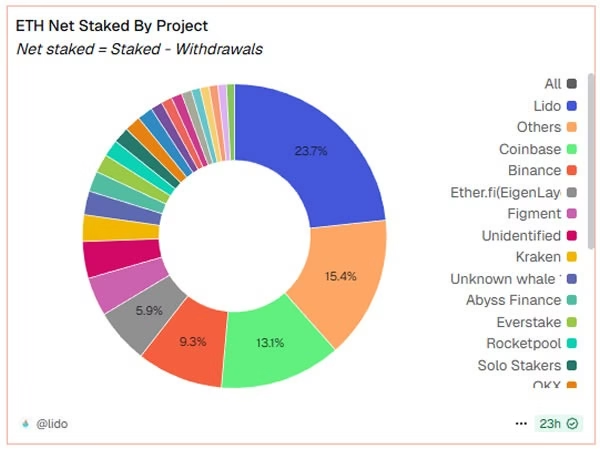
Lido has the lion’s share of staked Ether. Source: Dune Analytics

Innovation race as new crypto ETFs filed

Beyond VanEck, the week saw an array of crypto ETFs filed by other issuers experimenting with complex structures and new forms of exposure.

21Shares submitted a proposal for a 2x leveraged ETF linked to the Hyperliquid (HYPE) token, giving investors double the daily performance of the asset. The leveraged exposure, however, only applies to single-day returns as a structure designed for high-frequency traders rather than long-term holders.

This one’s so niche… but then you could look up in three or four years and it’s got a few billion, noted Eric Balchunas, senior ETF analyst at Bloomberg, describing the current environment as a total land rush.

That “land rush” captures the intensity of competition among issuers who are not waiting for formal approval to innovate. Many are strategically submitting applications now to gain priority when the SEC reopens.

ARK Invest broadens its Bitcoin ETF strategy

Also joining the filing wave, ARK Invest led by Cathie Wood introduced three new Bitcoin ETFs that merge yield, derivatives, and protection strategies.

The ARK Bitcoin Yield ETF aims to generate returns by writing options and collecting premiums on Bitcoin (BTC) holdings. Meanwhile, the ARK DIET Bitcoin 1 ETF and ARK DIET Bitcoin 2 ETF offer varying levels of downside protection (50% and 10%, respectively) while allowing for upside participation when Bitcoin prices rise.

VanEck also updated its Solana Staking ETF proposal, cutting management fees to 0.3%. This adjustment aligns with growing investor demand for Solana (SOL) staking exposure, reflecting the market’s appetite for diversified yield products within blockchain ecosystems.

Earlier in the week, Volatility Shares submitted filings for new leveraged ETFs offering 3x and 5x exposure to both crypto and traditional equity indices expanding the intersection between digital and conventional markets.

Shutdown stalls SEC reviews, but optimism builds

Although the SEC’s review process remains frozen, analysts believe the current flood of crypto ETFs filed represents a calculated bet on timing.

Once the government shutdown ends, spot crypto ETF floodgates open, said Nate Geraci, president of The ETF Store. It’s ironic that political gridlock and rising fiscal debt at the very things crypto aims to counter are what’s holding these products back.

Industry researchers agree that the filings illustrate increasing institutional faith in tokenized assets. This is a bet on the future of yield-based crypto exposure, said Tom McLoughlin, head of digital assets research at Bitwise Investments. Issuers aren’t waiting for permission as they’re preparing for inevitability.

The bigger picture: staking, yield, and the next ETF wave

Even as Washington remains at a standstill, issuers’ actions point toward an accelerating convergence between decentralized finance (DeFi) and regulated investment vehicles.

The latest crypto ETFs filed show how fund managers are leveraging on-chain staking, synthetic exposure, and derivatives to expand investor access beyond traditional spot Bitcoin or Ethereum products.

VanEck’s proposed staked Ethereum ETF built on the success of Lido’s liquid staking infrastructure could pioneer a new asset class where blockchain yield meets mainstream finance. For institutional investors, these filings suggest that once the SEC reopens, the next wave of approvals could finally bridge DeFi and Wall Street.


Tags: blockchainCrypto ETFsCryptocurrencydigital assetsexchange-traded fundsinstitutional adoptioninvestment innovationliquid staking boomproof-of-stake assetsregulatory filingsVanEckyield generation
Share197Tweet123
Victor Ohagwasi

Victor Ohagwasi

Helping Busy Founders, Startups & Creatives Tell Their Stories — Visually, Verbally & Virtually | Growth Hacker | Content Strategist | Ghostwriter | Digital Marketer | Helping Brands Rank Higher & Speak Louder

  • Trending
  • Comments
  • Latest
AI People joins Dubai’s innovation one — Declares war on the forgetting of humanity

AI People joins Dubai’s Innovation One program: Declares war on the forgetting of humanity

07/22/2025 - Updated On 07/23/2025
FBI nabs Nigerian ‘tech queen’ Sapphire Egemasi in multi-million dollar fraud scheme

FBI arrests Nigerian ‘tech queen’ Sapphire Egemasi in $1.3M heist targeting U.S. government

06/05/2025 - Updated On 06/17/2025
Crypto investor and wife found dead in Dubai as police investigate possible link to digital assets

Crypto investor and wife found dead in Dubai as police investigate possible link to digital assets

11/08/2025
Polygon Discord Channel Hacked, Throws Crypto Community in Turmoil

Polygon Discord Channel Hacked, Throws Crypto Community in Turmoil

2
Bitcoin reclaims $107,000 as Iran-Israel ceasefire cools market tensions

Bitcoin reclaims $107,000 as Iran-Israel ceasefire cools market tensions

2

Hello world!

1
Trump to host exclusive gala dinner for Trump memecoin holders amid impeachment saga

Trump says he’ll review pardon for Samourai Wallet founder days before prison term

12/16/2025
Singapore Retail Crypto Market Enters New Phase of Stability and Confidence

StraitsX to bring Singapore dollar and US dollar stablecoins to Solana in 2026

12/16/2025
Wyoming Crypto Bank petition headlines a rapidly intensifying legal confrontation that could reshape how crypto banks access the U.S. financial system. Wyoming-chartered Custodia Bank has formally petitioned the full Tenth Circuit Court of Appeals to review the Federal Reserve’s denial of its master account, escalating a five-year fight with sweeping implications for federal power, state banking authority, and digital asset innovation. Wyoming Crypto Bank petition filings submitted on December 15 request an en banc review, asking all active judges on the Tenth Circuit to reconsider an October panel ruling that upheld the Fed’s decision. Custodia argues the panel misread federal law and endorsed a system that grants regional Federal Reserve Banks unchecked discretion over legally eligible state-chartered institutions. Wyoming Crypto Bank Petition Challenges Fed’s Master Account Authority At the heart of the Wyoming Crypto Bank petition is the Federal Reserve’s refusal to grant Custodia access to a master account—an essential gateway to core payment rails such as wire transfers and automated clearinghouse (ACH) services. Without it, Custodia says its Wyoming-issued charter is effectively rendered meaningless. Custodia contends the ruling conflicts directly with the Monetary Control Act (MCA), which states that Federal Reserve services shall be available to nonmember depository institutions. The bank argues the Fed has transformed that mandate into what it calls an unconstitutional veto over state banking decisions. When the Fed denies a master account to a state-chartered financial institution, it effectively vetoes a bank charter that State regulators have approved, Custodia wrote in its petition. State Banking Authority Under Threat The Wyoming Crypto Bank petition also raises serious federalism concerns. Wyoming chartered Custodia in 2020 as a Special Purpose Depository Institution (SPDI), a regulatory framework specifically designed to attract digital asset firms while minimizing systemic risk through 100% reserve backing and a prohibition on lending. Custodia argues the Fed’s rejection undermines Wyoming’s carefully constructed regulatory regime and erodes states’ constitutional authority to charter banks. The petition warns that allowing the Fed such power could discourage innovation-driven state banking models nationwide. Constitutional Red Flags in the Wyoming Crypto Bank Petition Beyond federalism, the Wyoming Crypto Bank petition pushes into constitutional territory. Custodia’s legal team argues that if regional Federal Reserve Bank presidents possess unreviewable discretion over master accounts, they effectively function as “Officers of the United States” without proper constitutional appointment. Federal Reserve Bank presidents are selected by private bank directors and approved by the Board of Governors. Custodia says that structure violates the Appointments Clause if those officials wield significant executive authority. Judicial Split Deepens Over Wyoming Crypto Bank Petition The petition highlights a growing divide within the Tenth Circuit itself. Judge Timothy Tymkovich’s dissent in Custodia’s case aligns with Judge Robert Bacharach’s earlier opinion in Fourth Corner Credit Union v. Federal Reserve Bank of Kansas City, creating a 2-2 split among circuit judges. Tymkovich warned that the Fed’s interpretation grants “unreviewable discretion” that contradicts the plain language of the MCA and raises “thorny questions” under Article II of the Constitution. Fed’s Own Records Undermine Denial Rationale The Wyoming Crypto Bank petition also points to contradictions within the Federal Reserve’s own process. The Kansas City Fed denied Custodia’s application in January 2023 after a 27-month review, citing risks tied to “crypto-asset activities.” Yet internal documents show Fed staff initially found Custodia’s capital levels “adequate” and praised its leadership as “impressive.” Custodia says the decision only shifted after intervention by the Board of Governors. Federal Reserve Governor Christopher Waller later acknowledged publicly that the Fed has sufficient supervisory tools to manage risk without blanket denials. In an October interview, Waller said the Fed can “tailor” master account structures to fit a bank’s specific risk profile. Wyoming Crypto Bank Petition Lands Amid Crypto Debanking Reckoning The Wyoming Crypto Bank petition arrives as regulators face mounting scrutiny over crypto debanking. In December, the Office of the Comptroller of the Currency revealed that all nine of the largest U.S. banks imposed “inappropriate” restrictions on lawful businesses, including digital asset firms, between 2020 and 2023. Institutions such as JPMorgan Chase, Bank of America, Citibank, and Wells Fargo maintained internal policies that escalated or restricted entire sectors, reinforcing claims of systemic exclusion. If the full Tenth Circuit agrees to hear the Wyoming Crypto Bank petition, the outcome could redefine the balance of power between state banking regulators and the Federal Reserve—setting a precedent that reaches far beyond Custodia and Wyoming. For the crypto industry, the case may determine whether compliance-focused digital asset banks can ever gain equal footing within the U.S. financial system.Wyoming Crypto Bank Petition Sparks High-Stakes Legal Showdown as Fed Power Faces Fierce Constitutional Test

Wyoming-chartered Custodia Bank challenges Federal Reserve’s master account veto power

12/16/2025
No Result
View All Result
  • Home
  • Crypto News
  • Expert Analysis
  • Finance
  • Tech
  • Sponsored
  • Press Release
  • Opinion

Copyright © 2025 - The Bit Gazette.

Are you sure want to unlock this post?
Unlock left : 0
Are you sure want to cancel subscription?