








- Trending
- Comments
- Latest

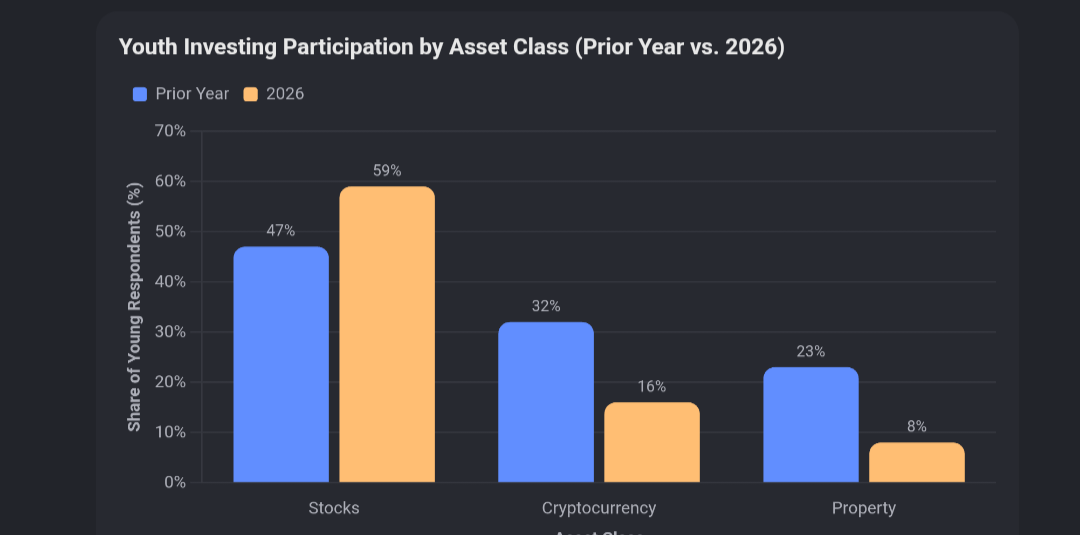
Crypto ownership among young people in Ireland has halved in a year, falling from 32% to 16%, while stock investing rose from 47% to 59%, a Bank of Ireland survey has found.
The Youth Mind and Money Research 2026, published on November 20, surveyed 526 people aged 13 to 30.
The survey identified a significant change in how young Irish investors allocate their money, with cryptocurrency losing popularity while traditional equity investments attract greater interest.
According to the findings, Crypto Asset participation declined from 32% in 2025 to 16% in 2026. Property investment also recorded a substantial drop, falling from 23% to just 8% over the same period.
By comparison, stocks emerged as the most popular investment option among respondents, with participation increasing from 47% to 59%.
The findings indicate that younger investors are increasingly favouring conventional financial instruments over cryptocurrencies and property, although the survey does not establish the specific reasons behind every investment decision.
Conall Mac Coille, chief economist at Bank of Ireland, described the changing preferences as one of the most notable findings.
“A striking feature of this youth survey is a move away from crypto assets, with participation more than halving from last year to this year,” Mac Coille said.
Despite the decline, the research found that interest in investing remains relatively strong. Some 56% of respondents said investing was an area of interest to them, suggesting that reduced cryptocurrency participation does not necessarily reflect a broader rejection of financial markets.
Although interest in investing is growing, the survey highlighted a considerable gap between curiosity and financial confidence.
Only 30% of respondents said they felt confident in their understanding of investment products, while 69% identified the possibility of losing money as a reason for not investing.
Concerns appear particularly pronounced around cryptocurrency. The research found that 82% of respondents agreed that investing in cryptocurrencies could result in losing a substantial amount, or even all, of their money.
Mac Coille also highlighted differences in investment behaviour between young men and women, particularly regarding exposure to online investment advice and cryptocurrency-related opportunities.
“Young males appear to be more at risk of falling foul of ‘get rich quick’ schemes – they are more likely to seek investment advice online and three times more likely to have invested in cryptocurrencies than females,” he said.
The findings raise questions about the quality of financial information available to younger investors, particularly as social media and online platforms increasingly influence investment decisions.
Four in 10 respondents said they had sought investment advice online or through social media rather than consulting professional financial advisers.
Beyond cryptocurrency participation, the survey highlighted the continued importance of saving among young people in Ireland.
Approximately 73% of respondents said they regularly set money aside, while 84% described saving as very important to them. Another 90% agreed that saving money offers considerable benefits.
However, Bank of Ireland believes the country’s strong savings culture has yet to translate into equally strong investment confidence.
“Ireland may be a country of savers, but we still have a lot of work to do to become more mature investors,” Mac Coille said.
He also pointed to the planned rollout of new Investment Accounts in 2027, arguing that financial education will be important as more opportunities to participate in investment markets become available.
“Cognisant of the rollout of the new Investment Accounts next year, the survey highlights the role for educating Irish savers on investing. The room for improvement is clear – less than one in three indicated they felt confident in their understanding of investment products and half would be more likely to invest with better access and understanding of investment products,” he added.
The research was conducted by Ipsos B&A among 526 respondents aged between 13 and 30.
While the decline in Crypto Asset participation marks a notable shift in the investment behaviour of young Irish people, the broader findings suggest that financial education, access to reliable advice and greater understanding of investment risks could play an important role in shaping their future decisions.



Copyright © 2025 - The Bit Gazette.

