- Trending
- Comments
- Latest

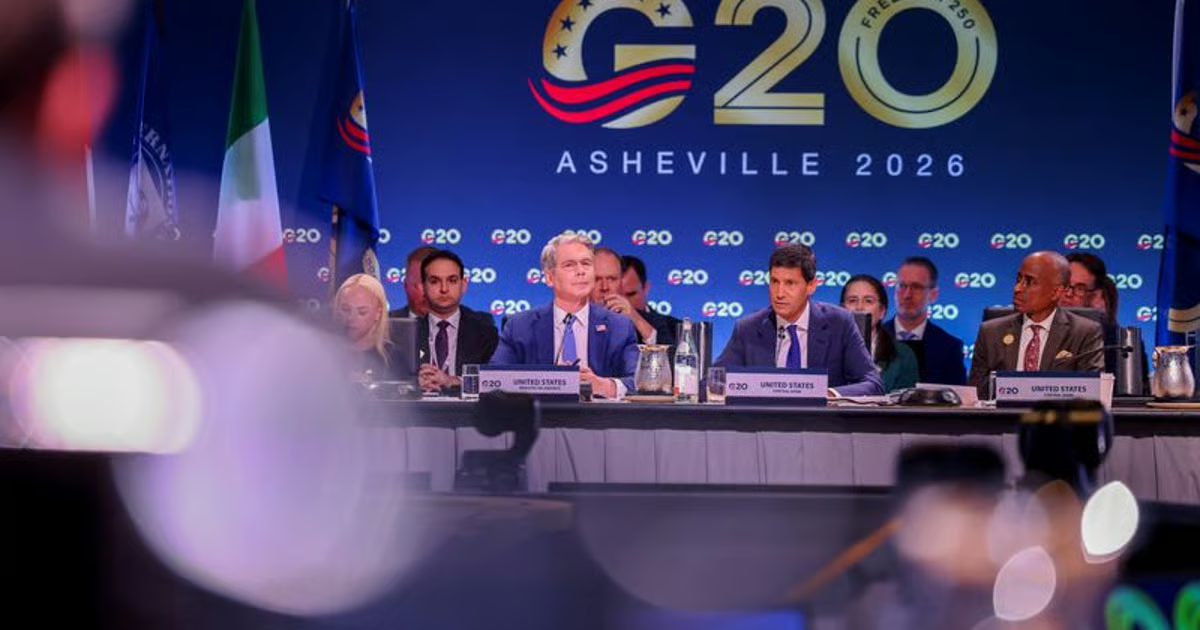
G20 finance ministers and central bank governors have endorsed a push for clearer regulatory and supervisory frameworks for digital assets following their August 31–September 1 meeting in Asheville, North Carolina.
The commitment, contained in the G20 Chair’s Statement issued by the U.S. Treasury, seeks to give digital finance a more defined regulatory path without compromising financial stability, monetary trust or the integrity of global payment systems.
However, the statement stops short of creating a single global crypto rulebook. Instead, individual jurisdictions are expected to develop appropriate frameworks while taking account of opportunities and risks that cross national borders.
The latest G20 position reflects a growing recognition that digital assets could contribute to economic expansion and private-sector innovation.
At the same time, policymakers remain concerned about the potential for crypto markets to transmit risks into the wider financial system.
That balance has shaped international crypto policy for several years. The Financial Stability Board, acting under a G20 mandate, has developed recommendations calling for comprehensive oversight of crypto-asset activities and service providers.
Its framework is based on the principle of “same activity, same risk, same regulation,” meaning similar financial activities should face comparable regulatory treatment regardless of the technology used.
The G20’s latest statement therefore does not represent a wholesale relaxation of crypto regulation. Instead, it points toward frameworks intended to provide greater certainty while ensuring that exchanges, issuers, stablecoin operators and other market participants remain subject to appropriate oversight.
For investors, clearer rules could eventually reduce some of the regulatory uncertainty that has affected digital asset businesses operating across multiple jurisdictions.
At the same time, stronger supervision could increase compliance costs for companies that have previously operated in less-regulated environments.
Stablecoins received particular attention in the G20 statement because of their growing potential role in payments and their increasingly close relationship with the traditional financial system.
The G20 said it was awaiting further findings from the Financial Stability Board concerning the cross-border implications of global stablecoin arrangements, as well as issues involving stablecoin data sources and availability.
The issue matters because stablecoins can move value across borders without relying entirely on traditional banking payment infrastructure.
Their expanding use could make them increasingly important to international commerce, remittances and financial settlement, but it also creates questions around reserves, redemption, consumer protection and regulatory jurisdiction.
The FSB has previously warned that stablecoins can create particular financial stability concerns because of their structure and potential interconnectedness with the broader financial system.
Its global framework therefore calls for effective regulation and supervision proportionate to the risks posed by these arrangements.
The latest G20 position does not introduce a universal stablecoin licensing regime. Instead, it signals that regulators will continue working toward greater international consistency while allowing individual countries to maintain their own legal frameworks.
A global consensus on basic principles could make it easier for legitimate stablecoin businesses to operate internationally, but differences between national regimes are likely to remain.
The G20 also connected its digital asset agenda with its long-running effort to improve cross-border payments.
Finance ministers and central bank governors reaffirmed their support for the G20 Roadmap for Enhancing Cross-border Payments.
They called on countries to pursue longer operating hours for large-value payment systems, promote the use of the ISO 20022 data model and facilitate cross-border transmission of financial services information while respecting domestic laws and data-security requirements.
The development of payment infrastructure could become increasingly relevant to digital assets, particularly stablecoins and tokenized financial products.
For the crypto industry, faster and more interoperable payment systems could create opportunities for digital assets to compete in areas traditionally dominated by banks and payment companies.
However, regulators are likely to demand greater transparency and controls as these networks become more closely integrated with conventional financial infrastructure.
The FSB’s previous implementation review illustrates the challenge. While most jurisdictions have either introduced or planned crypto and stablecoin regulatory frameworks, the organization has warned that inconsistent implementation can create regulatory arbitrage and weaken the effectiveness of international standards.
The G20’s approach also places significant emphasis on preventing digital assets from being used for money laundering, terrorism financing and other forms of illicit finance.
The Chair’s Statement called for countries with significant virtual asset activity to prioritize implementation of Financial Action Task Force standards. It also backed risk-based supervision and highlighted emerging threats involving fraud, scam operations and the misuse of artificial intelligence by criminals.
This means the push for clearer G20 digital asset rules is likely to involve more than licensing and market access.
Compliance requirements, transaction monitoring, customer identification and information sharing are expected to remain important components of the regulatory environment.
The direction is consistent with the G20’s previous position. In 2023, G20 leaders supported effective regulatory and supervisory frameworks for virtual assets, particularly in relation to money laundering, terrorism financing and proliferation-financing risks.
The immediate effect of the G20 announcement is unlikely to be a sudden change in crypto prices or market access. The more important development is the direction of global policymaking.
The G20 has effectively signaled that digital assets should have a place within the regulated financial system, provided that innovation does not undermine financial stability or trust in monetary and payment infrastructure.
It may also increase pressure on offshore operators, opaque stablecoin arrangements and businesses that rely on regulatory gaps between jurisdictions.
The FSB’s work reinforces that trend. Its 2025 review found progress in implementing the global crypto framework but also identified significant gaps and inconsistencies between jurisdictions.
The organization warned that uneven implementation can create opportunities for regulatory arbitrage.
For investors, the key issue is therefore not simply whether regulation becomes more favorable. It is whether regulations become sufficiently consistent to allow legitimate digital asset businesses to operate across borders without creating new systemic risks.
The G20 is expected to continue the discussion at its next finance ministers and central bank governors meeting in Bangkok on October 15, before the U.S. presidency culminates in the G20 Leaders’ Summit in December.
The next stage will determine whether the latest commitment develops into concrete regulatory coordination or remains primarily a policy statement.
Ultimately, the G20 has not created a single global crypto framework. It has, however, reinforced the idea that digital assets are now firmly part of the international financial policy conversation.
The success of the initiative will depend on whether member countries can turn that shared direction into practical, coordinated rules.



Copyright © 2025 - The Bit Gazette.