




- Trending
- Comments
- Latest

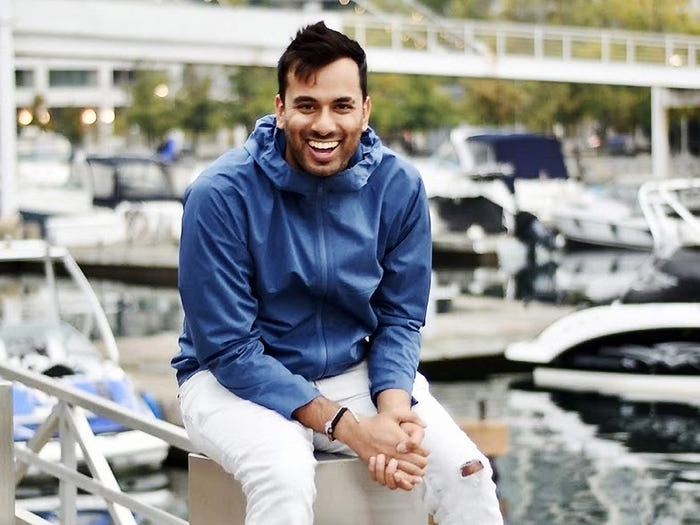
Software engineer Akshay Sapra has made and lost more than C$2 million day trading stocks and options since 2018, including over $350,000 wiped out in a single week of SpaceX bets in July 2026, he told Business Insider.
Sapra said those early experiences left him with a persistent scarcity mindset.
“My parents’ scarcity mindset shaped my relationship with money, even after we got out of poverty,” — Akshay Sapra, speaking to Business Insider.
His childhood was also marked by his mother’s battle with a brain tumour and bullying at school. Those experiences, he said, contributed to the emotional pressures that later affected his relationship with money and risk.
His first exposure to stock trading came in 2017, when he was a university student. A friend suggested marijuana stocks, arguing that legalization in Canada could create an opportunity.
Sapra bought the shares. Although the stocks rose, he made relatively little because he repeatedly bought and sold positions in an attempt to predict short-term price movements.
He eventually came to describe himself as having “paper hands” because he struggled to hold investments for the long term. Trading addiction was already becoming a pattern as he began trading from his laptop during university lectures and found it increasingly difficult to stop.
After graduating, Sapra secured a software engineering job in 2018. At first, his trading activity was relatively limited. He sometimes checked his positions while at work, including during trips to the washroom.
That changed after a bet on Meta. While the company was releasing earnings, Sapra placed a wager that its stock would fall. The company performed poorly, and the trade generated a substantial profit.
The experience reinforced the emotional reward he associated with trading.
Over the following four years, his finances repeatedly swung between gains and losses. He eventually left his software engineering job and spent his days delivering for Uber while continuing to trade stocks.
Sapra also developed software capable of trading cryptocurrency automatically. The technology meant his market activity no longer depended entirely on his own manual decisions. He was not only trading; he was building technology around the process.
His trading addiction eventually became serious enough for him to enter a three-week gambling addiction programme. During treatment, he was denied access to his phone, but his cryptocurrency trading bot continued operating.
“I eventually went to a three-week gambling addiction program for my stock trading habit, without access to my phone. Ironically, my bot continued to trade,” — Akshay Sapra, speaking to Business Insider.
The experience did not end his market activity. Sapra later acknowledged that other patients had predicted he would return to trading after treatment, and he eventually did.
The episode illustrates how trading addiction can extend beyond the act of manually buying and selling assets. In Sapra’s case, automated software allowed the activity to continue even when he was physically separated from his devices.
After the failed addiction programme, Sapra used money earned from Uber, as well as lines of credit and loans, to make increasingly large trades.
He said he generated more than C$1.7 million through trades involving companies including AMD and Nvidia.
But his financial target kept changing.
Sapra initially believed C$500,000 would be enough to leave his job, buy a home and continue trading. Once he approached C$2 million, however, that amount no longer seemed sufficient. Taxes and Canada’s expensive housing market became part of his calculations, pushing his financial goal higher.
As the target moved, the size of his trades increased as well.
Sapra said he sometimes traded for as many as 16 hours a day, often from an iPhone while lying in bed. On some days, he could make $15,000 with little apparent effort.
The gains, however, proved difficult to preserve.
By the end of 2025, Sapra said he had lost almost all of his previous gains after an investment in Beyond Meat collapsed, costing him nearly $200,000.
Rather than treating the loss as a reason to stop, he viewed it as money that needed to be recovered. He decided he needed to make another C$400,000 to compensate for the setback.
That response became another part of the trading addiction cycle: losses increased the pressure to generate new gains, while the pursuit of those gains exposed him to still larger losses.
Sapra subsequently reported losing more than $350,000 in stock market gains after investing in SpaceX.
Sapra described SpaceX as his favourite company, citing its scientific mission and ambition to make humanity interplanetary.
When SpaceX joined the Nasdaq 100, he expected billions of dollars in buying pressure to push the stock higher. He therefore made a large bet, purchasing thousands of shares and call options for July 7, the day after the inclusion.
The trade moved in the opposite direction.
Sapra said SpaceX fell from $158.92 at market open to $149.47, leaving him with a loss of more than $200,000.
He then changed direction, purchasing 2,200 put options, which are contracts that can benefit from a decline in the underlying stock. The strategy produced further losses and contributed to more than $350,000 in losses on SpaceX trades within a week.
Sapra later bought additional put options that generated more than $300,000. But as the stock continued to fall, a series of subsequent trades quickly erased those gains.
Over roughly a month, he said he had lost, recovered and then lost more than $300,000 through SpaceX-related bets.
Despite those losses, Sapra does not intend to leave the market. Instead, he plans to start a YouTube channel where he will publicly document his trades, hoping that transparency will provide a form of accountability.
“There’s a skill involved with what I do, but it veers into gambling territory far too often,” — Akshay Sapra, speaking to Business Insider.
His account highlights the difficult boundary between high-risk trading and gambling when financial losses lead to increasingly aggressive attempts to recover money.
For Sapra, trading addiction has evolved from an interest that began during university into an activity that has affected his career, finances and daily routine. Even after entering an addiction treatment programme, developing automated trading software and suffering substantial losses, he remains active in the markets.
His decision to publicly record future trades may provide greater accountability, but it also underscores the unresolved nature of the trading addiction cycle he describes.
Rather than viewing each loss as a signal to step away, Sapra has repeatedly treated losses as amounts that must be recovered through further trading. That pattern has produced periods of substantial gains, followed by equally significant setbacks.
The story ultimately raises a broader question about where disciplined investing ends and compulsive risk-taking begins. In Sapra’s case, the distinction has become increasingly difficult to maintain, with trading addiction continuing to influence how he approaches money, markets and financial risk.
Source: Money Control



Copyright © 2025 - The Bit Gazette.