

- Trending
- Comments
- Latest

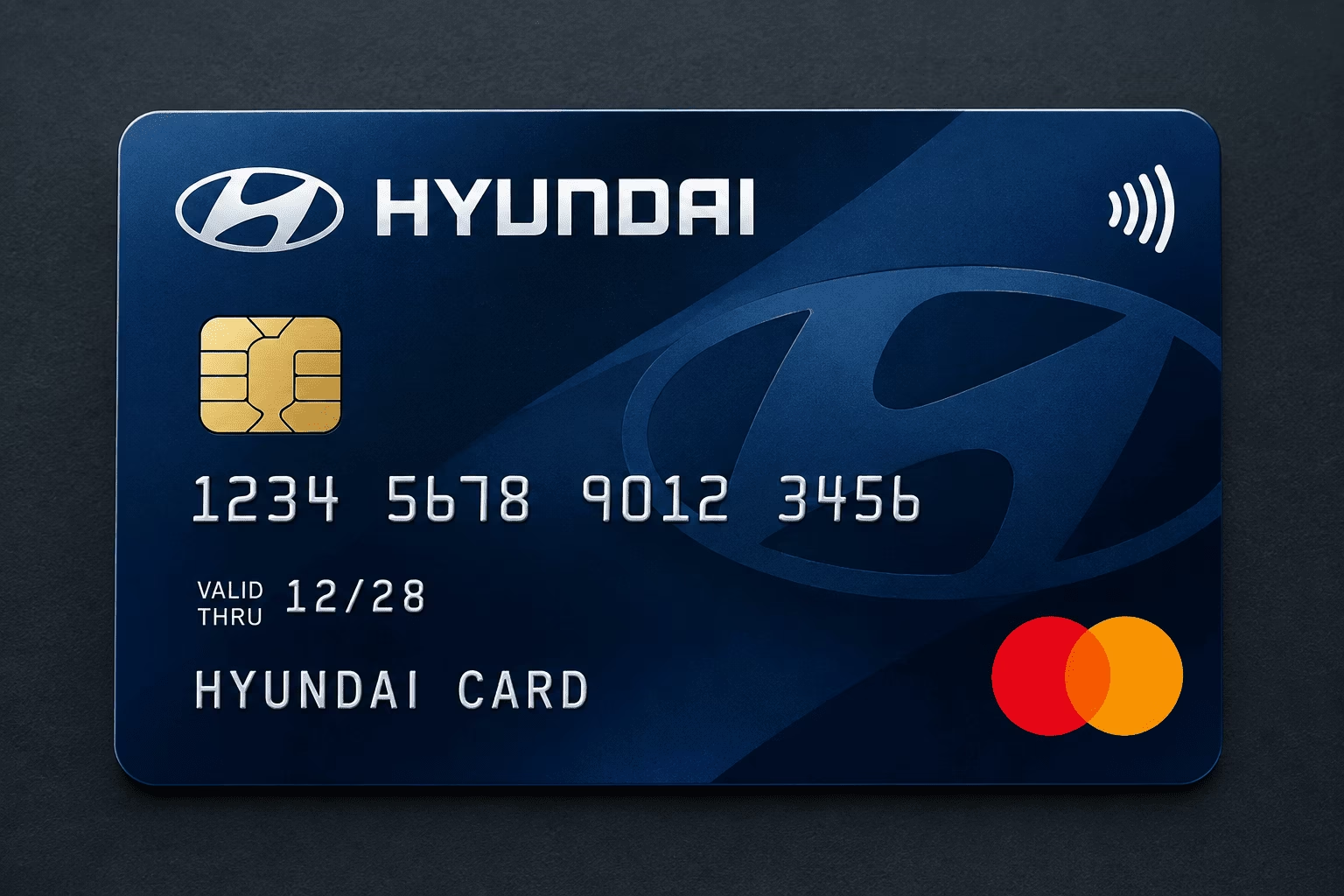
Hyundai Card says its stablecoin payments pilot now faces a harder test: proving the model works at scale, not just that it works at all. The comment from Heejung Nam, the company’s head of payments and business development, follows a live $20,000 USDT transfer between Hyundai Motor America and Hyundai Motor Mexico that took about seven minutes to complete.
The latest development came from Avalanche on Sept. 16, when Heejung Nam, head of payments and business development at Hyundai Card, outlined the next challenge for the project.
“We have to prove the entire operation model works at scale,” Nam said. She added: “What happens if we can scale up? Then the economic model works.”
The comments mark an important change in focus. The initial proof of concept established that stablecoins could be used for an actual intercompany transfer. The next phase will have to determine whether the same infrastructure can handle substantially greater transaction volumes, operational complexity and treasury requirements.
There is still no announced date for a group-wide rollout, however. The latest statement does not confirm that Hyundai Motor Group has approved routine stablecoin use across its global operations.
The original pilot involved real corporate funds rather than a simulated blockchain transaction.
Hyundai Motor America converted $20,000 into USDT, the dollar-pegged stablecoin issued by Tether. The tokens were then transferred through Avalanche to Hyundai Motor Mexico, where the funds were converted back into U.S. dollars.
According to Hyundai Card, the entire process, including the transfer and verification stages, took around seven minutes. The company compared that result with conventional international bank transfers, which it said generally require three to four hours or longer. That comparison reflects the specific process measured during the pilot rather than a universal benchmark for every international bank transaction.
The significance of the experiment went beyond transaction speed.
Hyundai Card led the regulatory and operational preparation, including reviews involving accounting, taxation, legal requirements and internal controls. It also designed the structure of the remittance process and determined the roles of the participants.
Tether supplied USDT, while Avalanche provided the blockchain network used for the transfer. Axiym, a blockchain payments infrastructure provider, also participated in the pilot.
A company spokesperson previously emphasized that the test was connected to an actual settlement requirement between Hyundai Motor’s overseas entities rather than being conducted solely as a theoretical blockchain demonstration.
That distinction matters for corporate adoption. A blockchain transaction can demonstrate that tokens move successfully, but an enterprise payment system must also account for compliance, accounting treatment, taxation, controls, liquidity and reconciliation.
The latest comments suggest the project is moving toward a harder test: proving that the model remains practical when transaction volumes increase.
A seven-minute transfer involving $20,000 demonstrates that the technical process can work. It does not, by itself, establish that the same system will deliver attractive economics when used for much larger or more frequent corporate settlements.
That is why Nam’s comments put particular emphasis on scalability and the economic model. The company needs to determine whether the benefits of blockchain-based settlement remain meaningful after accounting for liquidity, conversion costs, compliance procedures and the infrastructure required to operate the system continuously.
The issue is especially relevant for a multinational group with corporate entities operating across different jurisdictions. Increasing transaction volume can introduce additional requirements around foreign exchange, liquidity management, internal controls and regulatory reporting.
Hyundai Card’s original July announcement said the company wanted to explore stablecoins for international remittances, settlements and payments between overseas Hyundai Motor entities.
That means the current experiment is better viewed as part of a broader infrastructure study than as the immediate launch of a new commercial payment product.
The original roadmap also included a second proof of concept involving Hyundai Motor entities in Europe.
Unlike the U.S.-Mexico experiment, which used dollars at both ends of the transaction, the European test was designed to examine transfers involving different local currencies. Circle and Visa were expected to participate in that phase, with the objective of examining issues including foreign-exchange costs and the economics of stablecoin-based transfers.
That makes the European experiment potentially more demanding than the first test because cross-currency settlement introduces another layer of complexity.
As of Sept. 17, however, there has been no public confirmation in the latest available Hyundai Card materials that the European pilot has been completed. The newest development instead centers on scaling the operating model following the successful initial proof of concept.
For now, Hyundai Card remains in testing mode. The company has demonstrated a real-world USDT transfer between Hyundai Motor entities, but it has not announced a timetable for full commercial deployment or group-wide adoption.
The next milestone is therefore less about proving that a stablecoin can move money and more about determining whether the entire corporate payment operation can reliably support larger volumes.
If the model passes that test, stablecoins could move another step closer to becoming part of mainstream multinational treasury infrastructure. If it does not, the $20,000 transfer will remain what it currently is: a successful proof of concept rather than a confirmed production system.
For now, the company’s message is clear: the technology has been tested in the real world, and the next question is whether the economics and operating model can survive at scale.



Copyright © 2025 - The Bit Gazette.