

- Trending
- Comments
- Latest

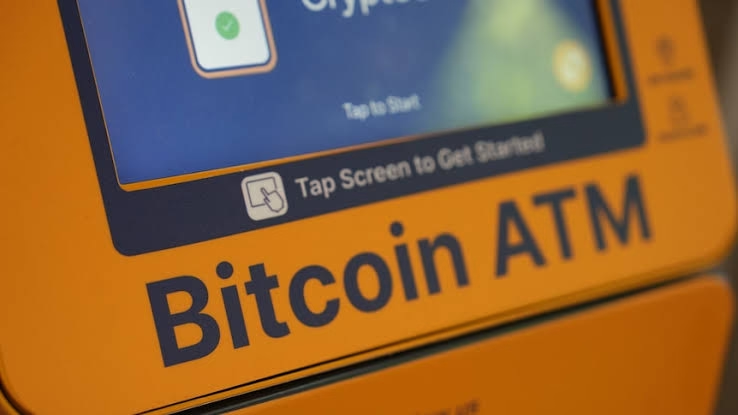
Star, Idaho, has banned crypto ATMs within city limits, and neighboring Kuna is weighing the same move, as scammers posing as police officers drain victims through the kiosks. Thirty victims in Meridian alone lost $1.3 million between January and July 2026, according to the Treasure Valley Partnership.
The figures have prompted local authorities to examine the role cryptocurrency ATMs can play in fraudulent transactions and to encourage residents to recognize common warning signs before sending money.
A Crypto ATM scam can involve a fraudster posing as a police officer or other law enforcement official and telling a victim that an arrest warrant has been issued. The victim is then instructed to use a cryptocurrency ATM to make a payment, often under pressure or the threat of immediate legal consequences.
Once cryptocurrency is transferred to the scammer’s digital wallet, recovering the funds can be extremely difficult.
The scale of the reported losses has continued to grow across several Treasure Valley communities. In Eagle, Star, Kuna and unincorporated Ada County, cryptocurrency scam losses totaled $486,000 in 2025, according to the information released by local agencies and the Treasure Valley Partnership.
For 2026, losses in those areas had already reached $406,000 by September. The figures underscore the financial impact of cryptocurrency fraud while highlighting concerns about transactions that can be difficult to reverse.
The Meridian figures provide another indication of the financial damage associated with the Crypto ATM scam trend. Thirty reported victims lost $1.3 million during the first seven months of 2026, according to the Treasure Valley Partnership.
Local governments are responding to the reported Crypto ATM scam cases with regulatory measures aimed at limiting access to the machines used in some fraudulent transactions.
Star Mayor Trevor Chadwick recently adopted an ordinance banning cryptocurrency ATMs within city limits. The move represents one of the clearest steps taken by a Treasure Valley municipality to address concerns surrounding cryptocurrency kiosks.
The ordinance follows increased attention from local agencies and officials as reported fraud cases accumulate across the region. Rather than focusing solely on public warnings, the city has moved toward restricting the machines themselves.
The action in Star also comes as neighboring Kuna considers its own response to cryptocurrency kiosks and the problems associated with fraudulent transfers.
Kuna Mayor Joe Stear has also been working on measures addressing cryptocurrency kiosks. According to the information provided by the city, the effort could ultimately lead to Kuna “prohibiting the machines within city limits” because of concerns surrounding their use in fraudulent transactions.
Stear cited the machines’ “repeated use in fraud and the difficulty of recovering money once funds are transferred to a scammer’s digital wallet.” — Joe Stear, Kuna mayor
The comments point to two concerns facing local officials: how frequently cryptocurrency kiosks are associated with reported fraud and what happens after victims complete a transaction.
Unlike some traditional financial transactions, cryptocurrency transfers generally cannot simply be reversed after funds have reached another wallet. That characteristic can make recovery particularly challenging when a victim has been deceived into voluntarily transferring assets.
For residents, the development means a Crypto ATM scam may involve more than an unsolicited request for cryptocurrency. Fraudsters can combine impersonation, urgency and threats of legal action to persuade victims to make payments before they have time to verify the claims.
The response to the Crypto ATM scam problem is unfolding across multiple levels of the Treasure Valley. The City of Caldwell, Caldwell Police Department and Treasure Valley Partnership have used public communications to raise awareness of cryptocurrency fraud and highlight the financial losses reported in the region.
The agencies’ efforts come as local governments consider whether restrictions on cryptocurrency ATMs can reduce opportunities for fraud. In Star, officials have already adopted a ban, while Kuna is evaluating similar action.
The reported cases also demonstrate why authorities are emphasizing caution around demands for cryptocurrency payments. A legitimate law enforcement agency would not ordinarily require someone to resolve an arrest warrant by sending cryptocurrency through an ATM, and residents who receive such demands face a heightened risk of a Crypto ATM scam.
The losses reported in Meridian and across Ada County show the potential financial consequences when victims follow fraudulent instructions. The $1.3 million reported lost by Meridian victims between January and July, combined with hundreds of thousands of dollars in losses elsewhere in the county, has placed cryptocurrency fraud firmly on the agenda for local officials.
As municipalities consider restrictions and agencies continue public education efforts, the Crypto ATM scam remains a concern for residents using or encountering cryptocurrency kiosks. The debate now extends beyond individual cases to questions about whether restricting the machines can help prevent fraud and reduce losses.
For Treasure Valley authorities, the immediate focus remains awareness and prevention as reported cryptocurrency fraud continues to affect residents. With Star already banning cryptocurrency ATMs and Kuna considering a similar prohibition, local governments are taking different steps to address the challenges surrounding cryptocurrency kiosks and the Crypto ATM scam cases linked to them.
The developments also illustrate the broader difficulty of recovering cryptocurrency once it has been transferred to a scammer. For victims and authorities alike, preventing a fraudulent transaction before funds leave a victim’s control can be significantly more straightforward than attempting to recover cryptocurrency afterward.



Copyright © 2025 - The Bit Gazette.