

- Trending
- Comments
- Latest

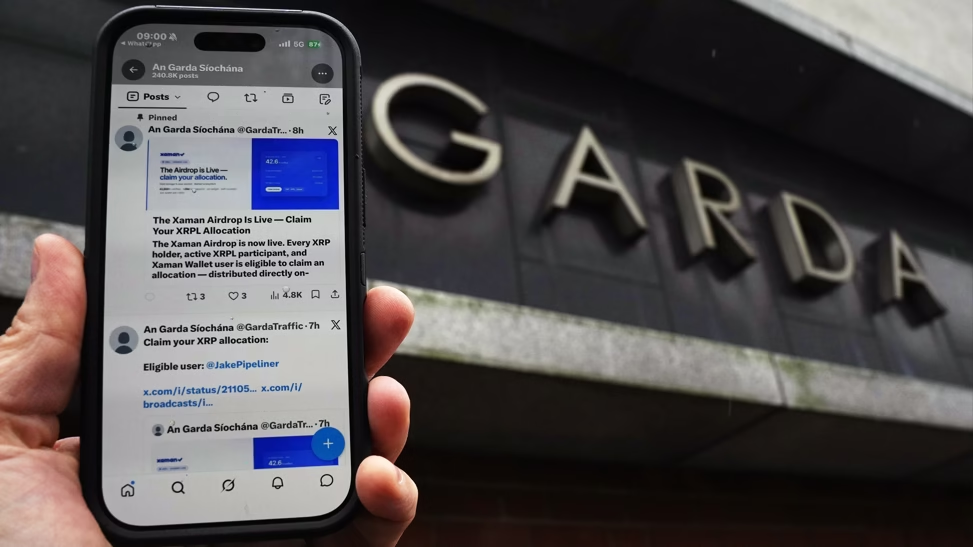
The attackers relied on the reputation of Ireland’s national police force to make the fraudulent cryptocurrency promotion appear credible. By publishing posts through established official accounts, they could reach hundreds of thousands of followers without having to build an audience from scratch.
The scale of the incident was particularly significant because both compromised profiles served public information functions. Their combined audience exceeded 900,000 followers, creating an opportunity for the attackers to distribute misleading messages to people who might ordinarily trust communications published through official police channels.
The posts promoted a Fake XRP airdrop, suggesting that users could receive cryptocurrency allocations. Such offers are a recurring feature of cryptocurrency fraud, where criminals use the promise of free digital assets to persuade people to visit external websites, connect their wallets or approve transactions.
The involvement of links associated with Xaman added another layer of concern. While the wallet provider confirmed that the advertised allocations were fraudulent, the appearance of a recognizable cryptocurrency service in a promotional message could make it harder for inexperienced users to distinguish a legitimate service from an impersonation or malicious website.
The incident also highlights a broader security problem: the credibility of a social media account can be exploited even when the organization behind it has not suffered a wider network intrusion.
A Fake XRP airdrop advertised through an official government account may appear more trustworthy than an unsolicited message from an unknown profile. However, the account’s apparent legitimacy does not establish that the offer itself is genuine.
Following the discovery, An Garda Síochána clarified that the compromise was limited to the X platform. The force reported no evidence that its internal police systems or data had been accessed without authorization.
This distinction is important because a compromised social media profile does not automatically mean that an organization’s internal network has also been breached. Nevertheless, attackers who gain control of an official account can misuse its established reputation, publish misleading information and potentially expose followers to financial losses.
The police urged the public not to engage with the affected accounts and cautioned users about impersonator profiles that might attempt to exploit the incident.
X is cooperating with investigators as authorities seek to determine how the attackers obtained access and what steps may be necessary to prevent similar incidents.
The available information does not establish how the accounts were compromised, whether any followers lost money or whether the attackers obtained information beyond their access to the profiles. Those questions remain important to understanding the incident’s full impact.
The Fake XRP airdrop campaign therefore presents two separate concerns: the security of official social media accounts and the financial risks faced by users who trust the messages published through them.
While the absence of evidence of an internal systems breach offers some reassurance, it does not eliminate the potential consequences of the fraudulent posts.
Airdrop scams typically promise free tokens to attract users into interacting with fraudulent websites or cryptocurrency transactions. Depending on the method employed, victims may be asked to connect a digital wallet, disclose sensitive information or approve blockchain transactions that transfer control of their assets.
Some malicious websites imitate legitimate cryptocurrency platforms, while other scams use the names and branding of established projects to create a false impression of authenticity. Once a victim authorizes a harmful transaction or exposes sensitive credentials, recovering the affected assets may be difficult or impossible.
The Irish police incident illustrates how criminals can extend these tactics beyond the cryptocurrency industry by hijacking accounts belonging to public institutions. Instead of relying solely on impersonated exchanges or token projects, attackers can use an institution’s existing audience and reputation to increase the apparent legitimacy of a fraudulent offer.
For users, the Fake XRP airdrop incident reinforces the importance of independently verifying cryptocurrency promotions before taking action. A post appearing on a verified or widely followed account should not automatically be treated as proof that a giveaway is genuine, particularly when it asks users to connect a wallet or approve a transaction.
Users should also avoid clicking unfamiliar links, sharing recovery phrases or private keys, and authorizing transactions they do not fully understand. Cryptocurrency wallet providers and public institutions can help limit harm by issuing timely warnings and communicating through alternative official channels when an account is compromised.
Organizations, meanwhile, face the challenge of securing accounts that serve as important public communication channels. Strong authentication, restricted account access and effective incident-response procedures can help reduce the likelihood and impact of unauthorized access.
The investigation into the Irish police account breach remains ongoing, with X cooperating with authorities. The full consequences of the campaign have yet to be established, but the incident demonstrates how cybercriminals can exploit trusted public profiles to spread cryptocurrency fraud.
As the investigation progresses, the Fake XRP airdrop serves as a reminder that users must verify the authenticity of digital asset offers independently, even when the messages appear to come from familiar and reputable institutions.



Copyright © 2025 - The Bit Gazette.