








- Trending
- Comments
- Latest

The median crypto seed round has climbed above $5 million in 2026 even as the number of seed deals fell about 40%, according to CryptoRank data published on November 17.
The shift reflects the disappearance of smaller early-stage rounds, with CryptoRank counting 143 seed rounds through October and about $920 million in disclosed seed capital.
The current slowdown becomes clearer when compared with the previous funding cycle. The 2022 bull market marked the peak for both the number of seed transactions and the amount of capital invested in early-stage cryptocurrency businesses.
Although investment activity declined after that period, disclosed funding remained relatively resilient through 2025, even as the number of deals contracted.
That trend changed in 2026. Disclosed seed capital dropped to approximately $920 million, while the number of funding rounds with publicly available amounts returned close to levels last recorded in 2020.
Despite the decline in activity, the amount of capital raised remained more than twice the nominal figure recorded in 2020.
CryptoRank identified 143 seed rounds through October, with the slowdown becoming apparent during the first half of the year and intensifying after June.
Importantly, the proportion of transactions with disclosed funding amounts remained relatively stable. Approximately nine out of every 10 rounds reported their funding figures in both 2025 and 2026. This suggests that reduced disclosure was not responsible for the decline in recorded activity.
The report also noted that transactions below $5 million accounted for roughly two-thirds of the reduction in disclosed deal count. Meanwhile, larger financings worth at least $20 million remained broadly stable.
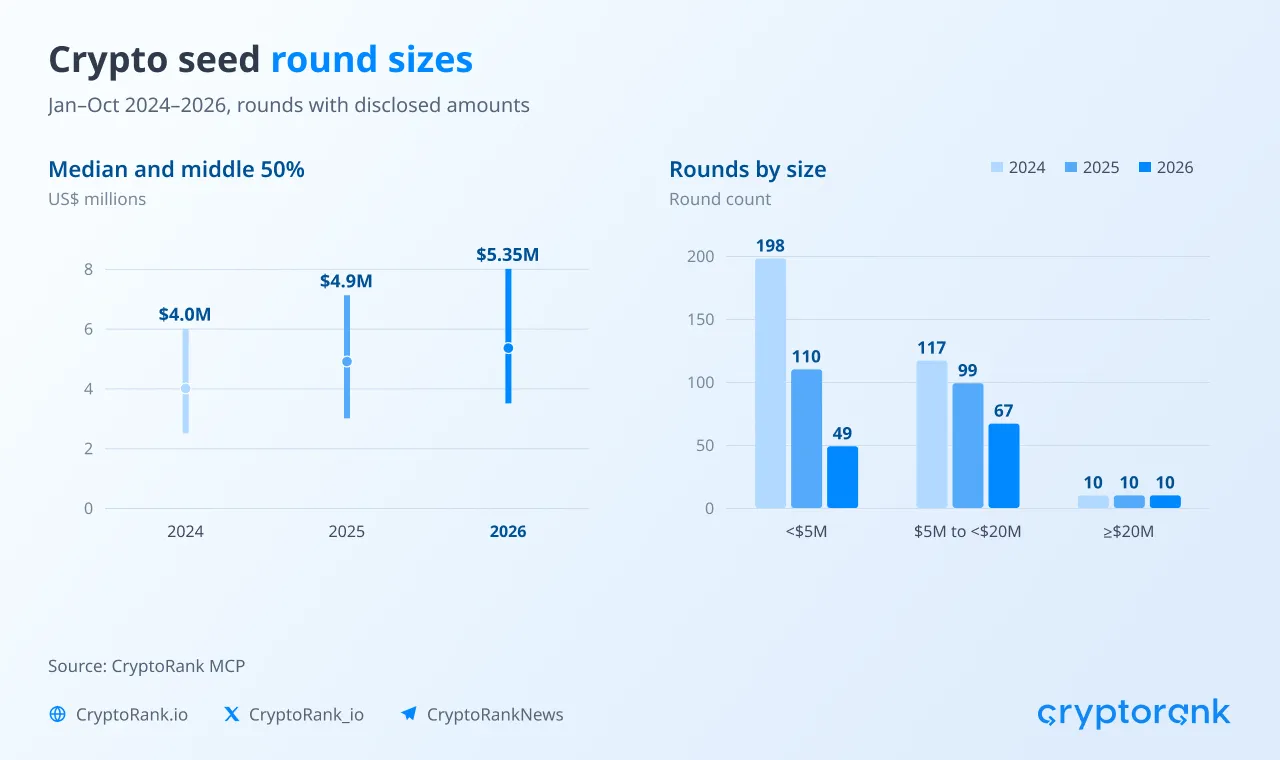
Consequently, the median seed investment increased even as fewer companies received funding. The changing figures indicate that Crypto seed fundraising is becoming concentrated around larger transactions rather than expanding across a wider pool of startups.
The comparison with 2025 requires additional context because that year’s figures included Flying Tulip’s $200 million in announced commitments.
According to CryptoRank, some of those commitments were never funded or were subsequently redeemed. This makes the headline comparison less straightforward when assessing the actual capital available to early-stage companies.
Even after excluding the five largest funding rounds from each year, disclosed seed investment in 2026 declined by more than one-third.
The contraction also extended beyond seed-stage companies. Pre-seed investments and funding extensions weakened alongside traditional seed rounds, suggesting that the decline was not simply the result of companies or investors classifying early-stage transactions differently.
Across all stages, from pre-seed through Series H, disclosed venture funding reached approximately $9 billion in 2026. However, the number of transactions declined.
Kalshi accounted for roughly one-quarter of that total through just two funding rounds, demonstrating how a small number of large transactions can influence overall venture capital figures while smaller companies continue to face difficult fundraising conditions.
This concentration is central to understanding the Crypto seed fundraising environment. Aggregate investment figures can appear relatively strong even when the number of startups receiving financial backing is falling.
While most cryptocurrency sectors recorded fewer seed transactions, exchanges and prediction markets experienced growth in deal activity during 2026.
Together with real-world asset projects, these categories attracted nearly twice as many seed rounds as they did in the previous year.
Artificial intelligence and payments also remained among the largest investment categories. Their share of overall activity increased because their transaction numbers declined more slowly than the broader market.
The report identified several projects illustrating the changing direction of investor interest.
Ekiden develops a system for matching derivatives orders off-chain before settling transactions on the Canton Network. XO Market allows users to create customised prediction markets, while Tare uses Avalanche to track credit assets as loans move through different stages, from origination to servicing.
These projects demonstrate how blockchain applications are increasingly being developed around specific financial activities rather than focusing exclusively on general infrastructure.
Real-world assets also recorded an increase in funding, although the category’s overall dollar growth was heavily influenced by Valinor’s financing round. CryptoRank noted that this single transaction exceeded the entire increase in funding recorded by the category.
Even without their two largest transactions, exchanges, prediction markets and RWA projects collectively raised more in 2026 than in 2025.
By comparison, infrastructure, blockchain and interoperability projects experienced declining seed activity for the second consecutive year.
The latest figures suggest that investors are still willing to finance new cryptocurrency businesses, but their priorities are changing.
Trading platforms, derivatives infrastructure, prediction markets and financial asset applications are attracting greater attention as founders develop products designed to support recurring market activity.
However, securing initial investment may remain challenging for smaller teams, particularly those building foundational blockchain infrastructure without an established commercial use case.
CryptoRank’s analysis suggests that the next stage of Crypto seed fundraising will depend on whether these emerging financial products can demonstrate sustained demand.
Repeat trading activity, reliable settlement systems and continued asset issuance will be important indicators of whether the projects attracting investment today can establish viable businesses.
Follow-on funding will also provide a clearer picture of investor confidence. If several companies across these categories secure additional financing, it could indicate that venture capital firms see opportunities beyond a small group of heavily funded projects.



Copyright © 2025 - The Bit Gazette.

