






- Trending
- Comments
- Latest

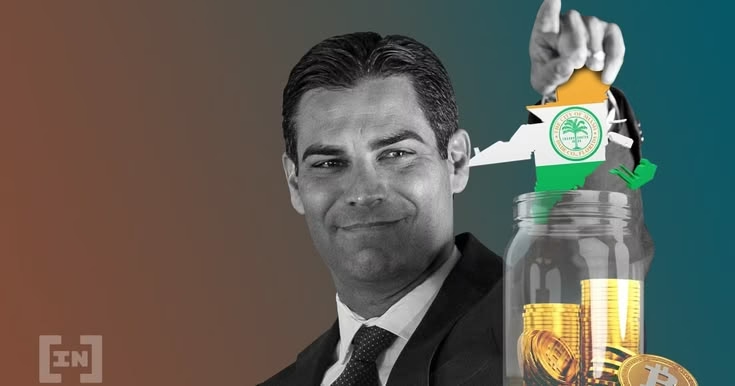
Miami’s new city manager, James Reyes, says cryptocurrency “has its worth” and “has its place”, just not at the center of the city’s economy anymore. Five years after Mayor Francis Suarez took his salary in Bitcoin and turned Miami into crypto’s unofficial U.S. capital, the city’s current leadership is redirecting attention toward permits, police stations and a proposed $450 million public-safety bond.
In separate interviews, City Manager James Reyes and Police Chief Edwin Lopez were asked about crypto and quickly moved the conversation elsewhere.
Reyes said crypto has its worth and has its place but should not be the backbone of Miami’s economic infrastructure.
Lopez was even more direct when asked whether the police department owns cryptocurrency.
“No, we do not own a cryptocurrency,” he said.
He would rather talk about drones, licence-plate readers and cameras. Mayor Eileen Higgins is talking about permits, old fire stations, housing, climate change and a $450 million public-safety bond.
That may sound like ordinary city administration. But for Miami, it represents something bigger.
The city that once sold Bitcoin as part of its future is now selling something more basic: a city that works.
The story begins with Suarez.
He became Miami’s mayor in 2017 and spent much of his second term aggressively promoting the city as a destination for technology, finance and cryptocurrency.
Miami hosted Bitcoin 2021, one of the biggest Bitcoin conferences ever held at the time. More than 12,000 people attended the sold-out conference, while thousands more descended on the city for the surrounding parties and events.
The following year’s conference was expected to draw about 35,000 people.
Miami was no longer simply hosting crypto events. It was becoming part of the crypto story itself. Suarez embraced the image.
He became known as the Bitcoin mayor after announcing that he would take his city salary in Bitcoin. He later continued receiving his salary this way even during the 2022 crypto crash.He also courted crypto companies.
FTX planned to move its U.S. headquarters to Miami in 2022 and had already purchased the naming rights to the Miami Heat’s arena for $135 million.
For a moment, everything appeared to be going in the same direction. Miami wanted crypto. Crypto wanted Miami.
MiamiCoin was supposed to take the experiment even further. The token was created through the CityCoins protocol, not by the City of Miami itself.
The idea was that people would mine and trade MiamiCoin, while a portion of the proceeds would go to the city. By September 2021, Suarez said the project had generated about $7.1 million for Miami.
By early 2022, the figure had risen above $22 million in the city’s wallet. The mayor began talking about using the proceeds to benefit residents, including a proposed Bitcoin dividend.
At one point, Suarez suggested MiamiCoin could generate enough money to help the city eventually eliminate taxes.
That was the dream.
But crypto markets do not reward dreams simply because a politician likes them. MiamiCoin’s value collapsed.
By 2022, it had lost around 95% from its peak, according to CoinDesk, while the Miami Herald reported that its value had fallen roughly 98% from its highest point.
By 2023, OKCoin, the only exchange hosting MiamiCoin trading, suspended the token because of limited liquidity and concerns about possible manipulation and fraud. The token had lost more than 90% of its peak value.
That mattered for more than the people holding MiamiCoin. It exposed the weakness in the idea that a city’s economic future could be tied too closely to a speculative digital asset.
Even Suarez eventually became less certain.
“I don’t know whether it’s going to work or not,” he said in 2022.
MiamiCoin was not the only warning.FTX collapsed in November 2022.The exchange had become one of the most visible symbols of Miami’s crypto boom. Its name was on the city’s basketball arena, and its U.S. operation had announced plans to establish itself in Miami. Then the company filed for bankruptcy. The FTX collapse did not destroy Miami’s technology ambitions, but it made one thing clear:
Being associated with crypto success can also mean being associated with crypto failure.
The city-branded token had collapsed.One of the world’s biggest crypto exchanges had collapsed. The crypto market entered a brutal downturn. And the argument that Miami could build a new economic identity around crypto suddenly looked much less certain.
Yet Miami did not become irrelevant. Something more interesting happened. The city continued attracting wealthy people and major companies, but increasingly for reasons that had little to do with MiamiCoin.
Consider Ken Griffin.
In 2022, Griffin moved Citadel’s headquarters from Chicago to Miami.The move was widely discussed in the context of Florida’s business environment, but Griffin himself later made an important point.
He said low taxes were not the reason for the move.Instead, he talked about schools, the environment and safe, clean streets. That is important because it sounds similar to the argument Miami’s new city manager is making today.
Reyes says wealthy newcomers are buying into Miami because of what the city can offer as a place to live and raise a family.
Public safety, he argues, comes first.
That does not mean crypto played no role in Miami’s growth. It clearly did.
But the city may have discovered that crypto was an accelerator, not the entire engine.
The latest example is Mark Zuckerberg.
The Meta founder and his wife bought a Miami-area mansion for $170 million in March 2026, setting a Miami-Dade residential sales record. And Miami continues to attract billionaires, finance companies and technology businesses.
Four of the world’s five richest people now have waterfront properties in the Miami area, according to the Miami Herald’s March 2026 report.
So the question is not whether Miami has lost its appeal.
It has not.
The question is what exactly is Miami selling now?
This is where the Forbes story becomes more interesting.
James Reyes, the new city manager, does not sound anti-crypto. He simply refuses to make crypto the city’s foundation.
“Crypto has its worth. It has its place,” he said.
But he does not believe it should be the backbone of Miami’s economic infrastructure. His “number one asset” is the city’s people. That sounds almost boring compared with Bitcoin dividends and city cryptocurrencies.
But that may be the point.
Mayor Higgins has already launched a same-day permit process for certain small residential projects. The city says residents can now receive same-day reviews for eligible work such as fences, windows, roofing and minor repairs.
That is a very different kind of innovation from MiamiCoin. Instead of putting a city token on a blockchain, the administration is trying to make City Hall move faster.
Some of Miami’s public-safety infrastructure is old.
The city says more than half of its fire stations are over 50 years old, with some more than 60 years old.
The police headquarters has also suffered from leaks and deterioration.
The response is a proposed $450 million general obligation bond for police and fire facilities.
The Miami City Commission approved putting the proposal on the November ballot in July. The city says the full cost, including interest and issuance, would be around $795 million.
That is the kind of problem that cannot be solved by Bitcoin. It requires money, planning, construction and political approval. And that may explain why the city’s economic conversation has changed.
Crypto wealth has become a physical security problem. For years, much of the discussion around crypto crime focused on hacking, scams, ransomware and stolen private keys. That is changing.
Criminals have increasingly begun targeting people directly because they believe those people hold cryptocurrency.
Chainalysis estimated that violent crypto attacks had already resulted in about $30 million in stolen cryptocurrency in 2026 by mid-year, after such attacks reached a record estimated $58 million in 2025.
Home invasions accounted for 37% of reported incidents in 2026, compared with 26% in 2023. This is not a Miami-only problem. But Miami is an interesting place to examine it because the city deliberately marketed itself as a destination for wealthy crypto people.
And some crypto-related crimes have already involved Florida.
In one 2024 case, a Florida man was convicted for participating in a violent conspiracy targeting cryptocurrency holders. Prosecutors said the group used home invasions and threats to force victims to transfer cryptocurrency.
Another case involved a Miami man accused of participating in the kidnapping and torture of a cryptocurrency trader in New York over access to a Bitcoin wallet.
These cases do not prove that Miami’s crypto strategy caused violent crime.
That would be an unfair conclusion. But they show why public safety has become part of the crypto conversation.
The more visible crypto wealth becomes, the more valuable it can become to criminals.
Not exactly.
Higgins is not saying Miami does not want technology companies.
Quite the opposite.
She has said the city wants to attract technology, cybersecurity, artificial intelligence and biotech companies.
That is important.
The city is not replacing technology with traditional industries. It is trying to broaden the technology story.
Crypto is one part of the technology economy, AI is another, Cybersecurity is another, Biotech is another, Fintech is another.
If one sector crashes, the entire city does not have to crash with it. Miami may therefore be moving from “crypto city” to “technology city.”
But it could be a much stronger economic strategy.
The crypto community’s reaction to MiamiCoin was divided even when the project was still young.
Some Bitcoin users welcomed Suarez’s willingness to experiment.
A 2021 Reddit discussion about the proposed Bitcoin dividend attracted comments praising Miami’s political leadership for taking risks on crypto adoption.
One commenter called it fascinating to see “actual crypto mayors.”
Others were far less impressed.
Another commenter joked that Miami residents were being offered MiamiCoin in exchange for their actual Bitcoin.
As the token collapsed, the tone became harsher.
In a 2022 Reddit discussion after MiamiCoin lost most of its value, one commenter simply called it “another shit coin.”
Another wrote that the coin’s collapse was hardly surprising compared with other speculative tokens.
There were people who saw MiamiCoin as experimentation.There were others who saw it as municipal speculation.And the collapse gave the critics a powerful argument.
A city can experiment.
But citizens and investors eventually ask the same question:
What happens when the experiment fails?
It would be easy to look at MiamiCoin’s collapse and declare Suarez’s crypto strategy a failure. But that would ignore what actually happened to Miami. The city gained global attention. Crypto companies moved in.Major conferences came.
Investors, entrepreneurs and wealthy people became more interested in Miami. The city’s technology and finance reputation grew. Some of those gains survived the crypto crash. Citadel remained.Miami’s technology ambitions remained. The city’s appeal to wealthy residents remained.
What did not survive was the idea that cryptocurrency itself could become the city’s economic foundation. Suarez may have been right about Miami becoming a technology and finance centre. He may simply have been too aggressive in betting that crypto would be the defining symbol of that transformation.
Miami’s experience offers a warning to cities that want to build economic identities around fashionable technologies. There is nothing wrong with attracting crypto companies. There is nothing wrong with attracting AI companies. There is nothing wrong with creating friendly regulations for fintech.
The danger comes when branding becomes confused with economic policy.
A city cannot simply announce itself as the crypto capital and assume the industry will permanently create jobs, tax revenue and investment.
Markets change.
Companies fail.
Tokens collapse.
Executives move.
Technology evolves.
What remains is infrastructure.
It is the reason Miami’s new leadership keeps returning to roads, permits, police, fire stations, housing and climate resilience. Those things are not as exciting as Bitcoin.
But they determine whether people stay.
The answer depends on what crypto era means.
If it means a mayor standing on stage at Bitcoin conferences, taking his salary in Bitcoin and promoting a city token as a possible new source of municipal revenue, then yes.
That era appears to be over.
If it means Miami no longer wants crypto companies, investors or blockchain businesses, the evidence does not support that conclusion. The city still wants technology companies. It still has a large concentration of wealthy technology and finance residents.
It still benefits from the ecosystem that grew during the Suarez years. But Miami’s leaders now appear to be asking a different question.
Not:
How can Bitcoin transform Miami?
But:
What does Miami need to become a better city for everyone who is already here and for the people we want to attract next?
And perhaps the most interesting thing about Miami’s crypto experiment is that the city did not completely lose from it.
Instead, it may have learned where crypto belongs.
Not as the city itself.
As one part of the city.



Copyright © 2025 - The Bit Gazette.

