


- Trending
- Comments
- Latest

Nigeria’s tax agency has told crypto exchanges and other virtual asset providers, including foreign firms serving Nigerian customers, to register on its new tax portal by November 30 and connect their systems by December 31 or face penalties.
The Nigeria Revenue Service (NRS) said the portal creates no new tax, only a new way for providers to meet existing reporting rules.
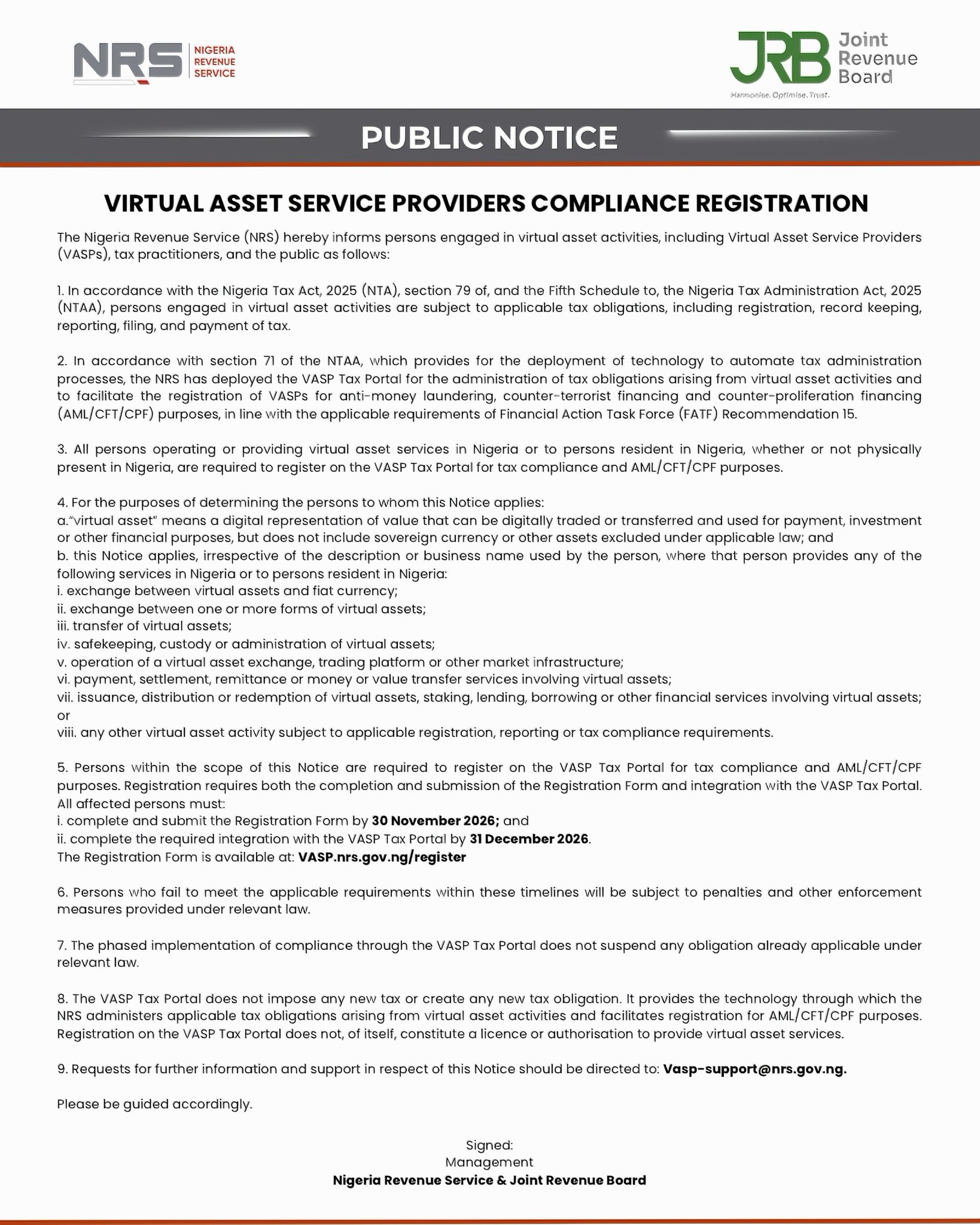
However, the agency clarified that the VASP Tax Portal does not introduce additional taxes or create new tax obligations, describing the initiative as an administrative requirement within Nigeria’s existing digital asset taxation framework.
Under the new directive, cryptocurrency businesses must complete their registration forms by November 30 before proceeding to the technical integration stage, which must be concluded by December 31.
The NRS has made clear that submitting the registration form alone does not constitute full registration. Providers must complete both stages to satisfy the onboarding requirements.
In its November 20 compliance notice, the agency stated: “The VASP Tax Portal does not impose any new tax or create any new tax obligation.”
According to the NRS registration guidance, businesses must obtain a Nigerian Tax Identification Number (Tax ID) before completing the application. Foreign providers without a Nigerian Tax ID are required to apply through the agency’s Tax ID Registration Portal before proceeding.
After submitting and verifying their registration forms, businesses will receive further onboarding instructions explaining how to connect their systems to the platform.
The technical process requires providers to complete application programming interface (API) integration and testing, according to the portal’s registration page.
The integration is intended to support tax reporting and the administration of taxes collected in digital tokens. However, fiat tax administration will continue through the NRS’s existing Rev 360 system.
The registration requirements extend beyond conventional cryptocurrency exchanges to cover a broader range of businesses involved in virtual asset activities.
According to the NRS guidance, affected services include cryptocurrency custody, transfers, payments and remittances, alongside digital asset issuance, staking, lending and borrowing.
This wider coverage means that companies providing infrastructure and financial services around digital assets may also fall within the registration framework, depending on the nature of their activities.
The directive builds on existing tax requirements rather than introducing cryptocurrency taxation for the first time.
Guidelines issued by the NRS on July 31, 2026, had already required virtual asset service providers to file tax returns, maintain transaction records and collect or withhold applicable taxes.
The latest VASP Tax Portal requirements therefore establish a centralised onboarding and technical integration process through which affected businesses can fulfil their existing reporting and administrative responsibilities.
The distinction is important for companies interpreting the new directive, as the December deadline does not replace their ongoing tax obligations.
Beyond business registration, Nigeria’s existing tax framework already requires certain virtual asset service providers to submit detailed information about their customers and transactions.
Section 25 of the Nigeria Tax Administration Act, 2025, requires taxable providers involved in virtual asset exchange, custody or management services to file returns containing customer information.
The required details include customers’ names, contact information and Tax Identification Numbers, alongside national identification numbers for individual customers.
Providers must also report transaction dates, the types of virtual assets involved and their corresponding values.
These reporting requirements place customer identification and transaction records within the country’s broader tax administration framework, giving authorities access to information needed to administer applicable tax obligations.
However, the NRS has clarified that the registration rules do not automatically apply to individuals simply because they own or use cryptocurrencies.
Personal investing, transferring one’s own digital assets and making or receiving cryptocurrency payments for personal goods and services do not, by themselves, require an individual to register as a VASP.
Any applicable personal tax obligations remain unchanged.
The NRS has also distinguished tax registration from the separate regulatory authorisations required to operate a virtual asset business in Nigeria.
Registration through the VASP Tax Portal does not constitute an operating licence and does not replace other regulatory requirements applicable to cryptocurrency companies.
Businesses must therefore continue meeting their existing licensing, reporting and tax responsibilities while completing the new onboarding process.
The November 30 registration deadline and December 31 integration deadline give affected providers a defined period to complete the requirements.



Copyright © 2025 - The Bit Gazette.