



- Trending
- Comments
- Latest

Pump.fun will charge an extra fee on non-developer wallets that buy a token in the same block it launches, starting December 4, co-founder Alon announced on November 26. The “block0” fee targets bundling, where developers use hidden wallets to scoop up supply before ordinary traders can trade. Half the fees will go to ecosystem growth and half to buybacks and burns of the $PUMP token.
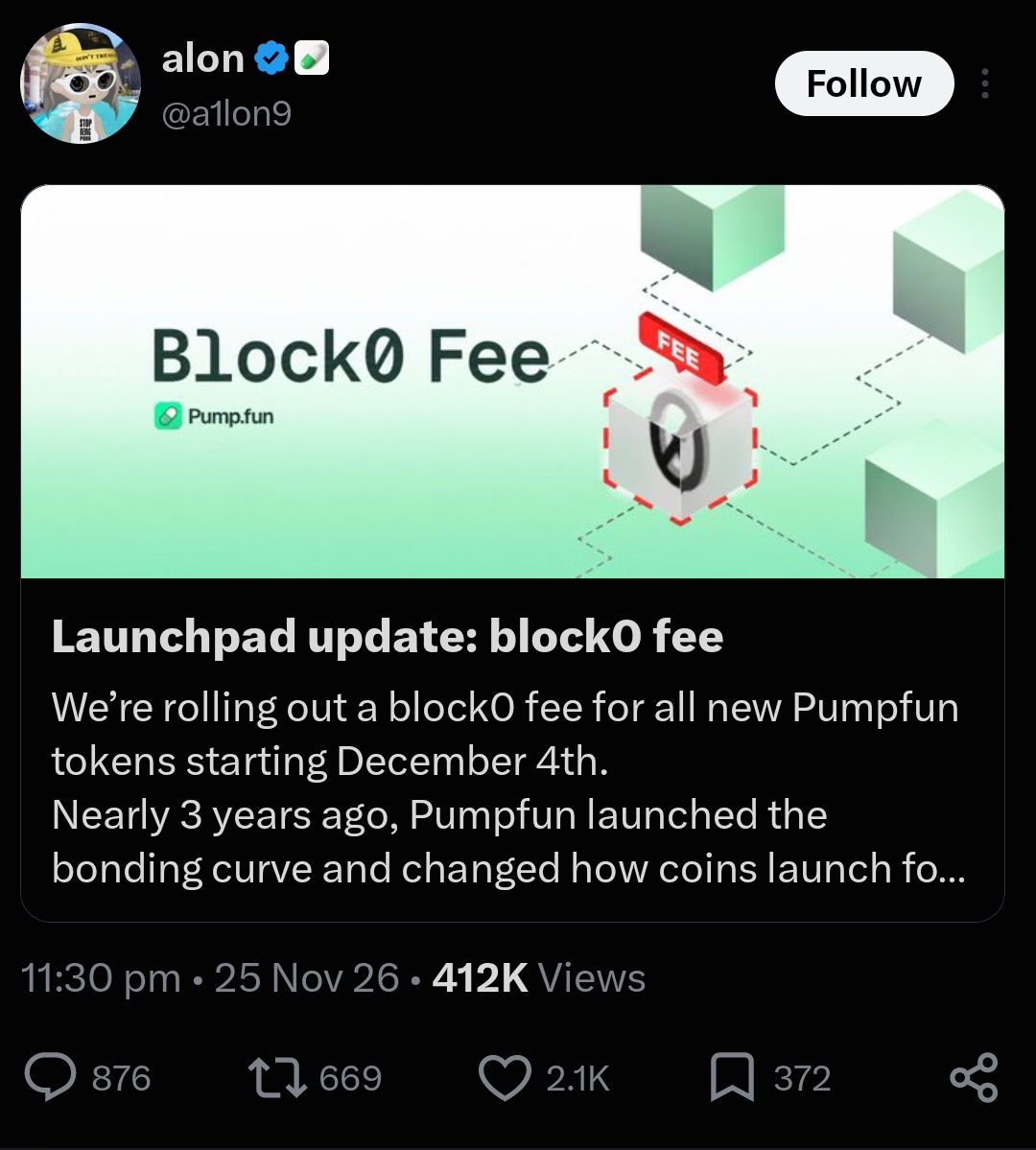
Pump.fun introduced its bonding curve mechanism nearly three years ago, allowing users to create and launch tokens without requiring upfront capital or advanced development expertise.
Since then, the platform says its ecosystem has facilitated hundreds of billions of dollars in trading activity, contributing to the growth of on-chain trading terminals, social trading applications and professional trading tools.
However, the increasing sophistication of these tools has also created opportunities for certain participants to gain an advantage during a token’s earliest trading moments.
One practice attracting particular attention is block0 bundling. This involves a token developer purchasing their newly created token through the developer wallet while simultaneously using other seemingly unrelated wallets to acquire additional supplies in the same block.
Because the creator controls the initial launch, these transactions can occur before ordinary traders have a meaningful opportunity to participate.
The practice makes it difficult for investors to determine whether early buying activity represents genuine market demand or coordinated purchases by the token’s creator.
Pump.fun argues that this lack of transparency creates an uneven trading environment, particularly for participants who do not have access to sophisticated trading infrastructure.
Under the proposed policy, non-developer wallets interacting with a newly created token during block0 will face an additional fee. The developer’s primary wallet will remain exempt.
The new fee is designed to make coordinated launch purchases more expensive rather than completely eliminate them.
Pump.fun acknowledged that token developers could continue using multiple wallets to purchase their own tokens during the initial block. However, doing so would now involve additional costs.
Developers who want to secure an early position without paying the block0 fee can purchase tokens directly through their designated developer wallets. However, excessively large developer holdings would remain visible to other market participants.
Alternatively, developers could spread their purchases across other wallets in subsequent blocks, although they would then compete with ordinary traders under more balanced conditions.
The platform also clarified that the proposed charge would only apply to transactions within the token’s creation block.
Once trading moves into subsequent blocks, identifying developer-affiliated wallets becomes more difficult because other market participants have already begun interacting with the token.
Pump.fun said it is considering extending the fee mechanism to later blocks, including block1 and block2, but has not committed to introducing those additional charges.
For the average trader, the platform expects the immediate impact to be limited because most transactions occur after the initial creation block.
The broader objective is to reduce the amount of token supply captured through coordinated launch activity and make developer holdings easier to assess.
Beyond addressing token launch manipulation, Pump.fun intends to use the revenue generated from the new fee to support its wider ecosystem.
According to the announcement, 50% of collected block0 fees will be directed towards ecosystem development. This includes initiatives supporting the Pump.fun launchpad, its application and trading terminal, alongside callout rewards, competitions and other community programmes.
The remaining 50% will be allocated to programmatic buybacks and burns of the platform’s native $PUMP token.
The company also clarified that the fees would not be automatically reinjected into the same tokens from which they were collected.
That distinction is intended to prevent traders who pay the additional fee through block0 sniping from recovering some of their costs through subsequent liquidity injections into the same token.
Pump.fun described the initial implementation as an iterative process, acknowledging that the fee might not immediately eliminate the trading practices it is designed to discourage.
The platform expects market participants to adapt their strategies and plans to evaluate their responses using transaction data and community feedback.
It also indicated that the fee structure could change over time as the company gathers more information about its effectiveness.
Ultimately, Pump.fun’s latest policy represents an attempt to address a persistent challenge in the memecoin market: the advantage enjoyed by participants who can access and execute sophisticated trading strategies before ordinary investors enter a newly launched token.
Whether the block0 fee significantly reduces these advantages will depend on how developers, automated trading systems and other market participants respond after the December 4 rollout.



Copyright © 2025 - The Bit Gazette.