


- Trending
- Comments
- Latest

Qubic has restarted its layer-1 blockchain and opened a claims process for users hit by a $1.4 million theft that drained 1,404 wallets, after an attacker exploited predictable wallet seed generation. The project is also warning that any wallet created before web wallet version 4.26.4 should be treated as insecure, even if funds were never touched.
The network’s return follows a temporary suspension on October 18, when Qubic halted blockchain processing to limit further movement of the stolen tokens.
The disruption came after an attacker exploited weaknesses in the wallet seed-generation process, potentially enabling access to accounts whose recovery credentials were insufficiently random.
According to reporting by Cointelegraph, the network resumed processing at approximately 8:00 p.m. on October 19, moving beyond the point where operations had been suspended.
The restart marks an important step toward restoring normal network activity. However, reopening the blockchain does not automatically mean every affected investor will receive full compensation.
In its October 20 announcement on X, the Qubic team confirmed the recovery process and reported that initial payments had reached verified owners.
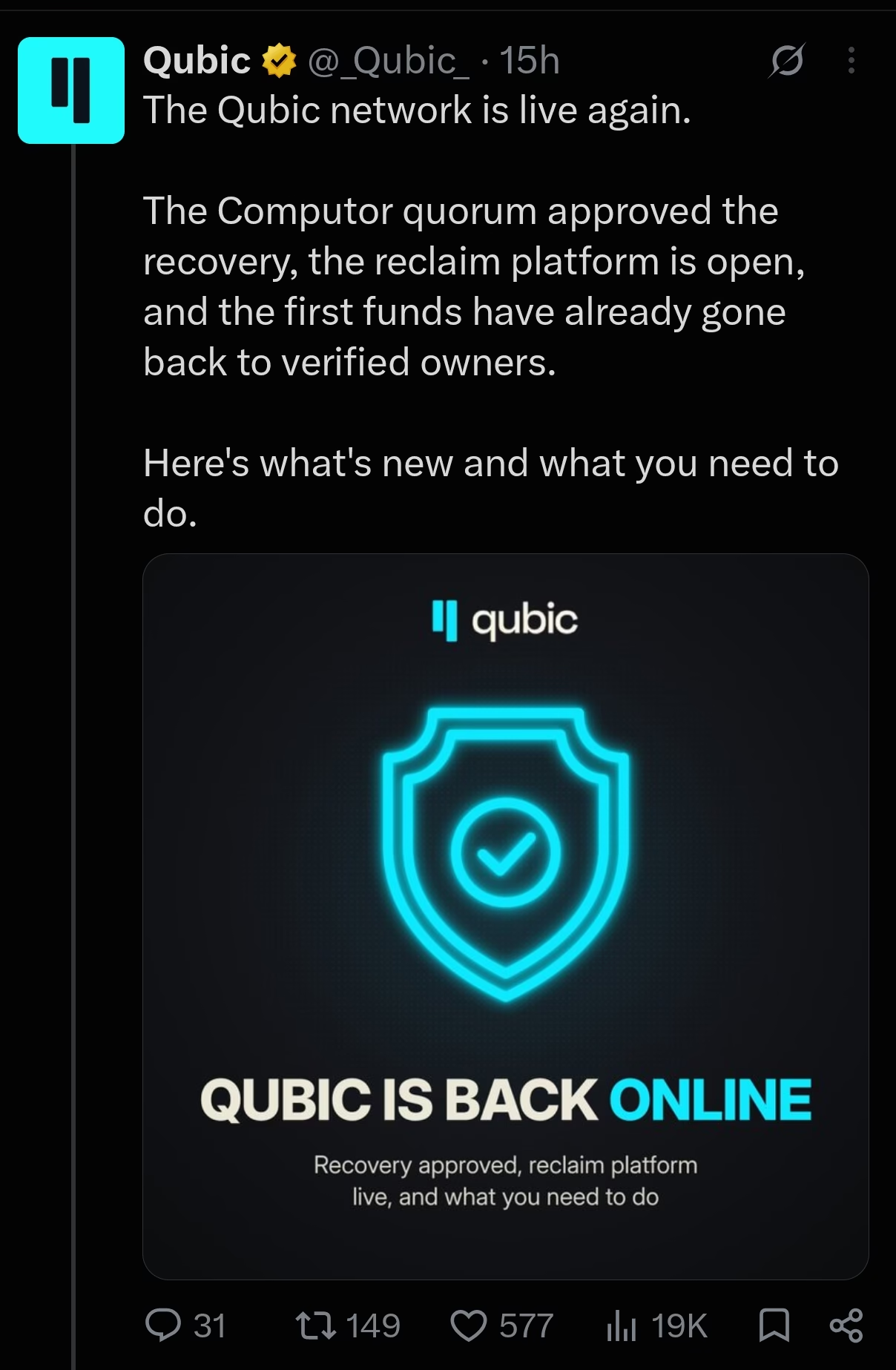
The project stated: “The Qubic network is live again.” — Qubic, official project announcement, October 20, 2026.
Although the statement confirmed the network’s return, the project did not disclose the total value of funds distributed, the number of approved claims, or a complete timetable for resolving outstanding cases.
Investigations into the incident point to a vulnerability in the creation of wallet recovery seeds rather than a confirmed failure of Qubic’s blockchain consensus mechanism.
A recovery seed is a sequence of secret information used to restore access to a cryptocurrency wallet. Its security depends on sufficient randomness.
If a wallet generates predictable seeds, an attacker may be able to reproduce the credentials required to control an account without obtaining the owner’s physical device.
Qubic’s incident updates identified certain wallet seeds created through its web wallet on Apple devices and browsers as potentially affected. The issue involved an insecure random-number generation method that could make some recovery credentials easier to predict.
The team subsequently released web wallet version 4.26.4 on October 19 to address the weakness. However, installing the updated software does not automatically make an old recovery seed safe.
Qubic issued the following warning to users: “If you created your wallet with the Qubic web wallet before version 4.26.4 (released 19 October), treat it as insecure, even if your funds were never touched.” — Qubic team, wallet security advisory.
This warning is particularly relevant because an account that has not suffered a visible loss may still have exposed credentials.
The project’s guidance is to install version 4.26.4 or later, generate a completely new wallet and transfer any remaining funds to the new address. Users should avoid reusing the old recovery phrase.
The recovery programme gives affected users additional time to establish ownership and request the return of eligible assets. According to the project’s announcement, claims will remain open until May 1, 2027.
The process requires claimants to identify the affected wallet, provide a newly generated destination identity, sign a message and submit supporting evidence of ownership.
These requirements reflect a difficult challenge in blockchain recovery: a valid wallet signature alone may not establish who legitimately owns an account when an attacker has obtained or reconstructed its compromised seed.
Consequently, the Qubic exploit recovery process must distinguish legitimate holders from individuals who may possess the same compromised credentials. Verification is essential to reduce the risk of stolen assets being returned to the wrong party.
Qubic has indicated that initial funds have already been returned to verified users. Nevertheless, the project has not publicly established the final recovery rate or confirmed that all affected holders will receive their entire losses.
Investors should therefore distinguish between the opening of a recovery programme and the successful reimbursement of every affected account.
Anyone seeking assistance should begin with the project’s official announcements and designated recovery platform, rather than relying on unsolicited messages or third-party accounts promising guaranteed refunds.
The incident highlights a broader lesson for cryptocurrency investors: blockchain security depends on more than the underlying network. Wallet software, recovery phrases, private-key generation and operational safeguards all play important roles in protecting digital assets.
Even when a blockchain continues to function as designed, a vulnerability in the software used to create wallets can expose users to substantial financial losses.
The Qubic exploit also demonstrates why investors should monitor security disclosures and respond promptly when developers identify potentially compromised credentials. Waiting until funds disappear may leave fewer options for protecting an account.
For holders who may have used an affected version of the Qubic web wallet, generating a fresh wallet and moving remaining funds are immediate priorities. Investors should also verify that software updates and recovery instructions come from official sources.
From a market perspective, the network restart and the opening of claims provide positive operational developments, but they do not settle every question raised by the attack.
The scale of successful reimbursements, the handling of disputed claims and the project’s ability to prevent similar vulnerabilities will influence confidence in its security practices.
The Qubic exploit recovery effort is now moving from emergency containment toward claims verification and restitution. Its eventual success will depend not only on restoring network activity but also on providing affected users with a transparent process and credible evidence of progress.
Until further recovery figures are published, investors should treat the restart as a step toward resolution rather than proof that the financial consequences have been fully addressed.



Copyright © 2025 - The Bit Gazette.