

- Trending
- Comments
- Latest

Russia crypto regulation is expected to reshape how investors access digital assets from September 1, with Sberbank projecting that regulated cryptocurrency trading could reach between 3.5 trillion and 4 trillion rubles, or about $46.43 billion, during the first year of the new legal framework.
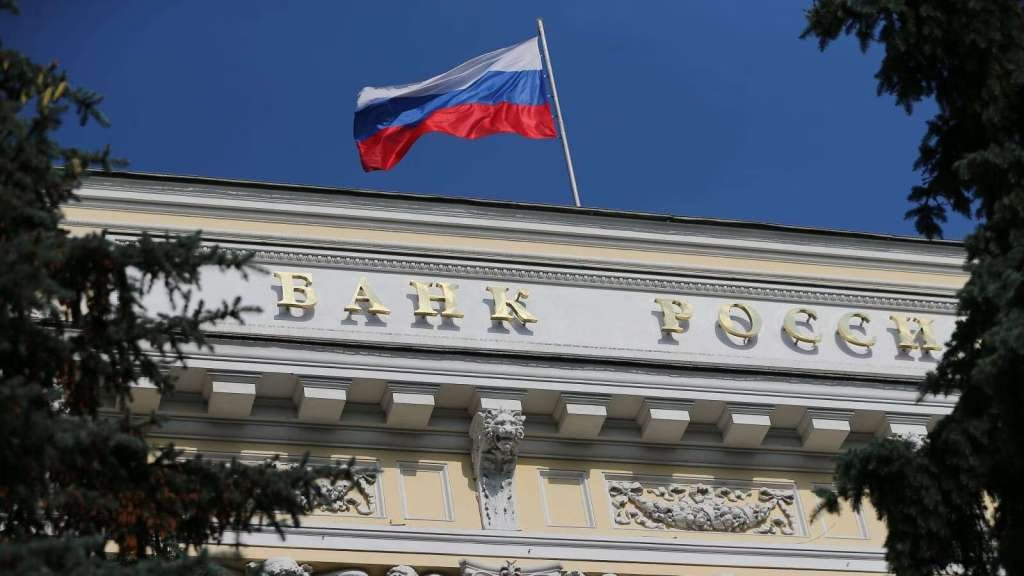
The forecast comes after the Bank of Russia approved draft regulations allowing investors to legally purchase cryptocurrencies through brokers. While the move marks a significant shift in Russia crypto regulation, Sberbank believes only a fraction of the country’s existing cryptocurrency activity will initially migrate to licensed exchanges.
According to Anatoly Popov, Deputy Chairman of Sberbank’s Executive Board, the bank’s projections remain conservative because many Russian investors are expected to continue using cryptocurrency services outside the newly regulated system.
The new framework, which takes effect on September 1, allows Russian investors to purchase digital assets legally through approved intermediaries, bringing part of the country’s large cryptocurrency market under formal regulatory oversight.
Russia crypto regulation has historically developed cautiously, with authorities balancing investor access against concerns surrounding financial stability and market risks. The latest framework represents an effort to channel cryptocurrency trading through licensed brokers and regulated exchanges rather than leaving activity concentrated on unregistered platforms.
Sberbank estimates that official trading could reach at least 4 trillion rubles during the first year of legalization. Over time, the bank expects participation in the regulated system to expand as more investors migrate toward officially approved channels.
“According to Finance Ministry data as of February, the daily volume of cryptocurrency transactions in Russia is around 50 billion rubles, or roughly 18 trillion rubles a year. SberCIB Investment Research analysts have a fairly conservative estimate: in the first year after legalization, around 20% of this volume, or 3.5-4 trillion rubles a year, will be traded on exchanges. This figure could rise to 4.75-5.25 trillion rubles by 2028 and to 7.5 trillion rubles by 2029,” — Anatoly Popov, Deputy Chairman of the Executive Board, Sberbank, told TASS.
The projection suggests that regulated exchanges could initially capture roughly one-fifth of Russia’s estimated annual cryptocurrency transaction volume.
Under Sberbank’s forecast, Russia crypto regulation could gradually bring a larger share of cryptocurrency activity into the official financial system.
The bank expects regulated exchange volumes to increase from between 3.5 trillion and 4 trillion rubles in the first year to approximately 4.75 trillion to 5.25 trillion rubles by 2028. By 2029, that figure could reach around 7.5 trillion rubles, equivalent to approximately $87.06 billion based on the estimates cited in the report.
However, the growth forecast does not assume that all cryptocurrency trading will move into regulated channels. Popov noted that Sberbank’s estimate was deliberately conservative, reflecting the continued presence of unregistered cryptocurrency exchange services.
That distinction could prove central to the effectiveness of Russia crypto regulation. The country already has substantial cryptocurrency transaction activity, but attracting users into licensed channels will depend on whether official platforms provide enough flexibility and access to meet investor demand.
The regulatory framework is designed to formalize part of that activity, but significant restrictions could limit how quickly the official market expands.
One of the most significant constraints under Russia crypto regulation is the limit placed on how much certain investors can purchase through licensed intermediaries.
Non-qualified investors can buy up to 300,000 rubles, or approximately $3,800, worth of cryptocurrency annually through a single licensed intermediary. Before making those investments, they must also complete a risk awareness test.
The limits were introduced as part of the Bank of Russia’s approach to managing the risks associated with cryptocurrency investments.
Requirements for becoming a qualified investor have recently been eased, but qualified investors still face limits of up to 3 million rubles, or roughly $38,000, in investments under the framework described in the report.
These restrictions could affect overall trading volumes, particularly among investors seeking to execute larger transactions through regulated platforms.
As a result, Russia crypto regulation may create a two-track market in which official exchanges handle a growing share of transactions while some investors continue using services outside the regulated system.
The investment caps, combined with restrictions on available assets, are among the main reasons Sberbank expects only a portion of existing cryptocurrency activity to move to official exchanges during the first year.
Another major limitation is the narrow range of cryptocurrencies approved for official trading.
Under the current framework, only Bitcoin, Ethereum and Tether’s USDT have received approval from the Bank of Russia for trading on official Russian exchanges.
That means investors interested in other cryptocurrencies and altcoins will not have access to those assets through the regulated platforms covered by the new rules.
The restricted list could become another factor shaping the success of Russia crypto regulation, particularly in a market where investor demand extends beyond the three approved digital assets.
While Bitcoin, Ethereum and USDT account for some of the largest and most widely used segments of the global crypto market, excluding other major tokens may encourage investors seeking broader exposure to remain on unapproved platforms.
Russia crypto regulation will also include a transition period for exchanges. Platforms can register under the new framework by July 1, 2027, giving market participants time to adapt to the changing legal environment.
For Sberbank, however, the direction of the market is clear. Even if regulated platforms initially capture only a relatively small portion of Russia’s estimated 18 trillion rubles in annual cryptocurrency transactions, the bank expects legal trading volumes to grow steadily over the coming years.
The first-year projection of up to 4 trillion rubles will offer an early test of whether Russia crypto regulation can successfully bring a meaningful share of the country’s existing digital asset activity into the official financial system without driving investors toward alternative channels.



Copyright © 2025 - The Bit Gazette.