







- Trending
- Comments
- Latest

Spotware launches fraud network letting brokers, prop firms warn each other about suspicious traders
Spotware Systems, the developer of the cTrader platform, launched cAntifraud on Wednesday, November 4, 2026, a service that lets brokers and proprietary trading firms share anonymized data on flagged traders so a warning from one firm can reach the rest of the network. The company claims it can spot suspicious activity within 15 minutes and keep fraud below 0.08% of turnover.
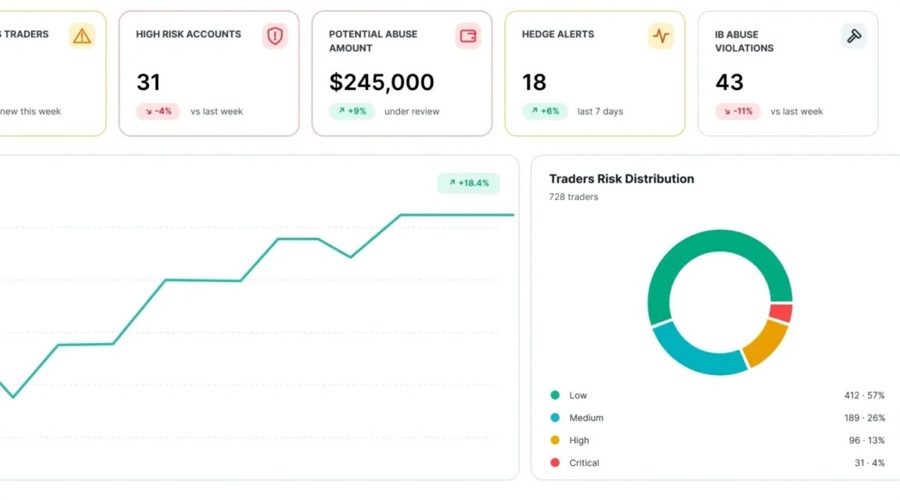
By combining information from participating companies, Spotware aims to give financial firms a broader view of suspicious trading behaviour that might otherwise remain undetected.
According to the company, cAntifraud can identify suspicious activities within 15 minutes and helps keep fraud below 0.08% of turnover.
The introduction of cAntifraud comes amid increasing concerns about organised trading abuse, particularly among proprietary trading firms that offer traders access to funded accounts after completing evaluation challenges.
One example emerged in March 2025, when proprietary trading firm PipFarm disclosed that it had identified a group of approximately 800 traders allegedly coordinating positions across different prop firms.
The group reportedly opened opposing positions at separate companies, allowing its members to secure profits regardless of the direction in which the market moved. Such arrangements can expose proprietary trading businesses to significant losses while making it difficult for individual firms to recognise the broader operation.
The potential financial consequences are substantial. Ruben Abitbol, former head of trading and risk at The5ers, said last year that fewer than 1% of traders could bankrupt a proprietary trading firm that failed to identify them.
This vulnerability highlights the limitations of relying exclusively on internal monitoring systems. A firm might identify suspicious activity within its own accounts without knowing that the same trader or coordinated group is operating elsewhere.
Spotware’s Fraud Network is intended to address this information gap by allowing participating businesses to exchange relevant risk intelligence without exposing their underlying customer records.
Pavel Demin, general manager of cAntifraud at Spotware, explained the problem facing individual risk management teams.
“Trading abuse doesn’t stop at the boundaries of a single firm,” he said.
The platform is designed to make suspicious trading patterns visible across participating businesses rather than leaving each company to investigate potentially connected activities independently.
Spotware said cAntifraud monitors suspicious behaviour throughout the customer lifecycle, beginning with onboarding and initial Know Your Customer (KYC) checks and continuing after traders start executing transactions.
Its detection system examines several indicators, including execution timing, connections between trading accounts and coordinated trading activities.
Participating brokers and proprietary trading firms exchange relevant information through an encrypted and anonymized data-sharing framework. Each member can access its own records, while information contributed by other companies is shared without exposing their underlying customer databases.
This approach allows a Fraud Network participant to receive warnings when another member identifies potentially suspicious behaviour associated with a trader or trading pattern.
The system also targets different forms of abuse depending on the type of financial institution using it.
For brokers, the service is designed to identify introducing broker commission abuse, latency arbitrage, multiple-account operations, cross-broker hedging and bonus exploitation.
Proprietary trading firms, meanwhile, can use it to investigate challenge farming, external hedging and violations of trading rules.
Importantly, cAntifraud does not automatically block traders or make decisions about whether customers should receive payouts. Instead, it provides risk management teams with evidence and alerts, leaving the final decisions to individual companies.
That distinction gives participating firms greater visibility into potentially coordinated activity while maintaining their authority over account restrictions and payout assessments.
Spotware’s approach also resembles the model adopted by Match-Prime through its HawkEye system. Rather than automatically closing accounts, HawkEye redirects toxic trading flows into separate liquidity pools.
Spotware’s latest product represents its third new business addition in 2026, expanding beyond its established cTrader trading platform.
In March, the company introduced cBridge, a liquidity bridge service that charges customers based on servers and connections rather than trading volume.
It subsequently launched cFinancial in September, an institutional liquidity business operating under a Seychelles licence.
The new Fraud Network follows a similar commercial structure to cBridge, with Spotware offering cAntifraud through a flat monthly subscription.
The company’s website lists the standard subscription price at $999 per month. However, firms that join before December 31, 2026, can access the service for $250 monthly, with the discounted rate locked in for 12 months.
The service can operate independently or alongside cBridge, giving brokers and trading firms the option to integrate fraud monitoring into their existing infrastructure.
Spotware is not entering an entirely new category. Centroid Solutions introduced PropShield in June 2025, establishing a shared network through which proprietary trading firms could exchange anonymized trader information.
However, Spotware’s Fraud Network extends the concept by bringing brokers and proprietary trading firms into the same information-sharing ecosystem.
The broader compatibility of the service could also help it reach companies operating outside the cTrader environment. Spotware confirmed that cAntifraud connects with MetaTrader 5 (MT5) and other trading platforms through an application programming interface (API).
That integration is significant given the difference in platform reach. FM Intelligence’s platform comparison recorded approximately 574,000 organic visits to cTrader in the third quarter of 2026, compared with 3.5 million for MT5.
The figures indicate that MT5 attracted roughly six times as many organic visits during the period, giving Spotware an incentive to make its fraud detection infrastructure accessible beyond its own trading platform.
The launch of cAntifraud reflects Spotware’s broader effort to expand its commercial presence across the brokerage and proprietary trading industries.
The company reported that cTrader signed 104 new broker and proprietary trading firm clients in 2025, according to information released in January.
With cBridge, cFinancial and now cAntifraud, Spotware is building a wider collection of services targeting different operational requirements within the trading industry.



Copyright © 2025 - The Bit Gazette.

