

- Trending
- Comments
- Latest

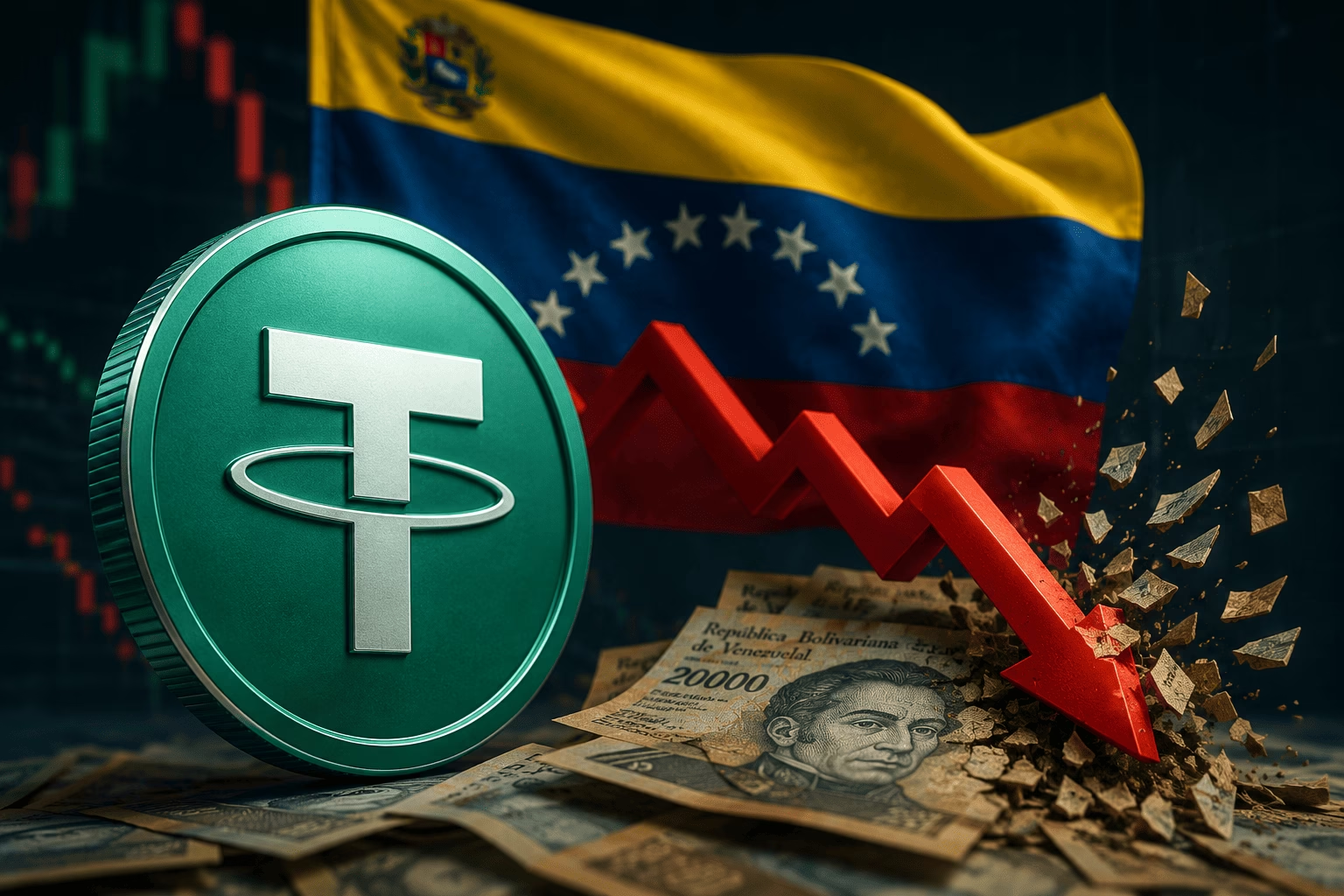
Venezuela’s central bank capped personal dollar purchases at $1,000 per month starting June 15, intensifying a stablecoin rush that has already pushed USDT’s price on local peer-to-peer markets up more than 16% in a month.
Data from peer-to-peer tracking platforms shows that the price of USDT on Venezuela’s P2P market surged more than 16% over the past month, climbing from roughly 690 bolivars in mid-May to above 800 bolivars before easing to around 794 bolivars.
The jump does not reflect any change in USDT’s dollar peg. Instead, it highlights the rapid erosion of the bolivar’s value and growing demand for digital dollars in a country where access to physical U.S. currency remains constrained.
Much of that demand is flowing through Binance’s peer-to-peer marketplace, which has become a critical venue for Venezuelans seeking to protect savings and conduct everyday transactions outside the traditional banking system.
The latest surge in Venezuela Crypto Adoption coincides with a sharp expansion in the local money supply.
According to figures released by the Central Bank of Venezuela (BCV), bolivar liquidity reached approximately 2.17 trillion bolivars in the week ending June 5, marking a 23% increase from levels recorded in early May.
Since January, the amount of bolivars circulating in the economy has expanded by 131%, significantly outpacing the availability of U.S. dollars in the formal banking system.
The widening imbalance between bolivar supply and accessible dollar liquidity is forcing households and businesses to seek alternative stores of value.
Crypto analyst Hever Castro highlighted the growing mismatch in a recent post on X, noting that the volume of dollars available through the BCV and commercial banks is failing to keep up with market demand.
As a result, Venezuelans are increasingly turning to stablecoins.
“People are looking for ways to preserve purchasing power as the bolivar continues to weaken,” Castro said.
The trend underscores how Venezuela Crypto Adoption is evolving beyond speculation and becoming a practical financial tool used for savings, remittances and everyday commerce.
Pressure on the parallel market intensified after the BCV introduced new restrictions on foreign currency purchases.
Effective June 15, Venezuelan authorities capped personal dollar purchases through banks at $1,000 per month and $12,000 annually. Electronic transactions were also limited to $500 per week.
Economists warn that the measures could have unintended consequences.
Asdrúbal Oliveros, a Venezuelan economist and managing partner at Ecoanalítica, argued that tighter controls are likely to increase demand in informal and peer-to-peer markets rather than reduce it.
“The restrictions will place even more pressure on the parallel market,” Oliveros said, adding that P2P platforms have already become a key source of dollar access for ordinary citizens.
Banks frequently suspend digital dollar sales once daily quotas are exhausted, leaving consumers with few alternatives.
For many Venezuelans, stablecoins have become the next best option.
This dynamic is accelerating Venezuela Crypto Adoption as users bypass conventional financial channels in favor of decentralized alternatives that offer faster access and fewer restrictions.
The divergence between official exchange rates and market pricing continues to widen.
At the time of writing, the BCV’s official exchange rate stood at approximately 590 bolivars per U.S. dollar. Meanwhile, peer-to-peer markets valued USDT near 794 bolivars, creating a spread of roughly 35%.
Some independent vendors in Caracas have reportedly quoted exchange rates as high as 1,200 bolivars per dollar, highlighting the growing disconnect between official benchmarks and real-world demand.
If the gap continues to widen, analysts say the central bank risks losing influence over price formation as businesses and consumers increasingly rely on alternative reference rates.
For years, Venezuelans have shifted between bolivars, U.S. dollars and cryptocurrencies depending on economic conditions.
One widely known practice, referred to locally as “bicicleta cambiaria,” involves purchasing dollars through official channels and reselling them at a premium on P2P platforms.
The new purchase caps appear designed to curb that arbitrage cycle. However, analysts say limiting access to dollars without increasing supply may ultimately strengthen the parallel market.
Instead of easing pressure, the policy could funnel more liquidity into stablecoins.
That shift is already visible in the latest wave of Venezuela Crypto Adoption, where digital assets are increasingly serving as an alternative monetary system.
As inflationary pressures persist and access to dollars tightens, Venezuela Crypto Adoption is likely to remain a defining feature of the country’s evolving financial landscape.
For many citizens, USDT is no longer simply a cryptocurrency—it is a hedge against currency instability, a savings vehicle and, increasingly, a substitute for cash.



Copyright © 2025 - The Bit Gazette.