

- Trending
- Comments
- Latest

A U.S. Army Special Forces master sergeant has been arrested on federal charges after allegedly placing $33,000 in bets on Polymarket using classified knowledge of a military operation targeting Venezuelan President Nicolás Maduro, then collecting more than $400,000 in profit within hours of the mission’s success.
According to the U.S. Department of Justice, the suspect identified as U.S. Army Special Forces Master Sergeant Gannon Ken Van Dyke used privileged knowledge of a military operation targeting Venezuelan leader Nicolás Maduro to place a series of highly strategic bets on Polymarket.
The soldier reportedly placed around $33,000 in bets across multiple contracts predicting Maduro’s removal before the operation was publicly announced. Within hours of the mission’s success, those bets generated more than $400,000 in profit.
This sequence of events sits at the core of the Polymarket Insider Trading case an example of near-perfect timing that prosecutors argue could only have come from access to classified information.
Prediction markets like Polymarket are designed to aggregate public information and sentiment about future events. But the Polymarket Insider Trading case challenges that premise.
“This is not speculation. This is exploitation,” one federal investigator noted in filings, emphasizing that the trades were executed using nonpublic intelligence.
The distinction is critical. In traditional finance, insider trading involves using confidential corporate information. In the Polymarket Insider Trading case, the “asset” wasn’t a company it was a real-world geopolitical event.
That shift fundamentally changes the risk profile of prediction markets. Instead of trading on earnings or mergers, users can now bet on military operations, arrests, or political outcomes events that may be known in advance by a small group of insiders.
Authorities allege that the suspect attempted to obscure his identity after the trades were completed. According to court documents, he transferred funds to foreign crypto accounts and requested the deletion of his Polymarket account.
These actions have become a central part of the Polymarket Insider Trading case, reinforcing claims that the trades were not only informed but deliberately concealed.
The charges include wire fraud, commodities fraud, and unlawful use of classified information offenses that could carry decades in prison if proven.
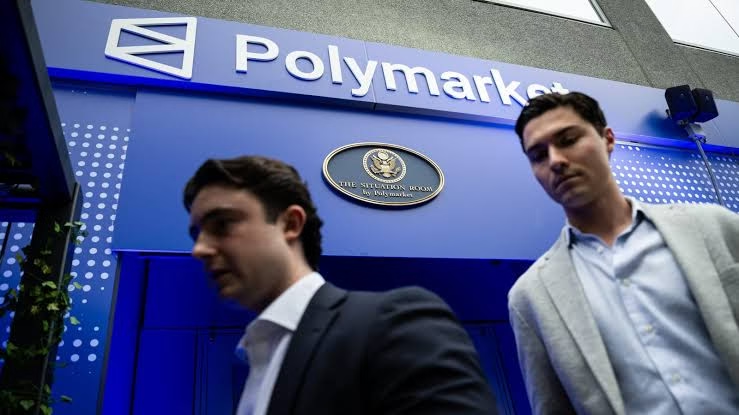
Polymarket has stated that it cooperated fully with authorities in the investigation. The platform emphasized that it identified suspicious activity and worked with law enforcement to trace the transactions.
Still, the Polymarket Insider Trading case raises deeper questions about platform design.
Prediction markets often operate with limited identity verification compared to traditional financial systems. While this openness encourages participation, it also creates vulnerabilities—particularly when users with privileged access to information enter the market.
The Polymarket Insider Trading case is not happening in isolation. Research has shown that “informed trading” may already be more common than previously thought.
A recent academic analysis found over $143 million in anomalous profits on Polymarket between 2024 and 2026, suggesting that some traders may have benefited from unusually timely or privileged information.
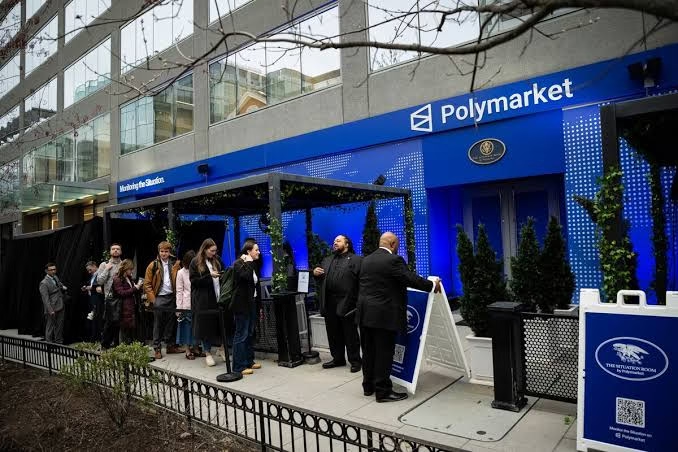
While not all such cases involve illegal activity, the findings reinforce concerns that the line between insight and insider access can be difficult to define—and even harder to enforce.
The case is also drawing attention from regulators, including the Commodity Futures Trading Commission, which has filed parallel civil charges.
The Polymarket Insider Trading case could accelerate efforts to bring prediction markets under stricter regulatory oversight, particularly as they expand into areas traditionally reserved for financial derivatives.
Lawmakers are increasingly questioning whether platforms like Polymarket should be treated more like exchanges subject to the same rules governing insider trading and market manipulation.
At its core, the Polymarket Insider Trading case exposes a structural vulnerability in prediction markets: extreme information asymmetry.
In traditional markets, insiders are limited to corporate environments. In prediction markets, insiders could include government officials, military personnel, or anyone directly involved in real-world events.
This creates a new category of risk one where outcomes are not just uncertain, but potentially predetermined for a select few.
The legal outcome of the Polymarket Insider Trading case will likely shape the future of prediction markets.
If prosecutors succeed, it could establish a clear precedent that using nonpublic information in these markets constitutes insider trading regardless of whether the underlying asset is a stock or a real-world event.

For platforms, it may force stricter compliance measures, including enhanced identity verification and monitoring systems.
For users, the implications are just as significant. The idea that prediction markets reflect collective intelligence may be challenged if insiders can systematically outperform the crowd.
It reveals how quickly financial innovation can intersect with legal and ethical boundaries. And it raises a difficult question: can prediction markets remain fair when some participants may already know the outcome?



Copyright © 2025 - The Bit Gazette.