







- Trending
- Comments
- Latest


Trump's Greenland ultimatum exposes the new battleground for Bitcoin mining and rare earth dominance
President Donald Trump said federal law enforcement has prevented at least $1.6 billion in scam losses this year and warned more than 10,000 Americans they were being targeted, as the White House pushed its campaign against overseas fraud networks. The FBI says Americans lost about $20.8 billion to cybercrime in 2025, though that figure covers all online crime, not only crypto.
The renewed focus on crypto fraud comes as law enforcement agencies grapple with the growing use of digital assets in investment scams. Separately, California Attorney General Rob Bonta said Americans lost $11.4 billion to cryptocurrency scams in 2025, within a broader $20.9 billion in reported losses from internet-based scams.
Speaking at the White House, Trump said his administration had made significant progress against foreign criminal networks targeting Americans through fraudulent investment offers and other online schemes.
“Federal law enforcement has been able to warn over 10,000 Americans targeted for victimization, and we’ve prevented $1.6 billion in losses — at least — this year,” Trump said, according to Reuters.
The president’s remarks came less than two weeks before the November 3 midterm elections, as his administration sought to demonstrate progress on public safety and financial protection.
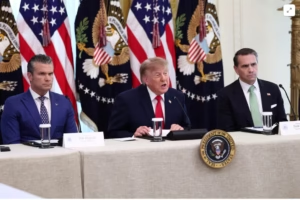
Reuters reported that the meeting focused on international scam operations and efforts to prevent Americans from being deceived into transferring money to fraudulent investment schemes.
FBI Director Kash Patel said the bureau had dismantled 20 scam compounds worldwide. Such operations have become a major concern for authorities investigating organised criminal networks that use online platforms to reach victims across borders.
The $20 billion figure, however, represents reported losses from a broad range of cyber-enabled crimes, not crypto fraud alone. These offences include phishing, ransomware, business email compromise, identity theft and investment scams.
According to the FBI, Americans filed more than one million internet crime complaints in 2025. Reported losses rose 26% from the previous year, illustrating the financial impact of online criminal activity.
The figures reflect complaints submitted to authorities rather than a complete accounting of all cybercrime. Many victims never report their losses, meaning the actual financial damage could be higher.
Cryptocurrency-related scams have emerged as a particularly costly component of the wider cybercrime problem. According to California Attorney General Rob Bonta, Americans lost $11.4 billion to cryptocurrency scams in 2025.
Bonta announced new consumer-protection resources on October 19, warning that criminals were using digital assets to move money quickly and make recovery difficult. His office said many schemes rely on familiar methods of deception but use cryptocurrency transfers to extract funds from victims.
“These are the same age-old scams we’ve always fought, but with the rise of widespread access to cryptocurrency, predators have found an insidious new means to take your money,” Bonta said.
The scams can take several forms, including fake investment platforms, fraudulent trading groups, impersonation schemes and romance-based confidence scams. Criminals may initially allow victims to withdraw small amounts of money to create the appearance of a legitimate investment before persuading them to commit larger sums.
Other operations use artificial intelligence to produce convincing voice imitations, fabricated videos and messages impersonating public figures or trusted contacts. Fraudsters may also direct victims to malicious websites or decentralised applications designed to gain access to digital wallets.
Once funds are transferred to a scammer-controlled wallet, victims can face substantial difficulties recovering them. Cryptocurrency transactions generally do not offer the same chargeback mechanisms available for some traditional payment methods, although law enforcement and specialist investigators can sometimes trace and seize assets.
The figures also underline the importance of distinguishing cryptocurrency itself from the criminal activity conducted through it. Digital assets can be used for legitimate transactions and investments, while scammers exploit their features to facilitate fraud and conceal the movement of proceeds.
For regulators and law enforcement agencies, the challenge is to identify criminal networks, trace stolen funds and disrupt the infrastructure used to target victims without treating all cryptocurrency activity as illicit.
The Trump administration has pursued a series of measures intended to strengthen the federal response to cybercrime. In March 2026, Trump signed an executive order directing federal agencies to prioritise efforts against cybercrime, fraud and predatory schemes targeting American citizens.
In August, the administration announced a national security memorandum expanding the government’s ability to work with private-sector companies on cyber operations against transnational criminal organisations operating abroad.
The White House said the initiative would allow participating companies to provide information and technical capabilities to support government-directed efforts against foreign criminal networks. The programme is intended to disrupt the infrastructure, services and financial channels used by cybercriminals.
The FBI has also launched Operation Riptide, a coordinated campaign targeting criminal actors and the services they depend on, including their communications platforms and financial networks.
In describing the threat, FBI Criminal Division Assistant Director Heith Janke said: “Cyber-enabled crime, fraud, and predatory schemes are draining American families of their savings and preying on those least able to absorb the loss.”
The operation reflects a shift towards targeting the systems that allow criminal groups to operate, rather than focusing exclusively on individual suspects after money has been stolen.
International cooperation remains central to these efforts because scam operations may be based overseas while their victims, financial intermediaries and cryptocurrency wallets are spread across several jurisdictions. Investigators often need cooperation from foreign authorities, banks, cryptocurrency exchanges and blockchain analytics firms to identify suspects and trace assets.
However, the administration’s reported enforcement results do not establish that every dollar described as prevented represents money already recovered for victims. Preventing a transfer, disrupting a scam operation and returning stolen funds are distinct outcomes, and the $1.6 billion figure cited by Trump would require further detail to determine precisely how the savings were calculated.
The administration’s campaign has placed crypto fraud and overseas investment scams at the centre of its cybercrime agenda. Yet the broader debate also concerns how effectively authorities can protect consumers, hold criminal networks accountable and recover money after victims have been deceived.
California’s attorney general has warned that scammers increasingly target younger users on social media and entertainment platforms, challenging the assumption that older adults are the primary victims. Fraudsters may impersonate investment advisers, promote fake trading opportunities or use fabricated endorsements to persuade users to transfer money.
Consumers are advised to verify investment platforms independently, avoid promises of guaranteed returns and exercise caution when strangers encourage them to move funds into cryptocurrency. Requests for upfront payments to release profits or recover previously stolen assets are also common warning signs.



Copyright © 2025 - The Bit Gazette.

