
- Trending
- Comments
- Latest

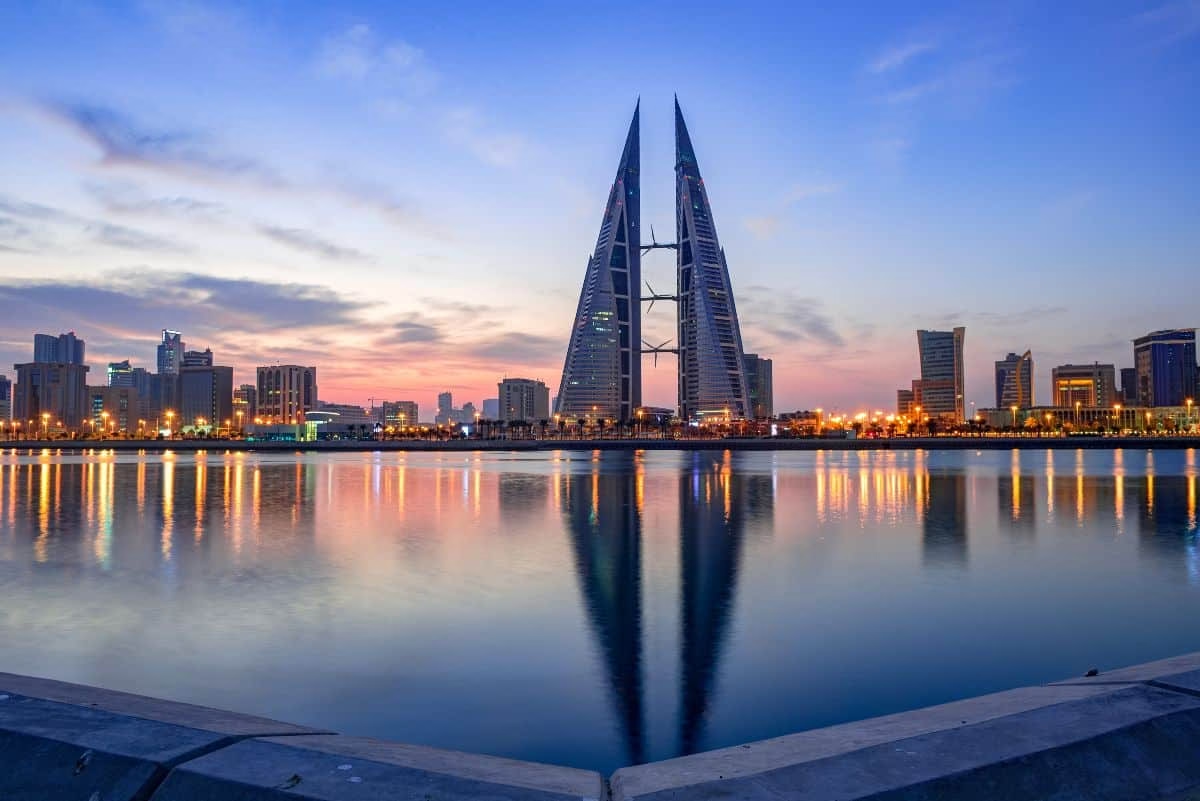
Bahrain ranked 13th among 36 countries in Henley & Partners’ 2026 Crypto Adoption Index, its first appearance on the list, as the Gulf kingdom courts a global pool of 135,694 crypto millionaires with zero personal income tax and a residency program requiring no minimum stay.
The report, published in September 2026, identifies Bahrain as an emerging destination for crypto investors and businesses, citing its financial-services sector, digital-asset regulations, technological infrastructure and residency options.
Bahrain entered the Henley Crypto Adoption Index for the first time in 2026, ranking 13th among 36 countries. Its inclusion reflects the kingdom’s broader effort to establish itself as a regulated financial and technology centre in the Gulf.
The crypto wealth report presents regulation as one of Bahrain’s central advantages in attracting digital-asset investors.
Bahrain began developing its fintech ecosystem as part of a wider effort to diversify its economy beyond oil. In 2017, the country became the first Gulf Cooperation Council member to establish a nationwide fintech regulatory sandbox, giving financial and technology companies a controlled environment to test new products under regulatory supervision.
That approach later expanded to digital assets and stablecoins.
Rain, described in the report as the region’s first licensed Sharia-compliant cryptocurrency platform, graduated from Bahrain’s regulatory sandbox. Binance subsequently selected Bahrain for its first crypto-asset service-provider license in the GCC.
The Central Bank of Bahrain, the country’s sole financial-services regulator, has also developed rules intended to bring digital assets within the regulated financial system rather than treating them as a separate activity operating outside traditional finance.
“Rather than treating digital assets as an activity sitting outside conventional finance, the approach has been to establish rules under which the sector can develop,” — Henley & Partners’ Bahrain report, citing the kingdom’s regulatory approach.
The Central Bank of Bahrain has continued to expand its regulatory framework as the sector develops. The report notes that the regulator introduced a framework for licensing and regulating stablecoin issuers, including requirements for companies seeking to issue fiat-backed stablecoins.
The framework also allows licensed financial institutions and crypto-asset service providers to digitally onboard customers outside Bahrain, potentially giving Bahrain-based platforms access to international clients while remaining under the kingdom’s regulatory system.
The crypto wealth report also points to a broader question facing wealthy digital-asset investors: what happens when cryptocurrency wealth becomes part of a larger family fortune?
Crypto investors and founders may initially accumulate wealth through digital assets, but their portfolios can eventually expand into property, private businesses, investment funds and conventional financial products.
That transition creates additional requirements around custody, governance, succession and wealth management.
Earlier, Standard Chartered had announced its intention to explore the sale of its Wealth & Retail Banking business in Bahrain,
Bahrain has sought to address that stage of wealth creation through its established financial infrastructure. The kingdom has more than a century of experience in financial services and is home to more than 350 banks and financial institutions, according to the report.
In 2023, the Central Bank of Bahrain introduced a dedicated licensing category for family offices. The framework covers services including wealth advisory, investment management, custody, trusts and fund management.
Crucially for digital-asset investors, the CBB’s Family Office Module expressly includes crypto-assets alongside other financial and investment assets.
“Crypto does not have to remain a separate part of an investor’s financial portfolio; it can form part of the same regulated structures used to manage, diversify, and eventually transfer wider family wealth,” — Henley & Partners’ Bahrain report.
That structure could allow investors who accumulated substantial crypto holdings to integrate those assets into broader family-wealth strategies rather than managing cryptocurrency independently from their other investments.
The development is particularly relevant as the number of wealthy digital-asset holders grows. The crypto wealth report estimates that the global crypto market was worth $2.6 trillion in 2026, while the number of crypto millionaires reached 135,694.
Beyond regulation and financial infrastructure, the crypto wealth report identifies residency as another factor influencing where wealthy digital-asset holders establish themselves.
Bahrain’s Golden Residency Program provides long-term residency pathways for property owners, professionals and talented individuals. The programme has no minimum-stay requirement, allowing eligible residents to maintain their status without being required to spend a specified amount of time in the kingdom.
In 2025, Bahrain reduced the minimum real-estate investment required for Golden Residency from $530,555 to $345,000, or BHD 130,000. The lower threshold strengthened the programme’s appeal to international investors seeking a long-term base in the Gulf.
The programme also provides routes for entrepreneurs and innovators through its talented-individual category, while eligible benefits can extend to immediate family members.

Bahrain’s tax environment adds another consideration for investors. The kingdom does not impose personal income tax, individual capital gains tax or inheritance tax, factors that can influence decisions around long-term wealth preservation.
The crypto wealth report argues that these considerations matter because crypto wealth is increasingly portable. Investors may not need to move their digital assets physically, but they still need a jurisdiction in which they can live, operate businesses, manage investments and plan for the future.
“Crypto has loosened the old ties between wealth and place,” — H.E. Noor bint Ali Alkhulaif, Minister of Sustainable Development and Chief Executive of the Bahrain Economic Development Board.
The crypto wealth report also highlights Bahrain’s digital infrastructure as part of its proposition for wealthy investors and financial businesses.
The kingdom has developed systems including a Cloud-First Policy, extensive electronic know-your-customer integration across retail banks, Open Banking infrastructure and real-time payment systems.
These systems are supported by data-protection frameworks intended to protect personal information and facilitate secure digital financial activity.
Bahrain’s compact financial ecosystem also places regulators, banks, financial institutions and decision-makers within a relatively concentrated market, a factor the report identifies as an advantage for businesses seeking access to the wider Gulf region.
The crypto wealth report ultimately presents Bahrain as part of a wider shift in how countries compete for wealthy digital-asset holders.
As crypto fortunes become larger and more diversified, investors increasingly require more than access to cryptocurrency markets. They need regulated financial services, wealth-management structures, residency options and mechanisms for transferring assets across generations.
Bahrain is seeking to combine those elements through its financial-services sector, digital-asset regulations, family-office framework, digital infrastructure and Golden Residency Program.



Copyright © 2025 - The Bit Gazette.