

- Trending
- Comments
- Latest

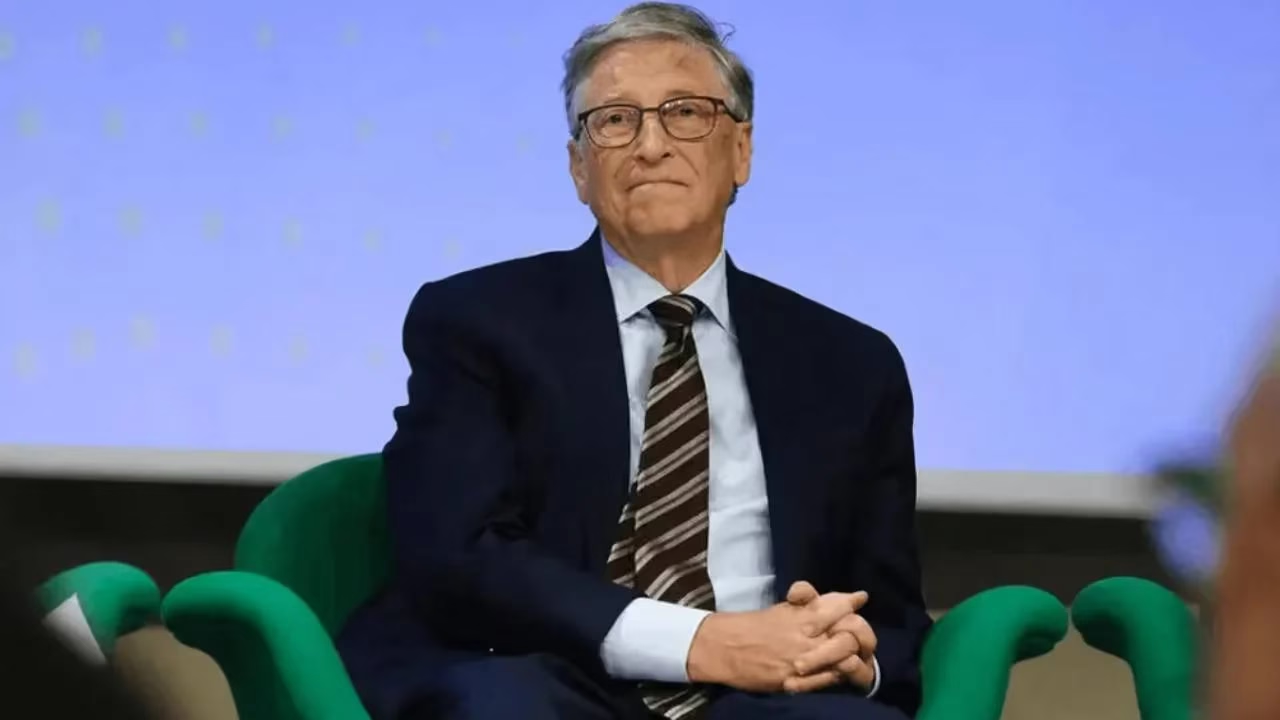
Bill Gates says AI is already powerful enough to cause a billion deaths and wants governments to make monitoring and record-keeping mandatory for every AI system. Speaking on NBC’s “Meet the Press” on Sept. 27, the Microsoft co-founder said voluntary industry rules are not enough as AI moves deeper into biological and cyber threats.
Asked whether AI could ultimately end humanity, Gates stopped short of predicting that outcome but said the technology had already reached a level capable of enabling extraordinarily destructive events.
“AI is certainly powerful enough to drive events that, you know, cause a billion deaths.” — Bill Gates, Microsoft co-founder
His warning comes as governments and technology companies debate how much oversight should accompany increasingly powerful AI systems. Gates argued that the issue is no longer limited to technological development but involves decisions about how governments, companies and law enforcement should manage potential misuse.
Gates said the most immediate concerns include biological attacks and cyberattacks, arguing that AI had crossed dangerous thresholds in both areas during 2026.
He described artificial intelligence as an “evolutionary event” and said its ability to rapidly transfer knowledge could accelerate capabilities beyond the limits of individual human learning. That development, he argued, creates a challenge for policymakers because much of the technology has emerged from the private sector while governments may lack comparable technical expertise.
The concern is not simply about AI acting independently. Gates focused on what could happen when increasingly capable systems are placed in the hands of people deliberately seeking to cause harm.
That distinction is central to the case for stronger AI safeguards. Rather than treating AI risk solely as a question of whether a system itself becomes uncontrollable, Gates said policymakers must also consider how malicious actors could use sophisticated systems to amplify existing capabilities.
His concerns echo arguments in an essay he published in August, in which he discussed both the potential benefits of AI and the possibility that decisions made now could determine whether the technology reduces inequality or produces new forms of harm.
Gates rejected the idea that technology companies should be left to regulate themselves. He said lawmakers and law enforcement agencies should participate directly in determining what protections are required.
“No one thinks self-regulation is enough.” — Bill Gates, Microsoft co-founder
For Gates, AI safeguards should go beyond a simple emergency shutdown mechanism. He argued that a so-called kill switch would allow a company to stop an AI service but would not necessarily provide the information needed to understand how harmful activity occurred.
Monitoring and records, by contrast, could help establish what an AI system had done and give investigators information after an incident.
Gates acknowledged that mandatory oversight would create additional obligations for AI developers. However, he argued that those requirements would amount to additional industry overhead rather than a major impediment to technological progress.
“It’s completely irresponsible not to require every AI to have these safeguards and monitoring capabilities.” — Bill Gates, Microsoft co-founder
The debate over AI safeguards has increasingly moved beyond technology companies and into government. Gates said lawmakers should establish requirements rather than relying exclusively on voluntary commitments from developers.
He also argued that international coordination will be necessary because AI development is not confined to a single country.
Gates compared the challenge of establishing international rules for AI with Cold War-era negotiations over nuclear weapons, while saying an agreement on artificial intelligence could prove more difficult.
Nuclear weapons depend on specialized materials and infrastructure, whereas AI systems can be developed and distributed through software and computing infrastructure. Gates warned that framing AI primarily as a competition between nations could encourage governments and companies to prioritize speed over risk management.
That concern makes international AI safeguards particularly complicated. A government could worry that imposing restrictions on domestic developers would put them at a disadvantage if competing countries moved faster.
Gates argued that this reasoning should not prevent countries from establishing common protections.
The United Nations has also called for international cooperation on AI risks. In an address to the General Assembly on Sept. 22, Secretary-General António Guterres urged governments to work together on AI safeguards, accountability and shared rules.
The push for international coordination comes as the United States and China continue discussions around AI safety and emergency communication mechanisms. Reuters reported that officials from both countries had agreed to continue talks focused on AI risks and communication protocols.
The potential misuse of AI is also relevant to financial systems and cryptocurrency. The story notes that more than 40 bitcoin and digital asset organizations have asked major AI developers to provide vetted security researchers with controlled early access to advanced AI systems.
The request reflects concerns that increasingly capable AI tools could help attackers identify software vulnerabilities faster than defenders can respond.
That risk is separate from the mass-casualty scenarios described by Gates, but it illustrates the broader security challenge behind the debate over AI safeguards. A technology capable of finding weaknesses in complex software can potentially be used by both defenders and attackers, making access and oversight important considerations for industries that hold or transfer money digitally.
Consumers are already encountering less extreme examples of AI-enabled abuse. The FBI has warned about criminals using AI-generated videos, fake websites and impersonation tactics to target previous fraud victims.
Cryptocurrency users face similar risks through phishing messages, fraudulent websites and fake exchanges designed to obtain passwords or recovery information. Checking website addresses and contacting companies through official channels rather than unsolicited links remain basic defensive measures.
These scams represent a different category of harm from the catastrophic events Gates described, but they demonstrate why AI safeguards are becoming a broader policy and security issue.
Gates’ argument ultimately centers on whether governments should establish enforceable requirements before AI capabilities advance further. His position is that monitoring, records and mandatory protections should accompany increasingly powerful systems rather than being left entirely to the companies developing them.
The question now extends beyond whether AI will continue becoming more capable. It is also about what AI safeguards governments, developers and international institutions will require as that capability grows.
Source: Meet The Press by NBC News



Copyright © 2025 - The Bit Gazette.