

- Trending
- Comments
- Latest

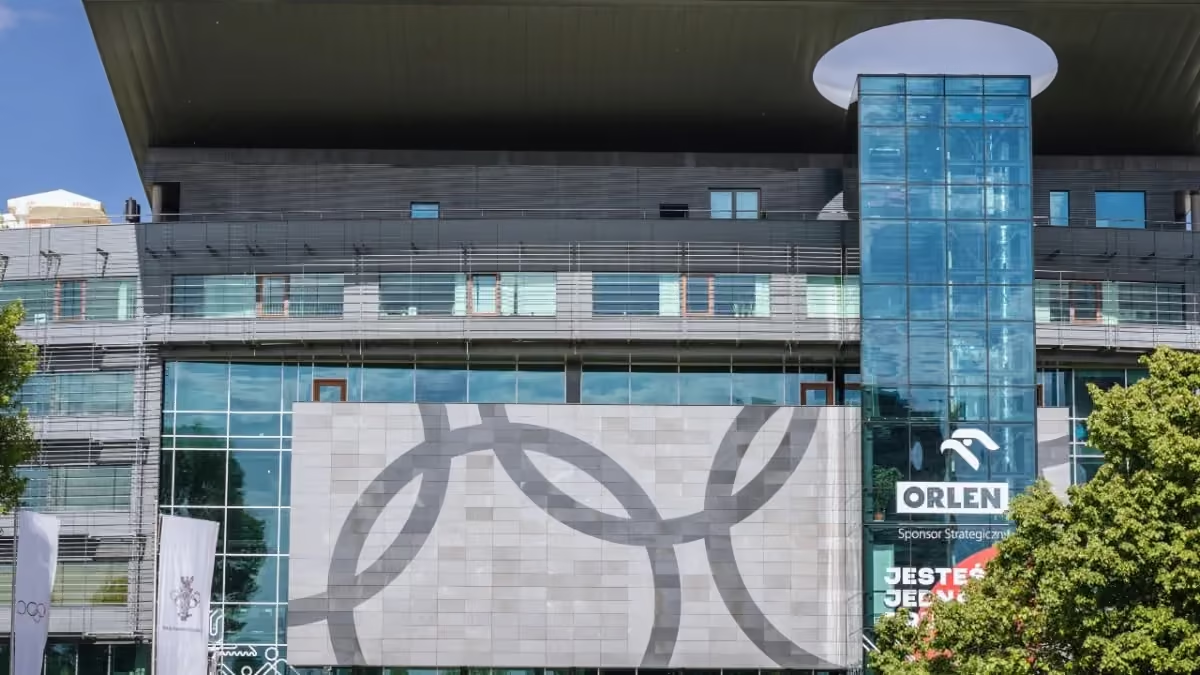
Poland’s Olympic Committee has removed its president, Radoslaw Piesiewicz, after his arrest last month in a corruption and fraud investigation tied to the collapsed crypto exchange Zondacrypto, a Ponzi-style scheme Polish authorities say cost roughly 30,000 people about $94 million.
The decision comes less than three weeks after Polish authorities detained Piesiewicz and formally charged him in connection with alleged influence-peddling and actions that prosecutors say harmed creditors of the cryptocurrency exchange. Piesiewicz has denied the allegations and did not admit to the charges during questioning, according to Poland’s National Prosecutor’s Office.
The case has placed the relationship between the Olympic organization and Zondacrypto under intense scrutiny, particularly because Piesiewicz was involved in the sponsorship agreement between the two organizations.
The leadership change followed weeks of mounting pressure on Piesiewicz after his arrest on Aug. 27. Polish prosecutors allege that he invoked connections to the country’s Office of Competition and Consumer Protection (UOKiK) in 2025 and accepted a luxury watch valued at 169,476 Polish zloty, roughly $46,000, as a financial benefit linked to an attempt to influence proceedings involving Zondacrypto.
Prosecutors have also accused Piesiewicz of encouraging a member of Zondacrypto’s operator, BB Trade Estonia OÜ, to transfer funds shortly before the company faced insolvency or bankruptcy. The transactions cited by prosecutors included 194,420.15 zloty and €100,000.
Piesiewicz rejected the allegations. Prosecutors said he exercised his right to legal representation and provided detailed explanations during questioning. A court subsequently ordered pretrial detention for three months, according to the prosecutor’s account.
Announcing the leadership transition, Kmita said the PKOl board had made a final decision to entrust him with the interim presidency. He will now oversee the committee through the remainder of Piesiewicz’s term.
The development marks a significant escalation of the Crypto scandal, which has moved beyond the collapse of a cryptocurrency business into a broader investigation involving alleged corruption, creditor losses and relationships between business and sports officials.
At the center of the investigation is Zondacrypto, formerly associated with the BitBay exchange. Polish prosecutors opened a formal investigation in April 2026 and later combined the case with an investigation connected to the disappearance of BitBay founder Sylwester Suszek.
The operator of Zondacrypto, BB Trade Estonia OÜ, was declared bankrupt by a court in Estonia on Aug. 27, according to Poland’s National Prosecutor’s Office. Polish authorities subsequently issued information for people who believe they were harmed by the exchange and instructed creditors on how to submit claims.
The scale of the alleged losses has become one of the most significant elements of the Crypto scandal. Polish authorities have publicly estimated losses at around 350 million zloty, with approximately 30,000 people identified as victims or affected customers. International reports have converted that figure into roughly $94 million, although exchange rates and reporting dates account for differences in dollar estimates.
Polish Interior Minister Marcin Kierwinski went further in August, describing Zondacrypto as being “in reality a Ponzi scheme.” That characterization remains an allegation by a government official rather than a final judicial finding.
The prosecutor’s investigation has continued to expand. In early September, authorities announced additional arrests and charges involving people suspected of participating in organized criminal activity and causing financial damage connected to Zondacrypto. Police also searched the premises of the PKOl and the UOKiK to secure documents potentially relevant to the investigation.
The relationship between Zondacrypto and the Olympic movement has become a central part of the controversy.
Piesiewicz was responsible for signing a sponsorship agreement between PKOl and Zondacrypto. Under the arrangement, Polish athletes achieving strong results at the 2026 Winter Olympics in Milan-Cortina were to receive cryptocurrency-related rewards.
The sponsorship has since become a focus of criticism, particularly because Zondacrypto later ceased operations and entered bankruptcy proceedings.
Polish Sports Minister Jakub Rudnicki confirmed Piesiewicz’s arrest in August and sharply criticized his leadership. Rudnicki said Piesiewicz “has discredited Polish Olympics,” according to reporting by Euronews and AFP.
Media reports have also focused on the luxury watch allegedly connected to Zondacrypto executive Przemyslaw Kral. Piesiewicz has disputed the implication that the watch was an improper benefit, saying he paid for it himself.
That dispute is now part of a much wider Crypto scandal, with prosecutors examining whether financial benefits and alleged influence over regulatory matters were connected.
The immediate challenge for Kmita is to stabilize the Olympic committee while the investigation continues.
Kmita acknowledged that PKOl is in a “rather difficult financial situation” and announced that the organization would undergo a financial audit. The audit is expected to provide greater visibility into the committee’s finances and the potential consequences of its relationship with Zondacrypto.
The investigation itself remains active. Poland’s National Prosecutor’s Office has continued announcing arrests and charges throughout September, while creditors affected by Zondacrypto’s bankruptcy have been directed to submit evidence supporting their claims.
For the Polish Olympic Committee, the consequences now extend well beyond the removal of its president. The organization must contend with questions surrounding sponsorship due diligence, financial oversight and its exposure to a cryptocurrency company that has entered bankruptcy.
For the broader crypto industry, the Crypto scandal illustrates how the failure of a digital-asset platform can extend into traditional institutions when commercial partnerships, public figures and financial operations become intertwined.
With Piesiewicz out of office and prosecutors continuing to build their case, the final financial and legal consequences of the Zondacrypto collapse remain unresolved. The PKOl audit and ongoing criminal investigation are expected to provide further clarity on how much damage was caused and whether additional individuals will face charges.



Copyright © 2025 - The Bit Gazette.