
- Trending
- Comments
- Latest

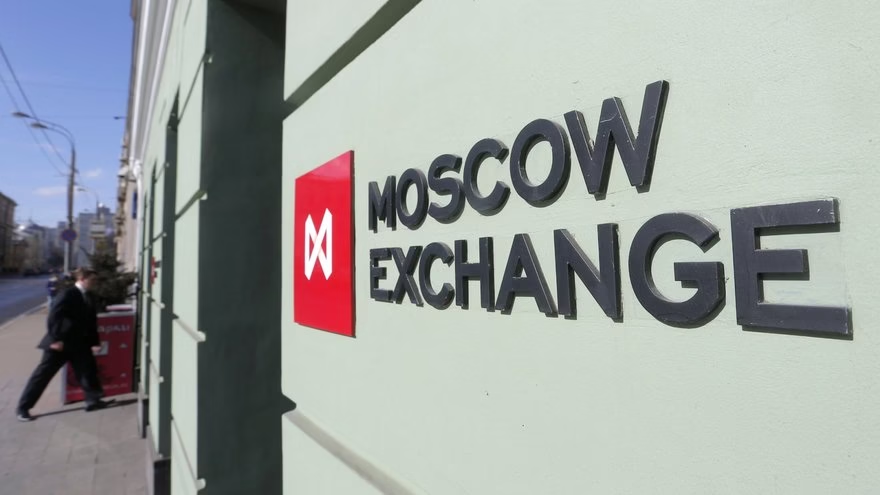
Moscow Exchange will begin trading futures contracts tied to Solana, XRP, and Tron on May 14, initially limiting access to qualified investors, the exchange said in an official statement.
The latest MOEX crypto futures products will trade under the tickers MOEXSOL, MOEXXRP, and MOEXTRX. Each derivative will track proprietary indices connected to Solana, XRP, and Tron, with the benchmark indices set to launch one day before trading opens.
The move highlights how quickly MOEX crypto futures have evolved since Russian regulators began allowing select crypto-linked derivatives last year.
The new MOEX crypto futures contracts build on the exchange’s earlier launch of Bitcoin and Ethereum-based derivatives.
MOEX already hosts trading for futures tied to its internal Bitcoin and Ethereum indices, alongside products tracking BlackRock’s crypto exchange-traded funds, including the iShares Bitcoin Trust ETF and iShares Ethereum Trust ETF.
By adding Solana, XRP, and Tron, the exchange is broadening investor access to some of the world’s largest cryptocurrencies without requiring direct ownership of digital assets.
According to the exchange, the new MOEX crypto futures contracts will be cash-settled and denominated in Russian rubles. Investors will not receive actual cryptocurrency at settlement. Instead, positions will be settled using the average value of the corresponding index on the contract’s expiration date.
The Solana contracts will trade with a minimum price increment of $0.01, while XRP and Tron contracts will feature smaller price increments of $0.0001.
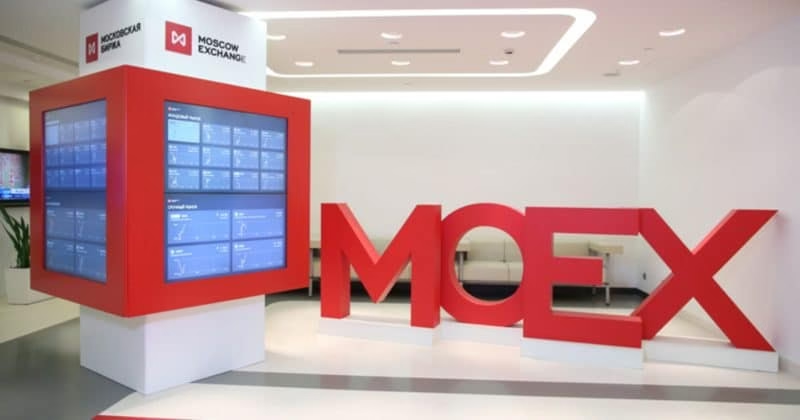
Each contract will carry a one-month maturity cycle, with the final trading session occurring on the last Friday of the contract month.
Interest in MOEX crypto futures has increased steadily since the exchange entered the market following approval from the Bank of Russia.
According to MOEX, more than 62,000 clients have already traded crypto-linked derivatives through the platform. The growing participation reflects rising institutional and professional demand for regulated digital asset exposure inside Russia.
Maria Patrikeeva, head of derivatives markets at MOEX, described the expansion as a natural progression for the exchange’s crypto strategy.
“The launch of futures on the Solana, Ripple, and Tron indices is a logical development,” Patrikeeva said in comments carried by Russian financial media. “More than 62,000 derivatives market clients have already participated in crypto asset contracts on Moscow Exchange, and we are pleased to offer them additional opportunities.”
The continued growth of MOEX crypto futures also reflects wider changes across the global financial industry, where traditional exchanges are increasingly integrating crypto-related investment products into mainstream trading infrastructure.
The rapid expansion of MOEX crypto futures comes as Russian authorities move closer to finalizing a comprehensive legal framework for digital assets.
The Bank of Russia released a regulatory proposal in late 2025 aimed at creating clearer rules for cryptocurrency investments and transactions. A broader “digital currency” bill is expected to be completed before July 1, 2026.
The legislation could eventually expand access to MOEX crypto futures and other digital asset products beyond qualified investors, although regulators are expected to maintain strict limitations for retail participation.
Russia’s approach to cryptocurrency has shifted noticeably in recent years. While officials previously maintained a cautious stance toward digital assets, authorities now appear more willing to support regulated crypto investment products operating within domestic financial structures.
That transition has positioned MOEX crypto futures as one of the country’s most visible entry points into regulated digital asset trading.
The addition of Solana, XRP, and Tron to the MOEX crypto futures lineup reflects the growing institutional visibility of alternative blockchain ecosystems.
Solana has become one of the fastest-growing smart contract platforms globally, attracting traders through low transaction costs and high-speed processing. XRP continues to maintain strong trading activity despite years of legal scrutiny surrounding Ripple Labs in the United States. Tron, meanwhile, remains heavily used for stablecoin transfers and blockchain-based payments.
The inclusion of these assets in MOEX crypto futures products signals that investor demand in Russia now extends well beyond Bitcoin and Ethereum.
For many traders, derivatives provide a more familiar and regulated way to gain crypto market exposure without directly managing wallets or digital asset custody.
That model has become increasingly attractive globally as institutional investors seek crypto exposure through established financial systems.
The expansion of MOEX crypto futures mirrors broader international trends as stock exchanges and traditional financial firms continue integrating digital assets into their product offerings.
Across the United States, Europe, and Asia, exchanges are rolling out crypto-linked ETFs, futures, tokenized assets, and structured investment products to meet rising investor demand.
What makes MOEX crypto futures particularly notable is the geopolitical context surrounding Russia’s financial system. With sanctions and restrictions limiting access to many Western financial services, domestic exchanges are playing a larger role in building independent investment infrastructure.
MOEX’s growing digital asset division reflects that strategy. The launch of Solana, XRP, and Tron futures shows that cryptocurrencies are increasingly becoming part of mainstream financial markets rather than existing outside them.
And as regulated crypto products continue expanding globally, MOEX crypto futures are positioning Moscow Exchange as a central player in Russia’s evolving digital asset economy.



Copyright © 2025 - The Bit Gazette.