

- Trending
- Comments
- Latest

The US Financial Crimes Enforcement Network (FinCEN) has reviewed 33,904 suspicious activity filings tied to roughly $12.7 billion in suspected crypto investment fraud, but the figure is not what victims lost.
The filings, submitted between September 2023 and December 2025, are leads for investigators, not proof of crime. They may include attempted transfers, repeat filings and transactions that later prove legitimate.
FinCEN’s analysis covers 33,904 Bank Secrecy Act filings submitted during the review period, representing approximately $12.7 billion in reported financial activity associated with digital asset investment fraud.
Although the figures are frequently rounded to more than 33,000 filings and roughly $13 billion, those simplified numbers do not represent additional findings. The underlying data describe reported activity identified by financial institutions and assessed by the agency.
The reporting period also reflects when filings were submitted, not necessarily when the underlying activity occurred. Some cases included in the analysis may have started before September 2023.
Suspicious activity reports provide investigative leads, but they do not independently establish that a crime occurred. Financial institutions submit them when they identify activity that meets applicable reporting criteria, leaving authorities to investigate the circumstances and assess the available evidence.
The distinction between a report, an administrative finding and a court ruling is essential when interpreting large financial crime figures.
The crypto fraud report does not establish that $12.7 billion was stolen, seized or conclusively traced to convicted criminals. Instead, the amount represents reported financial activity associated with suspected digital asset investment fraud.
The analysis also acknowledges that filings can contain erroneous information or transactions that are lawful despite their proximity to a suspicious event. These limitations mean the figures cannot be used to determine precisely how much money victims lost or how many individuals were directly affected.
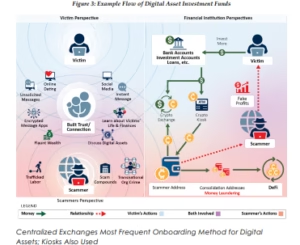
FinCEN’s analysis highlights the role of organised networks that facilitate digital asset investment fraud and help move proceeds through the financial system.
Such operations can involve several groups performing different tasks. Fraudsters may approach victims through deceptive online relationships, phishing campaigns or investment schemes before directing them to transfer money into accounts or cryptocurrency wallets under their control.
The funds may then pass through several accounts, wallets, service providers or jurisdictions to make their origins more difficult to establish. Supporting networks can provide account-opening services, facilitate phishing operations or specialise in laundering proceeds from criminal activity.
FinCEN’s reporting also points to the risks associated with scam centres. INTERPOL has separately documented cases in which such centres have been linked to human trafficking and forced participation in online fraud. These findings demonstrate a serious risk, although they should not be interpreted as evidence that every scam centre or worker is connected to trafficking.
The findings point to the need for coordinated prevention measures involving consumers, cryptocurrency platforms, payment providers and law enforcement agencies.
Platforms can strengthen their defences by monitoring unusual transaction patterns, verifying customer identities, reviewing suspicious conversion and withdrawal routes, and escalating credible concerns to the appropriate authorities.
Clear reporting channels can also help victims alert financial institutions and investigators quickly, potentially improving the chances of identifying suspicious transactions before funds move beyond reach.
In Europe, Regulation (EU) 2023/1113 establishes information requirements for certain transfers of funds and crypto-assets, including information about originators and beneficiaries. It also provides procedures for handling transfers where required information is missing, subject to the applicable rules and risk assessments.
These measures can improve the visibility of transactions and help providers identify potential warning signs. However, compliance systems cannot replace formal investigations or determine criminal liability on their own.
The crypto fraud report illustrates why effective enforcement requires both early detection and the ability to follow complex financial networks. Identifying an unusual transfer may be the first step, but establishing who controlled the funds, where they originated and whether a criminal offence occurred requires further investigation.
Ultimately, FinCEN’s analysis provides evidence of a substantial volume of suspicious financial activity associated with digital asset investment fraud, but it does not establish a definitive total for cryptocurrency-related losses.
The 33,904 filings and $12.7 billion in reported activity should be read as indicators of risk, not as proof that every transaction was criminal. Addressing the problem will require stronger preventive controls, reliable reporting systems and coordinated investigations capable of tracing funds across borders while respecting the distinction between suspicion and proven wrongdoing.



Copyright © 2025 - The Bit Gazette.